
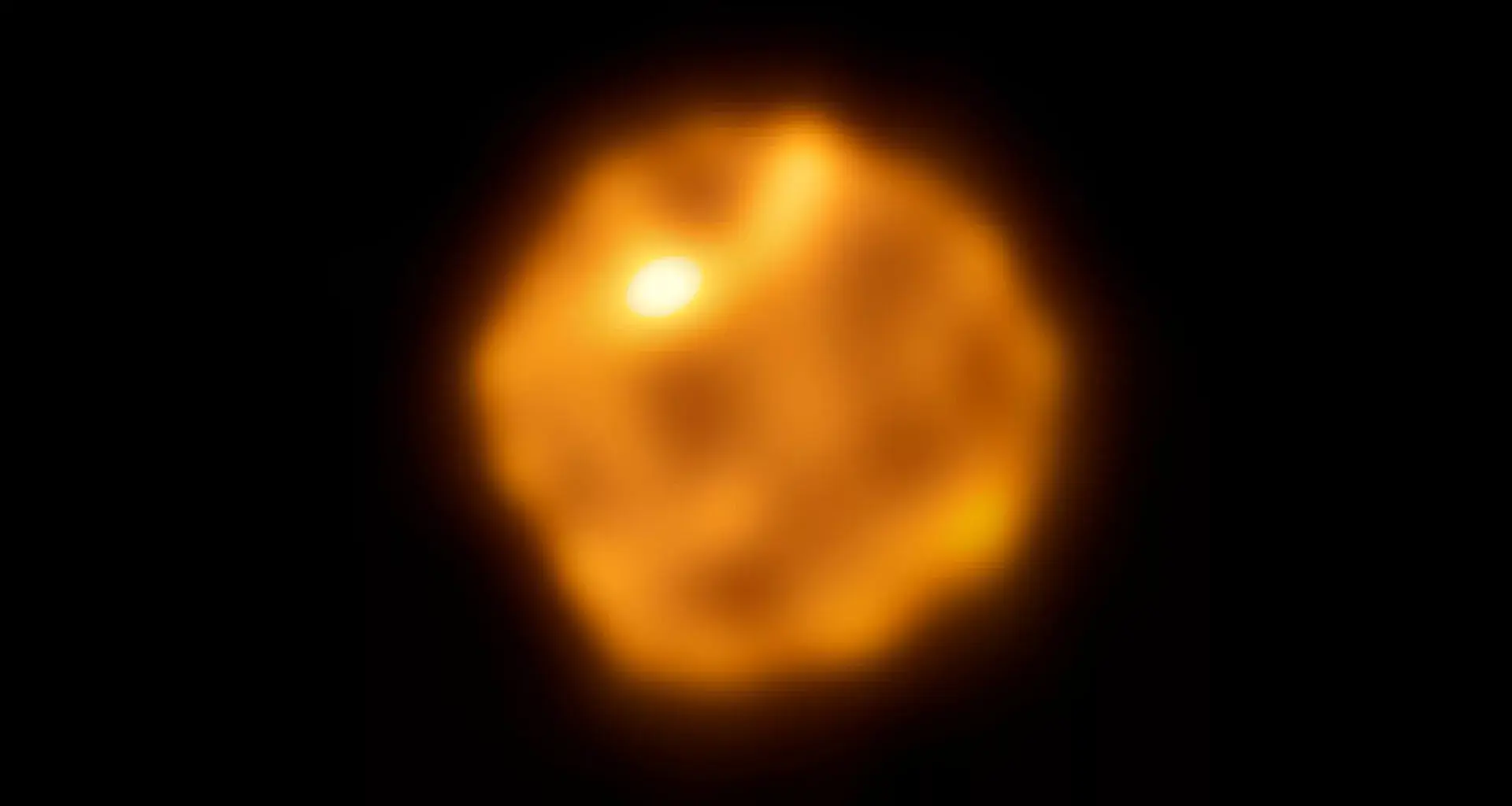
Betelgeuse, the fiery-orange beacon in Orion’s shoulder, has long fascinated astronomers. It’s a red supergiant nearly 800 times larger than our Sun, and one of the closest of its kind, sitting just 600 light-years away.
Unlike the Sun’s smooth, round surface, Betelgeuse looks lumpy and uneven, its atmosphere bubbling with giant convective cells that churn hot gas to the surface.
Now, new high-resolution images from the Atacama Large Millimeter/submillimeter Array (ALMA) have given us one of the most detailed views yet of this colossal star’s surface. And what they reveal is both expected and surprising.
Astronomers found two distinct “hot patches” on Betelgeuse’s surface, one to the northeast and another to the southwest. The brightest of these is about 800 degrees hotter than the surrounding photosphere. Remarkably, this hotspot appears almost unchanged compared to similar ALMA data taken seven years earlier.
Hubble discovered the cause of mysterious dimming of supergiant star Betelgeuse
The model of convection for red giant stars states that these types of features will be of short duration; they will last from one month to possibly a couple of years. The long-term presence of this hot spot indicates that there may be something unique happening. This may relate to stable convection in the polar regions, or it may relate to the effects of a companion star (indicated by other telescopic data).
The new ALMA data show Betelgeuse’s sub-millimeter photosphere has a radius about 1.1–1.3 times the star’s size, with a relatively constant temperature of ~2300 K. But it isn’t perfectly round. Deviations of up to 6% in radius make the star’s edge look irregular, with clumpy gas extending out to about 2.5 times the stellar radius.
It is believed that these irregularities are due to shocks created by convection; however, how long they last is contrary to our current understanding of stellar behavior.
Betelgeuse isn’t just any star; it’s a supergiant nearing the end of its life. In 2020, it famously dimmed, sparking speculation that it was about to explode. While that wasn’t the case, astronomers are keen to understand how surface activity and hotspots might relate to such dramatic events.
ESO Telescope Sees Surface of Dim Betelgeuse
“Its eventual fate as a supernova makes it fascinating to know what it actually looks like now,” says lead author Bill Dent, an astronomer at ESO. When Betelgeuse does finally explode, it will shine so brightly that it will be visible from Earth even in daylight.
The new observations confirm that stars do not remain still as if they were solid objects; rather, they are dynamic and active environments. The hotspots, bumps, and clumps on the surface of Betelgeuse illustrate how massive stars lose matter to the space surrounding them, and therefore enrich the interstellar medium with elements which can ultimately create planets and possibly life.
Journal Reference:
W.R.F. Dent, A.M.S. Richards, G.M. Harper, L.D. Matthews, E. O’Gorman. ALMA high-resolution observations of Betelgeuse: Persistent structure spanning the inner atmosphere. Astronomy & Astrophysics. DOI: 10.48550/arXiv.2608.19339