
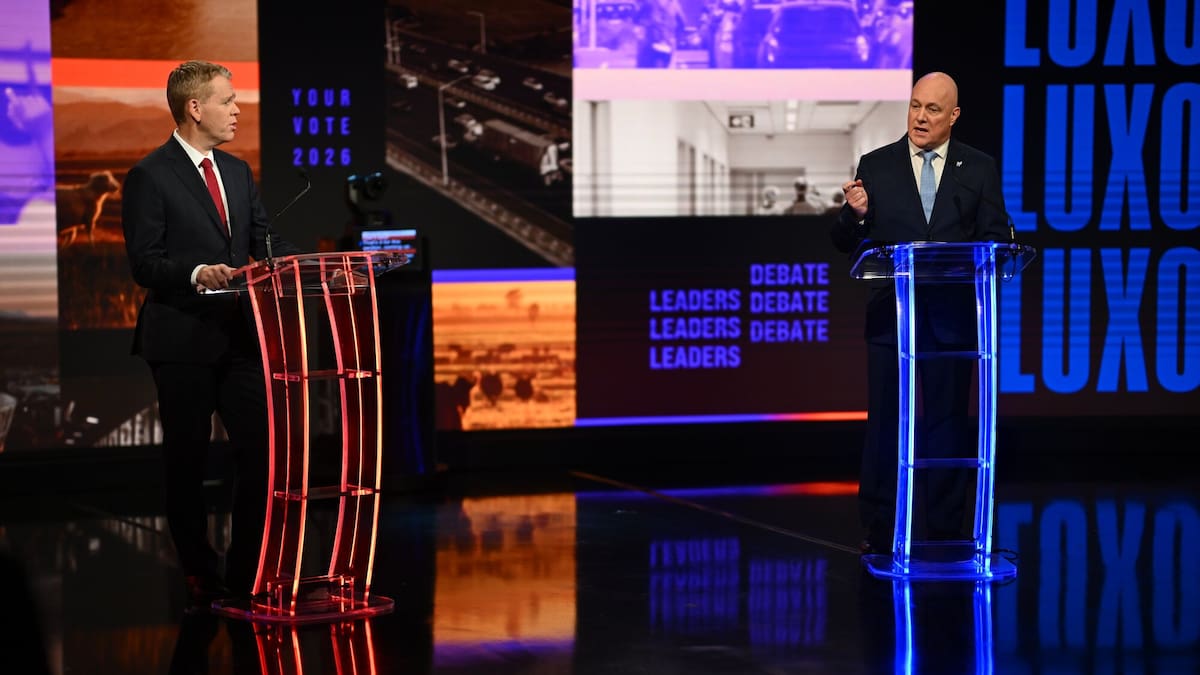
After entering a cavernous studio on Tuesday night (you wouldn’t know it, but it’s also home to the twice-weekly Lotto segment), in which he’s likely spent many hours preparing, Tame played host to the small live audience, mostly made up of TVNZ staff, their plus-ones, and a bunch of political journalists wanting the true courtside experience.
Standing in front of the lectern over which he would soon try to direct the flow of the exchange, Tame teased what he anticipated we were about to see unfold.
The debate would go surprisingly fast, Tame predicted. It was a 90-minute event, but once you take into account ad breaks, it’s more like 66 minutes or so of live television.
That may sound like a lot of time to listen to two people speak, but it’s not an easy feat to draw quick, simple answers out of politicians. Tame knew the challenge before him.
Nearby, in a corridor directly outside the studio, Hipkins waited patiently.
As others bustled about around him, the Labour leader stared through the studio door. Possibly playing over in his head the key beats he wanted to hit or the messages he hoped would cut through to the hundreds of thousands of Kiwis likely watching, he was composed with a blank face.
As it edged closer to 7pm, Hipkins turned and appeared to do what we all do when we are trying to pass time in an unfamiliar environment: read random signs on the walls (in this case, a guide to keeping safe in a working studio).
But it wasn’t long until he had a distraction. Luxon and his entourage had arrived.
The two leaders stood together in that corridor looking in at where they would soon have to lash each other over their political differences. After sharing some quiet words, chuckling and smiling, the pair headed to their respective positions as showtime beckoned.
There were no signs of nerves from either leader. They had been here before.
Labour’s Chris Hipkins appeared unbothered by any pressure. Photo / Harley Peters
On-air, and after the obligatory handshake to begin, each leader delivered pre-written statements that had been loaded into an autocue in the corners of the room, setting out their vision for New Zealand and their approaches as the would-be Prime Minister for the next three years.
Throughout the night, as Luxon spoke, Hipkins for the most part kept a straight face, gazing out into the studio rather than constantly watching his opponent. There were some stifled smiles from Hipkins whenever Luxon fumbled an answer or began to make predictable political attacks.
The Labour leader got the most impassioned as he threw barbs at Luxon over the National leader’s handling of comments by his coalition partners, swivelling his body towards Luxon, ready to take him on.
Luxon would frequently eye Hipkins as the Labour leader spoke, as if he was sizing him up, poised and ready to jump in to dispute something – as he did repeatedly.
If Luxon was answering a question and Hipkins began to interject, the National leader often kept staring ahead at Tame, as if to ignore Hipkins and not be thrown off message.
To help keep them on message, both Luxon and Hipkins had on their lecterns in front of them handwritten notes from what would have been hours of preparation beforehand.
Luxon’s were secured in a black folder, through which the National leader would flick as the debate jumped from topic to topic, canvassing everything from the cost of living, to boot camps for serious young offenders, to the conflicts in the Middle East, to the All Blacks and Warriors.
Both leaders had some clues as to what was coming next for them. As the television audience was whisked away to commercials, Tame would venture forth from behind his podium to give Hipkins and Luxon the general areas they would cover in the next segment.
The TVNZ debate was the first major contest between the two leaders this election campaign. Photo / Harley Peters
While in the first commercial break, Tame asked the leaders to speed up their responses; the moderator clearly cognisant any rambling could throw the debate off schedule, and critical question lines may be missed.
During one line of questioning, Hipkins expressed some frustration about being cut off from answering by the moderator. In the next ad break, Tame light-heartedly said the two leaders could beat up on him if they wished.
For the most part, the commercial breaks were an opportunity for Hipkins and Luxon to regroup with their respective aides to talk strategy and review how the evening was going.
Hipkins would speak with his team directly beside his podium, while Luxon’s group usually moved off to the side of the studio, away from any stickybeaks.
In Hipkins’ huddle were his chief press secretary Alex Masters, armed with a bright red folder of prep notes, and Labour pollster David Talbot, who has provided advice during previous leaders’ debates, including for Dame Jacinda Ardern. Hipkins’ chief of staff Chris Bramwell joined during some commercial breaks.
In Luxon’s corner were his deputy chief press secretary Jasmine Higginson and his policy director Joe Ascroft. Jake O’Flaherty, a senior adviser of Luxon’s who is never far from the National leader, was close by as well.
Christopher Luxon came armed with a big folder of notes to flick through. Photo / Harley Peters
Luxon appeared relaxed; his typically jovial self, hands often in his pockets as he spoke with his team or wandered back to his spot, sometimes to read his notes, write some new ones, or to find the right page for the next topic.
Hipkins also seemed unbothered by the pressure. During two commercial stops, he roamed over to the journalists in the room to chat, asking what their thoughts were on the debate so far.
Near the end of the 90 minutes, with both leaders back at their lecterns for one of their last rounds, they each commented they were just getting warmed up and could go later into the night. Like a telethon, Hipkins said.
But when the end did come around, Luxon was first to reach over for a handshake.
Moments later, with the debate off-air, not to be outdone, Hipkins went in for another handshake with the National leader.
For all the disagreement during the debate, there seemed to be a genuine level of courtesy between Luxon and Hipkins that shouldn’t go unmentioned.
Jamie Ensor is the NZ Herald’s chief political reporter, based in the press gallery at Parliament. He was previously a TV reporter and digital producer in the Newshub press gallery office. He was a finalist in 2025 for Political Journalist of the Year at the Voyager Media Awards.