
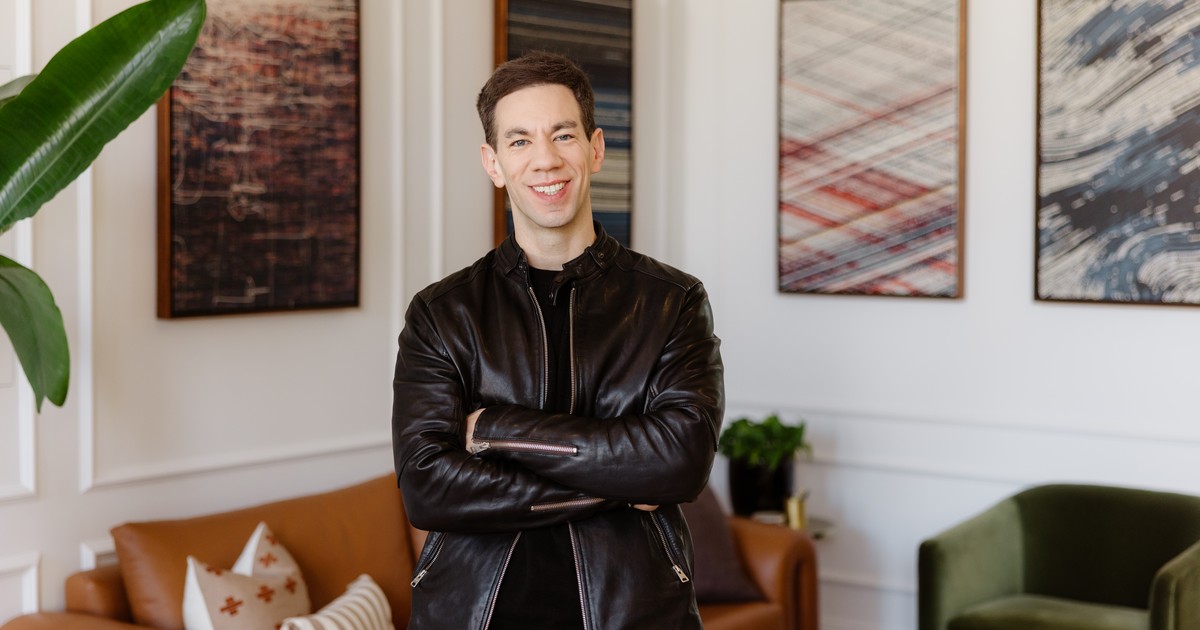
For nearly half a year, Stauch and McLeod had little to show for their efforts, in part because of the gulf between their aspirations and their product. “Alex was doing it all. He had his work cut out for him because we had this grand vision of a product that competes with a giant like ServiceNow. We’re going to build a full ITSM ticketing platform, workflow automation, access management, AI code gen agents, all this stuff,” says Stauch. While Alex built tirelessly, Stauch did what he could to sign design partners, which was challenging when there “really was just not enough of the product there yet,” says Stauch.
While ambition and ideas alone couldn’t win over customers, it caught the eye of Anas Biad at Sequoia, who were exploring investments in IT automation. “Everyone in the market at the time was building a small point solution, or like a feature on top of a bot on Slack,” says Biad, “and I meet Jake and he was trying to totally reinvent the entire system from the ground up to be the new system of record and system of automation for enterprise IT.”
Eventually, this vision convinced one team from Ramp to give them a shot as an unpaid design partner, offering feedback on the nascent product. Around the same time, Stauch and McLeod made their first hire, an engineer from a direct competitor (“That was a pretty cool vote of confidence,” remembers Stauch). By the end of 2024, they’d hired two more engineers, and signed on Perplexity as a third design partner. But by April 2025, Ramp decided to end their partnership citing the immaturity of Serval’s product. That’s when Stauch and McLeod went for another walk, this time to consider a pivot.
“I remember wondering, should we go upmarket and do something very narrow and small? Should we go downmarket and focus more on ticketing?,” says Stauch. But despite being in seemingly similarly dire straits, this low felt entirely different to Stauch than various crises with NeuroPlus. By then he’d spent years of his life having conversations with IT managers and CISOs to understand where they struggled and what they needed. In his gut, he knew there was a real market for their product if they could just buy themselves a little more time to build it; this really did feel like something he could will into being with enough perseverance and thought. “We decided in that conversation that we had to just keep going,” says Stauch. “The product just had to mature.”
Stauch arranged a call with the team at Perplexity and minced no words. “We were basically like, “what would it take for you to become a paying customer,” and they said, “well we can’t move off our existing vendor because they do X, Y, and Z.” And we’re like, “What if we build that?,” says Stauch. “And then we built that, and then they said, ‘Okay.’” Serval closed them as their first paying customer in May 2025.
Soon, others signed on as well. Finally, with a thing that he’d helped build from scratch, Stauch was experiencing how it felt to work towards a goal that meets a real need in a more universal way. The type of product-market fit that, according to Stauch, makes customers start to ‘round up.’ “If you can get a call, and a customer asks ‘can you do this? What about this?’ and instead of saying ‘it’s on the roadmap’ to 90% of things, you’re saying it to 10%, customers start to believe you, and to believe that what they want is eventually going to be delivered,” says Stauch.
By early 2026, workers started embracing agentic AI and vibe coding in droves — thanks in part to the rise of Claude Code & Cowork and its accompanying skills being shared enterprise-wide. Not only did this increase potential customers’ familiarity with Serval’s natural language workflow, it also raised demand for their product by introducing a whole new host of technology and permissions for IT teams to figure out how to service. Today, Serval’s product has created an experience described by one customer as “frictionless,” where, for example, a ping to a #servicedesk Slack channel for software access — which used to be routed to an IT person with a backlog of tickets — now gets handled by a Serval agent who can immediately provision access, assuming the request meets pre-approved protocols.
As Serval’s product has matured, the company has started garnering attention from the Fortune 500, expanding their potential impact not just on the processes they aim to fix, but also the people who implement them. “Ultimately, Serval hopes to automate all this manual work that nobody wants to do in IT, HR, finance—more. Right now, people in these fields get to spend maybe 20% of their job doing the actually meaningful stuff they signed up for,” says Stauch. “We want that to be 40%, then 60%, then 80%. And then eventually, one day we want your entire job to be just the most idealized thing that it can be.”
Stauch has realized that for him, that thing might just be making lots of things happen. “I am probably uniquely suited to jumping into a bunch of random problems,” he says. This is fortunate, because Stauch expects plenty of jumping and evolving ahead, and he’s increasingly convinced that this kind of ambiguity can’t be navigated alone. “These AI tools aren’t even five years old. I wouldn’t be surprised if in another five years, our product looks nothing like it does today,” he says. “For me, being the best long-term isn’t so much about nailing our current product vision as it is about assembling an incredible team that can understand and predict what people actually need as technologies, markets, and the world shift.”
For the first time in his professional career, Stauch is finding a degree of powerlessness exhilarating. “I can no longer keep the entire company in my mind,” he says. “It’s like trying to imagine a five-dimensional object in your head. I no longer know all the deals. I don’t have a deep relationship with everyone on the team. I don’t know all the work streams that are happening, and it’s incredibly disconcerting and a little terrifying and I feel great,” he says. Amid the constructive chaos inherent to leading a hypergrowth company in the age of AI (“We onboarded more people this Monday than we hired in our entire first year and a half as a company,” says Stauch), he is grateful to feel like he’s in an environment and working on a problem where potential can be realized.
“What I got really excited about early on with Serval is that we can elevate the IT role,” says Stauch. “I think with Serval, IT has the opportunity to be builders. They become the AI powerhouse of the organization. They’re increasingly seen as enablers for their colleagues — a feeling that everybody deserves to have. We’re bringing this to IT first, but the rest of workforce is next.”