
Labour accused National of “moving the goalposts” because it was not on track to reach its target of reducing the number of people receiving Jobseeker Support by 50,000 to 140,000 by 2030.
“Rather than creating jobs and growing the economy, National is changing the rules and making it harder for people to get the support they need,” Labour’s social development and employment spokeswoman, Willow-Jean Prime, said.
The latest Government report, for the quarter ending June 30, showed 218,500 people were receiving Jobseeker, 3300 more than the previous quarter. The status of this target was marked as “at risk.”
“That isn’t a jobs plan. It’s moving the goalposts because National has failed to deliver,” Prime said.
“People want to work. They want a decent job, a secure income and enough money to provide for their families.”
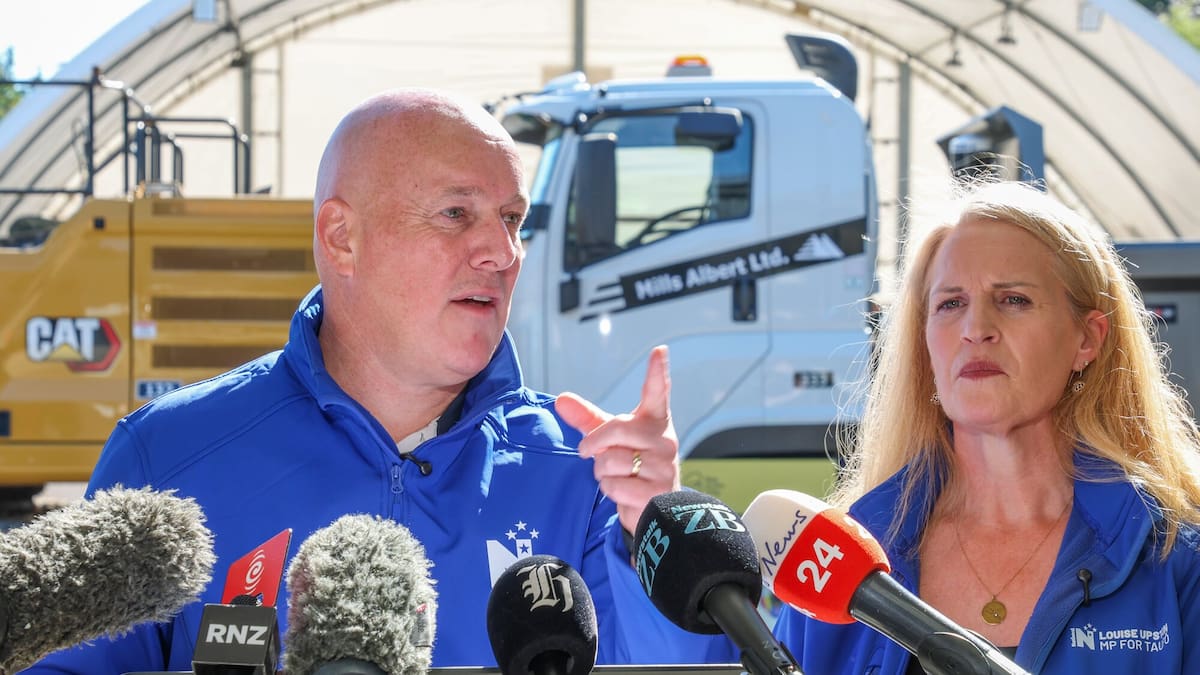
National leader Christopher Luxon chatting with workers during his visit to civil construction company Mills Albert in Paraparaumu today. Photo / Mark Mitchell
The Act Party, a coalition partner of National, said the policy was headed in the “right direction”, but did not go far enough. Act supported drug-testing MPs and parliamentary staff.
Under the policy, Upston said a first failed test would be recorded, and a second failure would result in a clinical alcohol and drug assessment. If beneficiaries did not comply with the assessment, they could face sanctions including benefit cuts.
National’s policy document estimated the cost of the drug-testing scheme to be about $1.5 million a year and expected it to be funded from the Ministry of Social Development’s baselines.
The party also wanted to reduce the Jobseeker benefit for those who had accessed it for two of the previous three years.
Under the proposal, recipients without children would have their benefit cut by $48.05 a week from April 2028, based on current figures.
Christopher Luxon receives instructions on operating an excavator during his visit to Mills Albert in Paraparaumu. Photo / Mark Mitchell
Couples without children would receive $552.18 a week, an effective reduction of $81.76 a week. Recipients with dependent children would face a smaller cut of $24.02 a week.
National noted that actual reductions would reflect Jobseeker rates in 2028, after annual increases to reflect inflation over the next two years.
The change was expected to save a future National-led government $572m over the four-year forecast period, almost all of the total plan’s estimated savings of $583m.
The remaining three items on National’s plan include doubling the non-entitlement period for beneficiaries who repeatedly leave employment without a sufficient reason from 13 weeks to 26 weeks; extending the minimum residence period to qualify for main benefits from two years to five years; and providing more “work-focused support” for 30,000 jobseekers who have been on the benefit for more than a year.
“This isn’t about punishing someone because they haven’t found a job,” Upston said in a statement.
“It’s about making sure people receiving Jobseeker Support meet reasonable expectations to be ready for work, which also helps ensure it is fair to hardworking taxpayers who fund the system.”
Upston and Luxon fronted the policy announcement on the Kāpiti Coast, north of Wellington, this morning.
Asked if he would be open to MPs facing random drug tests, Luxon said he was “fine” with it, but clarified that it wasn’t National policy. He acknowledged he expected such a question after today’s announcement.
He suggested he was open to funding more places in rehabilitation if demand increased as a result of the alcohol and drug assessments.
Upston explained that the proposed 2028 Jobseeker cuts would apply to some beneficiaries suffering from health conditions, but said it would not apply to those deemed unable to work, such as those battling cancer.
Act leader David Seymour said National’s policy went “a short distance in the right direction”.
“Yes, there need to be consequences, but if languishing on the dole is bad, why wait two years for consequences?
Christopher Luxon speaks to the owners of the South African Pantry in Paraparaumu during his visit this morning. Photo / Mark Mitchell
“This policy shows the next future government needs more Act to go further and faster in the right direction on welfare reform.
“Of course, drug testing should be essential to getting a benefit. Someone is not work-ready if they’re stoned. Why should people get up early and go to work to pay for other people’s drugs?”
The benefit reductions for people who had received it for two out of the past three years were another example of “too slow in the right direction”, he said.
“Two years on a benefit is too long. Act’s plan, already released, would put jobseekers on a plastic card for essentials only after four months.
“It’s good to test beneficiaries for drugs, but what’s better is not giving them cash to buy drugs in the first place.”
Green MP Ricardo Menéndez March said the National Party was “punching down” on people who needed support.
“The National Party has nothing to offer after cutting thousands of jobs. Their policy would end up depriving people who are sick, injured and disabled [of] benefits that they need to make ends meet.
“Today’s announcement will simply plunge more families who are trying to get a job when there are not enough jobs available deeper into poverty through no fault of their own.”
Next month, an estimated 4300 18- and 19-year-olds with parents earning more than $65,000 will no longer be able to access the Jobseeker benefit.
In July, under questioning in the House from Menendez-March, Upston acknowledged that about 1800 of them had a psychological or psychiatric condition.
Adam Pearse is the Deputy Political Editor and part of the NZ Herald’s Press Gallery team based at Parliament in Wellington. He has worked for NZME since 2018, reporting for the Northern Advocate in Whangārei and the Herald in Auckland.