
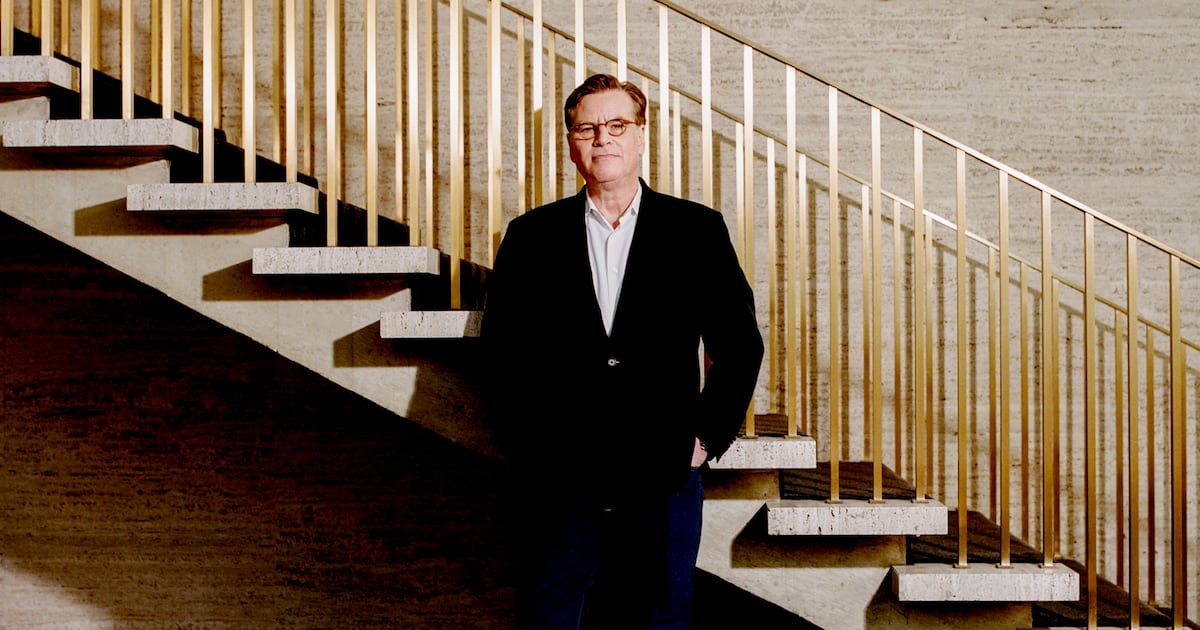
Aaron Sorkin, creator of The West Wing and ace screenwriter behind A Few Good Men, shakes his head and smiles. “I keep saying Facebook,” he says apologetically. “But it’s Meta now.”
Sorkin, who won an Academy Award for his screenplay for The Social Network, the 2010 film about how Mark Zuckerberg devised Facebook (as it then was), really ought to know.
For more than a decade, every time the social media billionaire made headlines – his MMA training, his kill-what-you-eat dinner with Jack Dorsey, his science-dinner brush with Elon Musk, his purchase of an Irish castle – fans have asked Sorkin to write a follow-up to that origin story.
“There have been so many times in the last 16 years, really anytime Facebook would be in the news – Cambridge Analytica, that kind of thing – when I’d get a phone call saying, ‘You should really return to Facebook. Write a sequel.’”
And on an unusually bright, autumnal morning in London, Sorkin has landed with just that. Sort of.
The Social Reckoning, he says, is not a follow-up in the strictest sense.
“But I’ve realised that there is going to be no convincing anyone that this isn’t a sequel to The Social Network, even though what it is really is another movie about Facebook, written by the same writer who wrote The Social Network, wherein one of the characters from The Social Network is also a character in this. It’s as if Henry Hill from Goodfellas showed up in Casino.”
Sorkin finally found his hook for a second Zuckerberg-centred feature in the 2021 Facebook leak by the whistle-blower Frances Haugen. A data engineer and former company loyalist, Haugen was nothing like the disgruntled or wronged workers one might expect to find testifying against a former employer before the United States Senate.
“I’m introduced to her,” Sorkin says. “She has a book proposal, and she seems very interesting to me, but I don’t understand a word that she’s saying. She has an IQ of 3,000 or something.
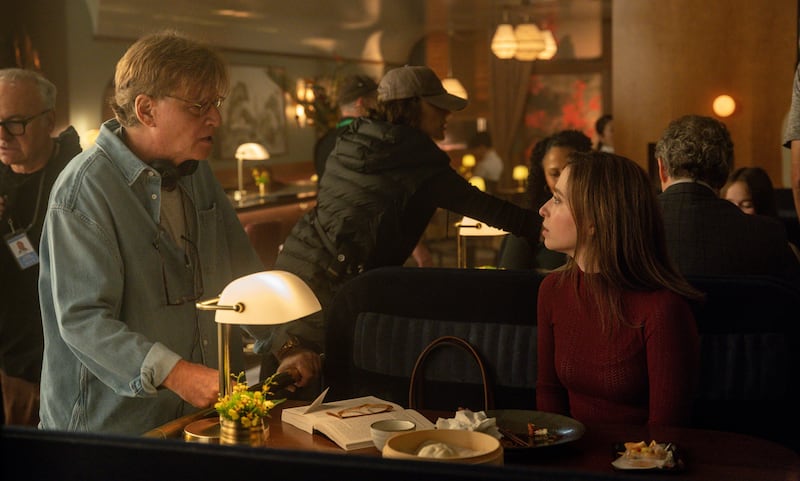 Aaron Sorkin and Mikey Madison on the set of Sorkin’s film The Social Reckoning, in which Madison plays the Facebook whistleblower Frances Haugen. Photograph: Sony Pictures
“And I meet Jeff Horwitz, the Wall Street Journal reporter who broke her story, and the same thing is happening there. Until I asked Jeff Horwitz – this is now about a year into banging my head against the wall and trying to figure out if there’s a movie there – a dramatist’s question, which was: ‘What was the inciting action for Frances?’ One day she wasn’t a whistle-blower, and the next day she was. What happened?”
The Social Reckoning dramatises the inciting action in a punchy overture about Meta’s algorithms and the purposeful radicalisation of the platform’s users.
“I imagined a prologue and wrote it,” Sorkin says. “I knew I had to write another 100 scenes if anyone was going to watch this movie. But once I had that scene I had to write the rest.”
The peculiar polarisation of US politics that has slowly swamped the rest of the planet, courtesy of Facebook and other social media platforms, also sneaked up on Sorkin. In particular, he was shocked by some of the Maga demographics.
“You assume it’s a certain kind of person,” he says. “The stereotype is a poorly educated, southern, redneckish kind of person. I live in Los Angeles, and I was frightened by the fact that some were people who live and work in Beverly Hills. Who are women! Who live and work in Beverly Hills! I don’t know what the source of anger or ignorance is.”
The Social Reckoning stars Mikey Madison as Haugen, who was originally a Facebook engineer in the company’s “civic integrity” division. Alarmed by the platform’s wilful spreading of misinformation and threats to electoral security, she reluctantly turns to Horwitz (played by Jeremy Allen White).
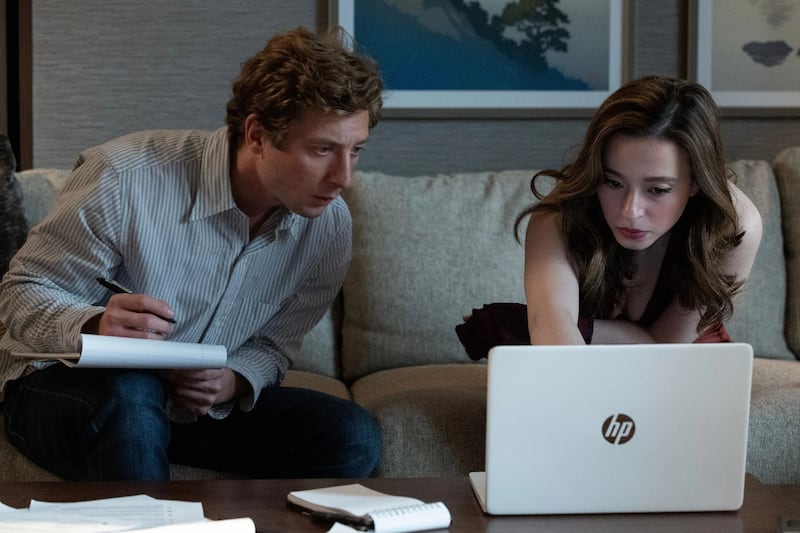 Jeremy Allen White and Mikey Madison in Aaron Sorkin’s film The Social Reckoning, in which White plays the journalist Jeff Horwitz and Madison plays the Facebook whistleblower Frances Haugen. Photograph: Sony Pictures
Their cagey, chatty encounters often resemble a screwball comedy more than the Deep Throat sequences in All the President’s Men. But a masterly turn by Jeremy Strong as Zuckerberg flags an obsession with power and the bottom line.
“I don’t, or didn’t, with Social Reckoning, try to really get inside Mark’s head for a motivation,” Sorkin says. “I was inside his head, or tried to be inside his head, for other things. But motivation? It’s tough for me to figure.
“The money can’t possibly be motivational. I think, right now, he is worth $120 billion. There’s nothing you can buy for $120 billion that you can’t buy for $119 billion. So it can’t be money.
“Why this need for growth at all costs? Once you are twice as big as the biggest country on Earth, wow, what’s getting you up in the morning to go to work? And why are you making these terrible decisions?”
The ethics of Zuckerberg’s actions, as depicted in The Social Reckoning, are queasy. Sadly, he’s not wrong about the business model. Ragebait sells.
“What Frances Haugen and Jeff Horwitz uncovered is that, not only is Facebook pumping misinformation out into the water supply, the air supply – alarming misinformation – but the distribution is industrial-strength.
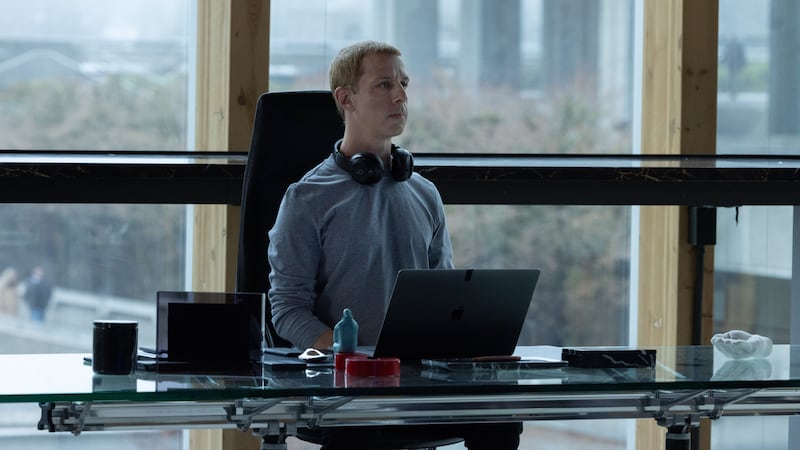 Jeremy Strong in Aaron Sorkin’s film The Social Reckoning, in which he plays the Facebook and Meta billionaire Mark Zuckerberg. Photograph: Sony Pictures
“In an effort to get you to stay on the platform a little bit longer, they want to give you things that you’re going to reshare. That’s what keeps you on the platform the longest.
“And they know the things you’re most likely to share are anything that makes you angry. Facebook is trying to make you angry. That’s the business they’re in, and business is booming.”
Sorkin has never met Zuckerberg. But he is familiar with Zuckerberg’s legal representatives.
“When Meta got wind of this movie, I know that Sony got some strong letters from their lawyers. They wanted to see the script. Of course, we don’t show the script to people who aren’t making the movie, but they let us know that they’re there.”
The Social Network, Sorkin acknowledges, was a tough act to follow. The film, widely regarded as David Fincher’s best, received eight Oscar nominations and won three: best adapted screenplay for Sorkin, best original score and best film editing.
[ Mark Zuckerberg’s few coins thrown to the GAA should not fool usOpens in new window ]
Sharp dialogue, memorable characters, Fincher’s stylish direction and the groundbreaking soundtrack by Trent Reznor and Atticus Ross continue to win it new fans.
Diehards still approach Jesse Eisenberg, who played Zuckerberg so memorably, to ask him to sign autographs with his line “I’m CEO, bitch.” That’s part of the reason the actor didn’t want to revisit the role.
“Jesse has a lot of fun memories of The Social Network, and he understands that it did a lot for him,” Sorkin says. “But he doesn’t like being conflated with Mark Zuckerberg. He doesn’t like the guy. And Jesse is also a very well-respected writer and director now.”
It has all worked out. The best scenes in The Social Reckoning concern Zuckerberg preparing to face US authorities, aided by a small squadron of media advisers fussing over every phrase and tie.
The film is another chance for Jeremy Strong to shine. The actor told GQ last month that he contacted Zuckerberg after being cast.
“I wrote to him – I’m probably going to give Sony an aneurysm – I sent him an email,” he explained. “Just to say that I take this responsibility very seriously, and the veracity of it seriously, and I’m approaching it with respect.”
We don’t yet know what Zuckerberg said in response, but Strong channels just the right amount of weird to convey the inscrutable billionaire.
[ Try! review: In this charming Irish documentary, everyone’s a winnerOpens in new window ]
“There’s no disrespect to Jesse – and I did go to Jesse first – but Jeremy had said to me, if for some reason Jesse doesn’t want to do it, that he wanted to do it,” Sorkin says.
“And he gives a thunderous performance. He is, as you know, a very immersive actor. So he showed up on his first day of shooting. And I only ever heard him speak in Mark’s voice.
“He never used his own voice until his last day of shooting. After I called, ‘Cut – check the gate,’ he walked up to me and was using his own voice. And I would bet you anything that, off the set, when he went back to his hotel, when he was talking to his wife and kids, that he was also using Mark’s voice.”
Sorkin seems bemused by the idea that The Social Reckoning is his fourth film as a director. He still thinks of himself as a playwright.
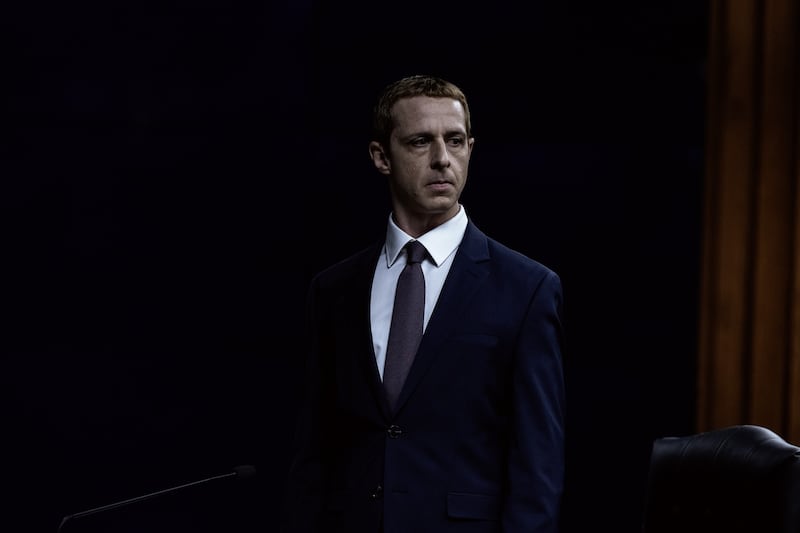 Jeremy Strong in Aaron Sorkin’s film The Social Reckoning, in which he plays the Facebook and Meta billionaire Mark Zuckerberg. Photograph: Sony Pictures
“I’m most comfortable doing that,” he says. “With film, with television, I kind of try to fake my way.”
In 2017 he turned in Molly’s Game, a biopic based on the Olympic-class skier turned poker mogul Molly Bloom, to his producer. “They told me, ‘You’re not done,’” he says.
So began a directorial run that has also taken in The Trial of the Chicago 7 from 2020, and Being the Ricardos from 2021.
“I was my second choice to direct The Social Reckoning,” Sorkin says, laughing. “David Fincher was my first choice. But David has some exclusive deal at Netflix. He just wasn’t able to do this. He was also kind of busy directing Quentin’s movie.”
Fincher has wrapped on The Further Mis-Adventures of Cliff Booth, a spin-off from Once Upon a Time … in Hollywood, written by Tarantino, and heading to cinemas in November before landing on Netflix in early December.
Sorkin’s accidental directing career is typical of his haphazard path into the arts. An aspiring actor, he graduated with a degree in musical theatre from Syracuse University, in New York state, before heading to New York City, where he worked odd jobs, including as a singing-telegram performer.
He had scored some early off-off-Broadway successes when his sister’s experiences as a lawyer with the United States Navy’s legal branch, the Judge Advocate General’s Corps, inspired the stage version of A Few Good Men. Sorkin is reviving that play-turned-Oscar-winner on Broadway.
“I love that I’m able to do both,” he says. “My last two films both opened during Covid. A lot of people saw them, but they never played in front of an audience.
“There’s nothing that replicates that experience of sitting with a group of strangers in a dark room. Laughing at the same thing. Crying at the same thing. Gasping at the same thing. When it works, there’s nothing like it.
“And, as it happens, A Few Good Men previews on Broadway the day before The Social Reckoning opens. October is a big month for me.”
Sorkin’s mother was a teacher. His father was a copyright lawyer and second World War veteran who went to college courtesy of the GI Bill. The younger Sorkin was, he notes, the first person in his family to get into show business. But not the last.
“I don’t know where the gene came from, but my daughter, Roxy, has just finished her first feature,” he says, laughing. “It’s a material breach of the deal I made with God on the day she was born. But here we are.”
The Social Reckoning is in cinemas from Friday, October 9th