
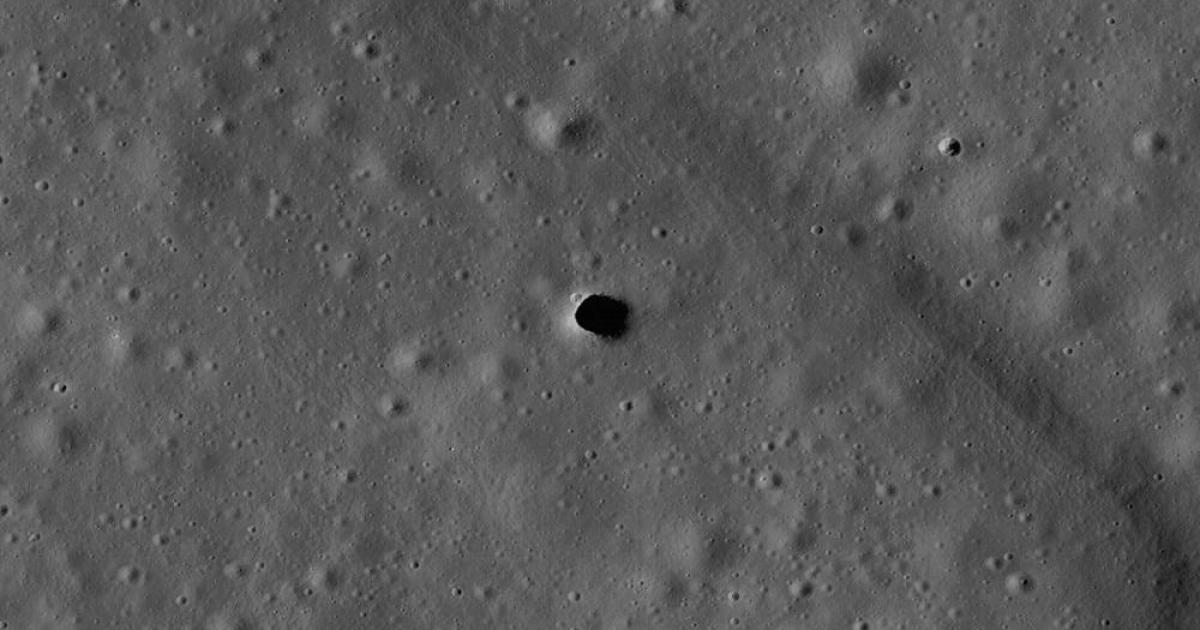
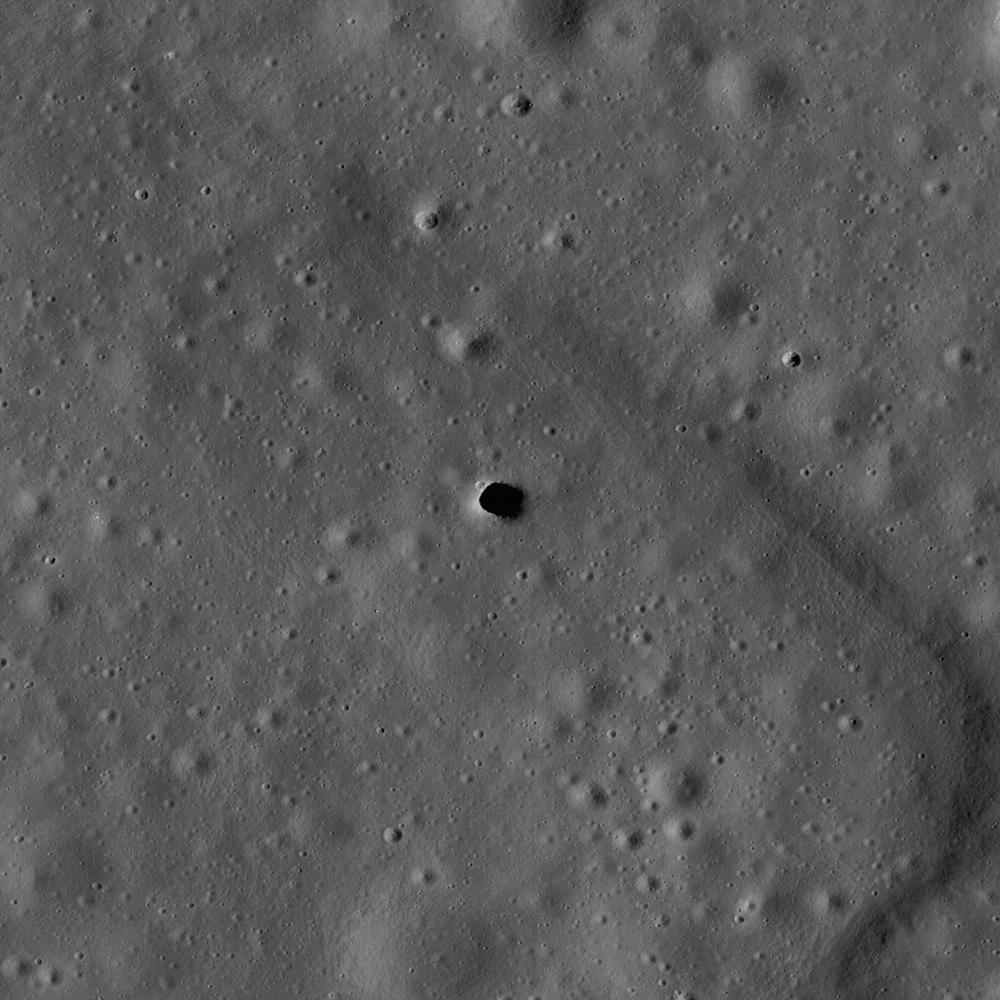
The Marius Hills Pit is a large hole, approximately 213 by 295 feet (65 by 90 meters), located in a region of the Moon that previously saw a large amount of volcanic activity. GIMLI, a newly selected NASA mission will collect data to characterize the pit and determine whether it opens into a larger subsurface lava tube. Credit: NASA/GSFC/Arizona State University
NASA has selected a mission proposal that will peer below a volcanic pit on the Moon to find out whether it opens onto a hidden lava tube — a geologic formation long theorized, but never confirmed on the Moon.
The proposal will send a mission to the Marius Hills Pit, a large hole — approximately 213 by 295 feet (65 by 90 meters) — located in Oceanus Procellarum, one of the Moon’s most volcanically varied regions. Announced Sept. 30, the GIMLI (Geophysical Instruments for Marius Lunar pit Investigation) mission shares its name with J.R.R. Tolkien’s cave-loving dwarf — a fitting namesake for NASA’s hunt for a cave of its own. GIMLI will use its suite of instruments to map and measure the ground beneath Marius Hills Pit, possibly providing the first on-the-ground evidence for a lunar lava tube.
GIMLI’s findings will inform future crewed missions and uncover new information about the Moon’s geology. The open lunar surface offers astronauts no cover from the harsh environment; a cave stretching past the pit’s mouth could protect explorers and preserve a record of the volcanic activity that shaped the Moon. GIMLI was selected alongside two other proposals to be funded through NASA’s Payloads and Research Investigations on the Surface of the Moon (PRISM) program, which the agency says will help lay the groundwork for a sustained presence on the Moon.
“NASA Science is building the ultimate interplanetary survival guide to ensure that science goes first to the lunar surface to provide our future astronaut crews with the vital information, resources, and safety precautions needed ahead of time to survive the night on the Moon,” said Nicky Fox, associate administrator of NASA’s Science Mission Directorate in a press release.
Mission architecture
While funding for the mission will come through PRISM, it will be launched through NASA’s Commercial Lunar Payload Services (CLPS) — a public-private partnership through which the agency awards lunar delivery contracts through a pool of approved commercial firms. GIMLI does not yet have a confirmed launch date or launch provider.
The Planetary Science Institute (PSI), an independent nonprofit headquartered in Tucson, Arizona, whose work in solar system exploration spans more than 30 states and several other countries, will lead the mission. GIMLI’s principal investigator is Than Putzig, a PSI senior scientist and the institute’s associate director. Honeybee Robotics, a subsidiary of Blue Origin, will manage the project, build the mission’s seismic sensors and gravimeter (a device for measuring the strength of gravity at a specific location), and mount everything on a CLPS lander and rover. The mission will also partner with the Norwegian Space Agency — who will provide the mission’s ground-penetrating radar — and co-investigators from Boise State University, Johns Hopkins University, the Lunar and Planetary Institute, and the University of Oslo.
The case for lunar lava tubes
On Earth, lava tubes form when the outer layer of a lava flow cools while molten rock keeps moving beneath it. Once the flow stops and the lava drains away, the hollow channel remains as an underground tunnel. Scientists have long theorized that this process likely unfolded over the course of lunar geological history as well. Where terrestrial lava tubes top out at about 100 feet (30 meters) wide, studies suggest that under the Moon’s weaker gravity, tubes could reach 1,260 feet (385 m) across.
RELATED: Lunar lava tube could shelter a future Moon base
No one knows for sure whether such tubes exist on the Moon, but scientists have proposed them since the Apollo era and recent evidence leans in their favor. In 2008, Japan’s Kaguya mission photographed the Marius Hills Pit, which scientists believed to be a skylight — an opening where part of a lava tube’s roof collapsed. Since then, nearly 300 lunar pits have been identified. A 2024 analysis of a pit in Mare Tranquillitatis used radar data from NASA’s Lunar Reconaissance Orbiter to find that it might lead to an underground cavern around a hundred feet long, the first evidence of an accessible lava tube on the Moon. And a 2017 study of the Marius Hills Pit, which paired radar data from the Kaguya orbiter with gravity measurements from NASA’s GRAIL mission, found strong evidence for a void beneath the surrounding surface, marking it as an area of interest for future exploration.
What GIMLI will do
Without actually entering Marius Hills Pit, GIMLI will combine a variety of instruments to search below the surface of the area around the opening and characterize what hides there, collecting the first-ever on-the-ground measurements of a lunar pit. Pulses from the Norwegian Space Agency’s ground-penetrating radar will map subsurface objects. A gravimeter will look for missing mass where an empty chamber might sit. And seismic sensors will measure the movement of sound waves through the ground — an approach Putzig said “has essentially not been done since the Apollo astronauts” ran the Moon’s first seismic surveys. Additionally, cameras will document what they can see of the surface and the pit’s walls. If a void exists, the combined data should help the team determine its shape and size.
A confirmed lava tube would pay off on two fronts. For future crews, it would offer protection from harmful radiation and micrometeoroids, and shield them from the Moon’s extreme temperatures. For scientists, the tube’s interior could hold its own record of the volcanic activity that carved it.
As Gareth Morgan, PSI senior scientist and GIMLI’s deputy principal investigator explained, “Confirming a substantial lava tube would give us an insight into how volcanism operated on the Moon. Lava tubes are a common feature of basaltic volcanism on Earth, so identifying them on the Moon means we could use knowledge of such terrestrial caves to better understand lunar history.”
The Gimli of Tolkien lore discovered a sprawling cave system which he described to his elven companion as, “chamber after chamber, Legolas; hall opening out of hall, dome after dome, stair beyond stair.” It’s far too soon to know whether PSI’s GIMLI will find such a cavernous complex beneath Marius Hill Pit, but a null result wouldn’t be a bust. Even with no cave, the measurements could still uncover how the pit formed and provide the team with a more detailed understanding of the geologic and volcanic history of the Moon.
Other PRISM picks
GIMLI shares the PRISM selection with two other mission proposals. Lunar Environment Monitoring Station – South Pole (LEMS-SP), led by Mehdi Benna of the University of Maryland, Baltimore County, is an unmanned hazard-monitoring station that will log micrometeoroid strikes, track the amount of volatiles in the Moon’s lunar exosphere, and listen for moonquakes with a seismometer — data meant to keep future Moon Base hardware safe.
Depth Imager with Spectral and Color Optics (DISCO), led by Ariel Deutsch of NASA’s Ames Research Center, will make the first in-situ measurements of ice in the Moon’s micro cold traps (the smallest but most abundant permanently shaded regions of the Moon, measuring 1 kilometer or less in size) — data that will eventually help NASA turn lunar ice into a usable resource. DISCO will also conduct tests on the lunar surface, investigating how it reacts to rocket exhaust and how firm it is for rovers.
The announcement comes as NASA is ramping up its focus on the Moon with the Artemis program and plans for a permanent Moon base. The latter, now in the first of three phases, has several missions on the immediate horizon. Moon Base I will send Blue Origin’s Blue Moon Mark 1 lander to the Shackleton Connecting Ridge near the south pole to study how engine plumes disturb lunar soil. Moon Base II will deliver Astrolab’s FLIP rover to Mons Mouton aboard a Griffin lander. And Moon Base III will carry Lunar Vertex, the first payload awarded under PRISM, to the lunar swirl at Reiner Gamma on Intuitive Machines’ Nova-C lander. All three missions were originally targeting launch in 2026, but NASA has yet to release any firm launch windows.
Brooks Mendenhall is a staff writer at Astronomy, based in Chattanooga, Tennessee, fueled by an unending curiosity about the universe. A former classroom teacher, he has a knack for breaking down complex concepts for a wide audience.