
Director Jeff T. Thomas has worked on dozens of television episodes and music videos, some featuring the likes of Arnold Schwarzenegger and Melissa Leo. But with AI, his feature debut is nigh.
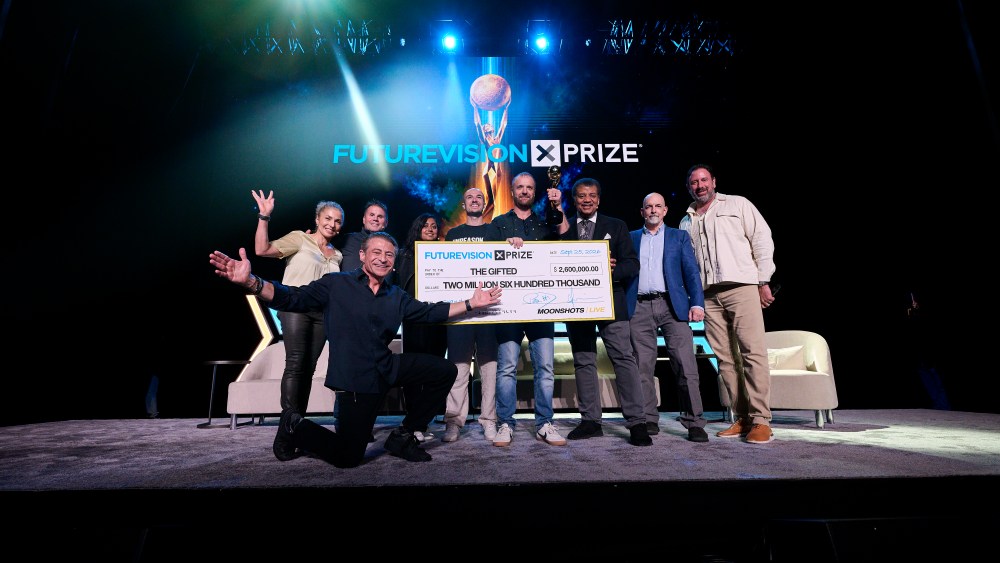
Thomas, under his moniker “Jeff Synthesized,” took home the $2.5 million “Future Vision XPRIZE” last month with the AI-generated proof-of-concept trailer for “The Gifted.” (Watch the trailer below.) The trailer was made with the prompt of depicting “a future worth building toward” within three minutes. The competition was judged by astrophysicist Neil deGrasse Tyson, novelist Neal Stephenson, Google‘s Mira Lane, Salesforce executive John Zissimos and ‘Star Trek’ steward Rod Roddenberry. Thomas’ trailer follows an 11-year-old boy who builds an AI version of his late mother who rebuilds his late mother that quietly begins saving lives, captured through various moments.
Now, with the win, Google and Range Media Partners (through their 100 Zeroes initiative) will help develop the trailer into a full-length feature.
It’s a story partly inspired by Thomas’ own childhood, having lost his mother at 14 due to an undiagnosed brain tumor. But having to navigate designing a hopeful film, one devoid of an antagonist that also heralds a positive view of AI, was a challenge in its own right.
But Thomas hopes the project can be a vehicle for that positive view of AI, both narratively and as a production tool, even as many in Hollywood remain fearful about its impact on jobs and some in the general public worry about its world-ending potential.
“I wanted to follow a character that became obsessive, compulsive about trying to bring his mother back,” he tells Variety. “In the movie that we’ll see, she admits to not being his actual mother, but she does actually end up helping him, helping the world, and hopefully this will be something that will be imitated by technology people, and we can actually do some good in the world.”
The participants — roughly 2,500, with the top five making it in front of the judges — were not required to use AI, but the fact that many of the final submissions was “evidence that AI is preoccupying people’s thoughts,” Tyson tells Variety.
Tyson says he found the trailer a “clever construct” in how it flipped people’s general fears about the technology’s “all-knowing” nature into a tool that connects people to help each other. His fellow judges agreed. “The choice of the number one was unanimous,” he says.
But that doesn’t mean he’s eager for completely AI-generated films, saying people flock to movies because “we want to see what humans can do” and that audiences will demand “human creativity, not machine creativity.”
“[AI] will raise the bar on creativity,” he says. “You can’t just be an artist aping the work of other artists because AI can do that. The value of that will drop in the workplace, but something that’s truly creative that comes out of the deepest parts of the minds of someone who dreamt it — I don’t see AI coming for that anytime soon.”
For Roddenberry, he says he wanted to see a project that could be “the next ‘Star Trek,’” one that left audiences believing the world the three-minute trailer presents is one they could aspire to.
“Is [the story] believable? No,” he admits. “It’s make believe. It can’t connect it exactly to reality, but I think it’s just a beautiful story of how technology, especially something like AI, which is so feared today, can have a positive message in it.”
It’s a philosphy Range subscribes to, CEO Peter Micelli says, investing in the prize to both showcase how people are using AI tools within the film industry and source new stories from contestants across the world. While the eventual “roughly $10 million” film will not be AI generated, he says, it’s a technology that could mimic the look of a film that costs 10 times that figure.
“This reality is here,” Micelli says. “This tool is very, very powerful. And I would be more concerned about us not being involved in these things because we need to be on the ground floor so we can advise our clients and partners that are established in Hollywood on [how] this is a reality, and everyone needs to be aware of what it is.”
Not that Thomas plans on making an AI film, promising his eventual movie will only utilize it as a tool. But he also doesn’t want those in the industry to write off AI as an end-all killer of creativity, pointing to his use of it while directing episodes of Amazon’s “House of David” series and his own experimentation with AI models.
“Audiences are still expecting $25 million-looking episodes, but you might have $10 million, you might have $12 million,” he says. “What AI can do is fill in the gaps between those to still provide the audience with something they want and still allow the studios to make the material for what they can afford. So, creatively wise, I think it will make entertainment better, because you won’t be as limited as we have been up until this point.”
Watch the trailer here: