
The same Peters whose deputy leader, Shane Jones, in April warned that the free trade deal with India would trigger a “butter chicken tsunami”.
The same Peters, and Jones, whose comments were condemned as racist in last week’s leaders’ debate between Chris Hipkins and Christopher Luxon; the former said he would have sacked them, while Luxon’s refusal to do so suggested he didn’t want to risk collapsing his coalition.
At a packed hall in Southland Boys’ High School today, a white retired man (a core NZ First constituent, one would think) asked Peters why he’d had to wait 65 years for his pension when Indian and Chinese “a**holes” only had to wait three years.
Peters calmly corrected the man, saying the stand-down time for residents was sliding up from 10 to 20 years; he’s campaigning on making it available only to New Zealand citizens.
He then said: “We do not put any race down, no matter where they are and who they are. At the end of the day, our pride as a country is: if you arrive here legally, and if you observe our laws, you’re entitled to the defence the same as anyone no matter how long you’ve been in our country.”
A public meeting is not the parliamentary debating chamber, where Peters made his comments to Xu-Nan, so it’s perhaps not surprising he didn’t let today’s offensive comment slide.
It still seemed a genuine rather than a strategic response, though there often seems to be an element of strategy in everything Peters says, perhaps here with an eye to the plateau in the party’s rise in the polls (as high as 15% in April, now between 10% and 12%) since those inflammatory comments.
Peters has long been a master of appealing to particular groups of voters who, together, are keeping support for NZ First well above the 5% threshold. This is the first time this has happened for the party following a term in Government, after falling short in 1999 (though it was returned to Parliament as Peters won his electorate), 2008 and 2020.
These groups were all in Peters’ sights at various points during his speech. There was the constant reminder of the SuperGold card and holding the superannuation age of eligibility at 65; the demand for a further Covid inquiry into injuries among under-18s; the decrying of any separate system for Māori and non-Māori that, for him, is a “road to apartheid”; workers on the minimum wage struggling with high power costs and an Australia-dominated banking sector.
These were also all given eloquent solutions, some simple, such as lifting the minimum wage, others more dubious like buying back the BNZ to fix the banking sector. None of the latter were seemingly a factor for the 300-strong crowd, given their enthusiastic applause at each of these stages of his speech.
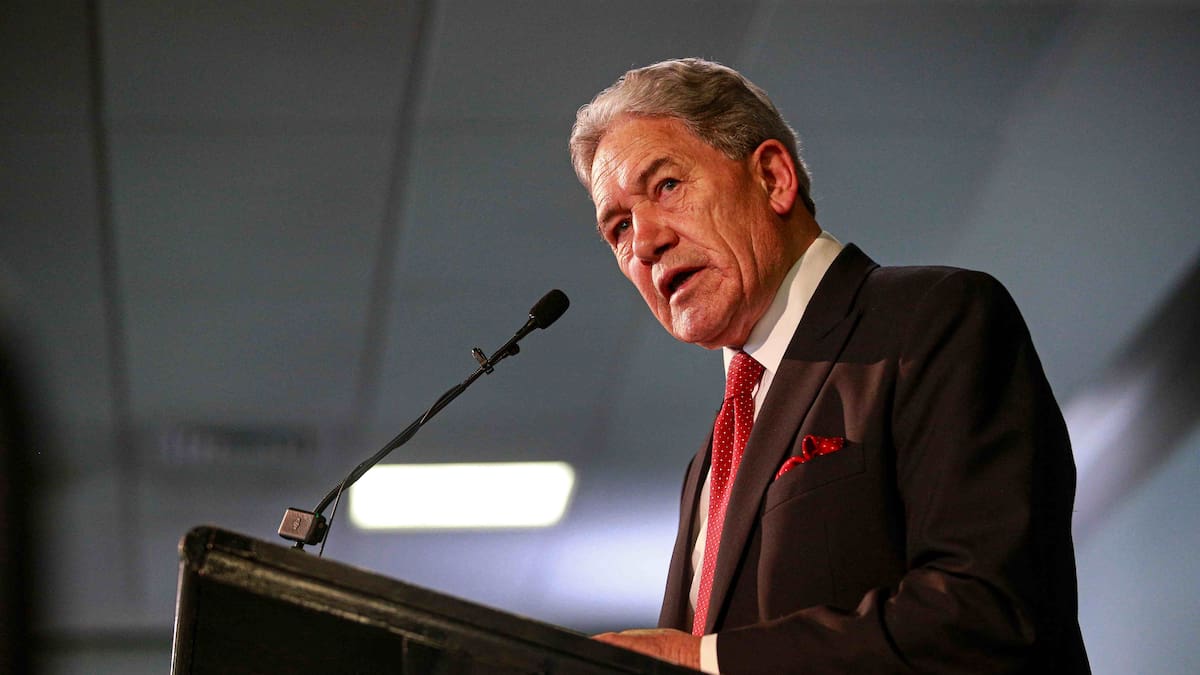
Winston Peters speaks to a packed hall in Invercargill on Saturday. Photo / Derek Cheng
Then there was the scorn for the other political choices, all doused in Peters’ particular flavour of campaign hyperbole.
Hipkins should be “behind bars” because of what happened during Covid. Opportunity’s biggest sin appears to be getting a lot of media coverage without holding any public meetings. The Greens have no business experience except for Chlöe Swarbrick.
“She ran an ice cream shop for five weeks that went bust. How can you go bust selling ice cream?” Peters said with a chuckle. (She was involved in several small businesses before entering Parliament including a small cafe and art gallery, a digital marketing consultancy and a fashion label.)
Then there’s National and Act, who want to cut, cut, cut (reprioritise), in particular the funds at Peters’ precious Ministry of Foreign Affairs and Trade.
This led Peters into local flattery: “You have the highest per capita export record of any province in New Zealand … You need more people offshore selling your product.”
It wasn’t until the question-and-answer session that people came forward with particular issues, rather than those who merely wanted to hear from the man they’ll vote for anyway.
There was the Pacific worker sweating the extension of his working visa; Peters told him “it’s complicated” because he has to convince National and Act.
The injured man wanting a Royal Commission of Inquiry into ACC; Peters was “sympathetic” to this.
“Double the economy by 2050,” was Peters’ fix when asked how he will improve the health system in Southland, which is in a particularly bleak and desperate state with no specialist urologist.
“Very concerning … we will look at it seriously,” he told a disability sports coach, who spoke of the pain of the sudden cuts to the sector in 2024.
One gentleman, part of a small Free Palestine protest at the school gates, managed to get inside and ask Peters if his party actually stood for Israel First.
“The last thing I want is your vote,” Peters told him as the protester, amid heckling, walked out.
The most tension arose after a question from a GP from Britain, a New Zealand resident but not a citizen, who had been working in rural Southland for 24 years.
“You don’t think I deserve a pension or to vote. I’ve put a lot into this country,” the GP told him.
Peters told her to sit down before he’d answer, and then said: “You’re here to sign up to my country, so why don’t you?”
One voter, perhaps wanting more insight into what Peters would prioritise in post-election talks, asked him about bottom lines. Peters doesn’t do them because they weaken his negotiating hand.
But that doesn’t mean the strategist doesn’t have a means of signalling his non-negotiables.
He won’t do a deal with Labour, for example. In 2023, he said “no ifs, buts or maybes” on changing the superannuation eligibility age.
These were statements, not bottom lines, Peters told the Herald after the meeting.
He repeated his “no ifs, buts or maybes” line when the Herald asked him about his policy on bottom trawling. Phasing it out is a bottom line for Opportunity, which Hipkins supports, while Luxon wants to review it.
NZ First frames itself as a champion of industry, including commercial fishers, and bottom trawling is responsible for about 9000 jobs and 70% of how commercial fish comes to market.
But Peters wasn’t saying it was a method he would necessarily protect, but an issue that needed further examination.
His line in the sand was that NZ First knew more about the issue than National, “no ifs, buts or maybes”.
Derek Cheng is a senior journalist who started at the Herald in 2004. He has worked several stints in the press gallery team and is a former deputy political editor.