
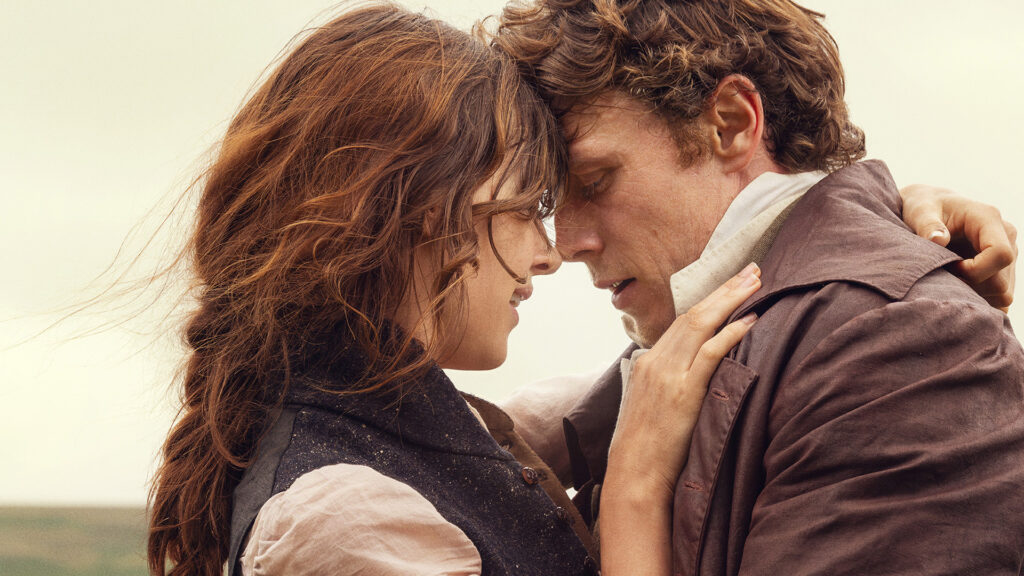
From Focus Features and Working Title comes an irresistible new take on Jane Austen’s iconic Sense and Sensibility: a charming, witty, and deeply relatable story of love and sisterhood starring Daisy Edgar-Jones and Esmé Creed-Miles.
Adapted for the screen by screenwriter Diana Reid and directed by Georgia Oakley, Nick L’Barrow spoke with the creatives behind the latest intepretation of this beloved novel ahead of it’s October 15 cinema release in Australia. In this interview, Diana and Georgia discuss balancing the concepts of adaptation and interpretation, the timelessness of Jane Austen’s work, and the first time they experienced a cinematic love story.

Nick: Diana, I’d love to start with you. I’m curious about your process when it comes to balancing adaptation and interpretation for this project. What were the elements of Jane Austen’s novel that you wanted to stay true too, and what were the things you were excited to creatively play around with?
Diana Reid: I guess my broad approach was respectful but not reverent. I loved the book, and I was always very clear that I wanted to try and retain the period accurate language, and make it all feel authentic. But then I was also open to changing things that just didn’t resonate. Two good examples of that are in the book, Marianna changes much more than Eleanor. Marianne has to just learn sense, and her whole personality changes to become more like Eleanor. And I think with this adaptation, what was more interesting to me was the kind of symbolic nature of Sense and Sensibility. I loved the idea that they both had to change, and that they both had to acquire the other’s qualities in order to become their true selves. Then the other thing, which is perhaps this legitimate reading of the book, is that these two women who live in a very confined society are forced to almost settle romantically. I wanted to tell a story where the romances were really compelling, and despite the constraints of their society, they were able to find romantic connection and find ways to be their full selves. I guess I really wanted to make the men worthy of them, and for that I drew on other Jane Austen novels like Pride & Prejudice, where the romances do feel really compelling. So I was definitely trying to bring those elements into this story a bit more.
Nick: And for you Georgia, how did you find the visual language of the film through Diana’s script? I don’t know if you shot this on film, but I was so immersed by the way you presented this story in a visual sense.
Georgia Oakley: Yeah, a big part of the conversation early on was the historical accuracy versus interpretation. In terms of direction, everything kind of comes down to instinct. I mean, it’s all planned out, but I am drawn to a slightly more naturalistic feeling, and that is what kind of excited me when I received the script. It felt like all of the characters were so fully formed, and it was so propulsive. I was intrigued what it would be like if I put my stamp on it. So with that, we leant more into low lighting and focusing on nature, because that’s how I instinctively wanted to tell the story. There were also a lot of conversations about hair and costumes, which centered a lot around historical accuracy. But at the same time, I think with Austen adaptations, there have been so many that we kind of have this idea of how everyone should be dressed. We had historians advising closer to the shoot, and I remember thinking that I had scaled everything down a little bit, like with the houses and the cottage they moved into. I felt like I had probably made things feel a little less grand than it might have been in the book. And actually the historian we had on board told us that it was actually much closer to the kinds of homes that they would have been living in, in his opinion. But also, I think the question of historical accuracy is a bit wooly, anyway. Things like bonnets, which are synonymous with Jane Austen. I had a conversation with my costume designer early on to say I didn’t want any bonnet unless they were elevated in some way. I didn’t want the classic bonnet. I was happy to have them, but they needed to be elevated. So, the costume designer found these amazing hoods that would go over the bonnets and make them waterproof-ish. And they looked great. Kind of like if Dover Street Market was doing super high fashion bonnets. I think that approach to the bonnets is kind of how we approached the entire film. It was really a riff on what was historically accurate. We were never throwing everything out of the window. We wanted to stay true to the things of that time, but there was room to play.
Nick: I always love when a new adaptation of a classic text comes out because it feels like a new chance for newer audiences to discover these timeless stories for the first time. Is there a book-to-movie adaptation of a classic story that sticks out to you as a formative movie watching experience?
DR: For me, Little Women – the 1990s one with Gillian Anderson – was something I watched growing up a lot. And of course I saw the Greta Gerwig one before I wrote this adaptation. I actually went back and rewatched them both back-to-back because I was trying to understand the process of adaptation and how you can have two texts that are so true to the original, but also have their own stamp on it. And that was so helpful because, I think to your point, there are certain stories that are timeless, and they do tap into emotions that you feel even in the present day. And there’s often multiple ways into those stories, and that’s why they keep getting told again and again.
GO: I don’t know if this answers the question, but I remember seeing Bright Star in the cinemas and just feeling like that was a period era film, but it felt so accessible in the fact that even though the characters are not at arm’s length, I’m not being deprived of the closeness I want to have with those characters. Just because they’re in costumes from the 1800s or whatever, there was a texture to it that felt so real. It was shot on film with beautiful cinematography, lots of nature. That one, yeah, was definitely quite something for me.
Thank you to Diana and Georgina for their time, and to Universal Pictures for organising the interview. Sense and Sensibility is in Australian cinemas October 15.