

Canadian employment declined unexpectedly in September, mostly isolated to the public sector and among youth.
Canada shed 68,000 jobs in September, well below consensus. On the back of a similarly unexpected drop of 42,000 jobs in August, the three-month average pace of employment is now in negative territory, declining by an average of almost 12,000 jobs. Despite the recent string of worrisome data, employment is still 0.5% higher than it was at the same time last year.
Public sector employment bore the brunt of the job losses, declining by 70,000. Year over year, public sector employment has declined by 119,000, a pull-back of 2.6%. On the contrary, private sector employment in Canada is up 163,000 year-over-year, and changed little in September. Previous analyses showed that 90% of the public-sector jobs recently eliminated have been permanent roles, consistent with the federal government’s stated goal of cutting 28,000 public service jobs. Interestingly, most of the public sector decline in September was in employment in educational services.
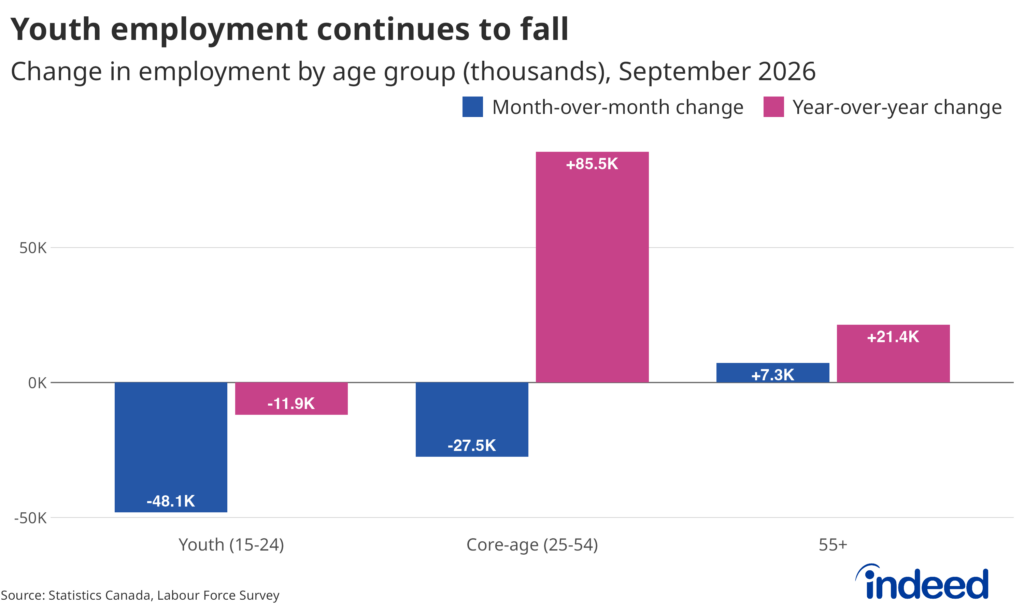
Youth employment also took another hit in September, with employment of 15-24-year-olds falling by 48,000. Both full-time and part-time youth employment declined notably, and overall youth employment is now almost 12,000 below its level at the same time last year. A significant decline in youth employment was in the public sector, with youth-held public administration jobs declining 42,000 in September and over 20,000 year over year (not seasonally adjusted). While employment was also down for core-age workers (-27,500), it increased for workers age 55 and older (+7,300), and year-over-year employment growth remains positive for both age groups. That makes youth employment the only major group with fewer jobs than a year ago.
Today’s release captures the first employment effects from the tariffs implemented amidst renewed trade tensions with the United States. And while broad-based impacts were not apparent, manufacturing employment in Canada declined by nearly 13,000 jobs in September.
Will employment continue to slide in Canada? Probably not at scale. The new tariffs affect a few sectors deeply, but broadly, most of Canadian activity is segmented from the shock. Looking ahead, Indeed job postings offer a wider perspective. Job postings have been fairly steady over the past year, with a positive year-over-year growth, as the Indeed Job Posting Index registered 100.8 as of September 30, 2026, slightly higher than the 99.2 recorded at the end of last September. Notably, however, the United States overtook Canada in year-over-year job posting growth in September 2026, reaching 2.5% by September 30, 2026, compared to 2% in Canada.
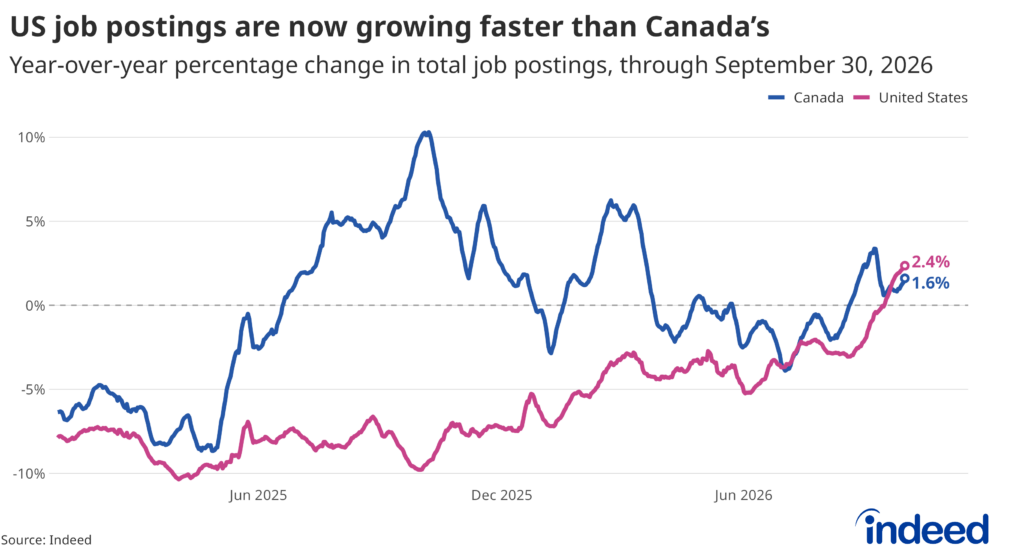
Job postings tend to lead hiring, so modest job posting growth would point to relatively flat employment growth, as is evident in the fluctuating employment data over the past few months. A larger rise in postings would be the first sign that a sustained recovery in hiring is on the way.