
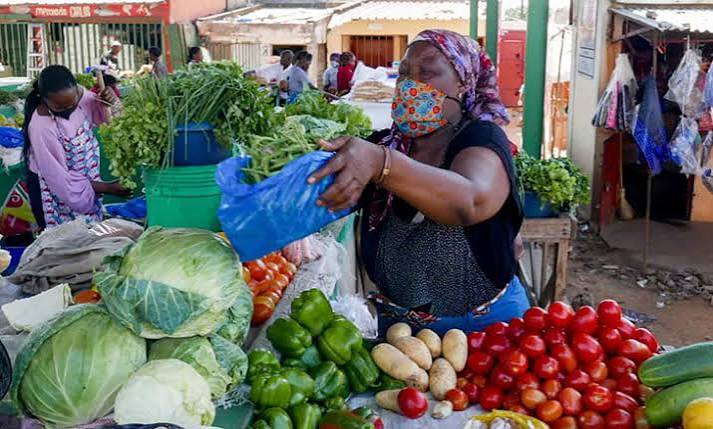
Photo: O País
Consumer prices in Mozambique rose by 0.16% in September, interrupting two consecutive months of deflation, while year-on-year inflation slowed slightly to 6.31%, the National Institute of Statistics (Instituto Nacional de Estatística – INE) announced today.
According to the September Consumer Price Index (CPI), the country recorded a slight monthly inflation rate after price drops of 0.28% in August and 0.26% in July.
The divisions for Restaurants, hotels, cafes and similar establishments, Food and non-alcoholic beverages, and Transport contributed most to the price increase, with positive impacts of 0.07, 0.03, and 0.03 percentage points, respectively.
Among individual products driving price growth, notable increases occurred in onions (+11.4%), grain maize (+10.4%), second-hand light motor vehicles (+3.9%), horse mackerel / carapau (+0.8%), beer consumed away from home (+0.8%), cement (+0.5%), and hamburgers, steak sandwiches (pregos/bifanas), and similar products (+2.5%). Collectively, these items added approximately 0.19 positive percentage points to monthly inflation.
Conversely, price drops were recorded in kale/cabbage (-6.3%), tomatoes (-2.4%), butter beans (-1.1%), head cabbage (-3.9%), cooking oil (-0.4%), coconut (-1.7%), and taps, pipes, valves, joints, elbows, and similar fittings (-3.8%), subtracting approximately 0.13 percentage points from monthly inflation.
The September CPI further indicates that accumulated inflation since January rose to 4.99% (up from 4.83% recorded through August), while year-on-year inflation decelerated slightly from 6.45% to 6.31%—remaining well within the Government’s target for 2026, which sits around 7%.
According to INE, Transport and Food and non-alcoholic beverages continue to exert the heaviest upward pressure on prices. In accumulated inflation since January, they contributed 2.09 and 1.55 percentage points, respectively, while on a year-on-year comparison, they recorded price increases of 14.72% and 8.69%.
Between January and September, the largest contributions to cumulative price increases came from diesel fuel, urban and suburban minibuses (chapas), fresh fish, gasoline, taxi services, onions, and kale/cabbage, which together accounted for approximately 2.81 percentage points of cumulative inflation.
City-level analysis reveals that only Chimoio and Tete recorded deflation in September, with price reductions of 0.17% and 0.05%, respectively. All other data collection centers recorded price increases, led by Beira (+0.43%), followed by Inhambane Province (+0.37%), Xai-Xai (+0.32%), Quelimane (+0.25%), Maputo (+0.19%), and Nampula (+0.04%).
For accumulated inflation since January, Xai-Xai recorded the highest rate at 6.93%, followed by Tete (6.85%) and Inhambane Province (6.36%). Maputo recorded the lowest accumulated rate at 3.65%.
In year-on-year terms, Tete continues to present the highest inflation rate in the country at 9.35%, followed by Inhambane Province (8.56%) and Xai-Xai (8.33%), whereas Maputo recorded the lowest rate at 4.14%.
Prices in Mozambique increased by 3.23% across the entire year of 2025, according to previous INE data, while accumulated inflation for 2024 stood at 4.15%—below the 5.3% recorded in 2023 and well beneath the peak of nearly 13% reached in July 2022.
The Bank of Mozambique recently maintained its benchmark MIMO policy interest rate at 9.25%, continuing to project that inflation will remain in single digits over the medium term.
Source: Lusa