
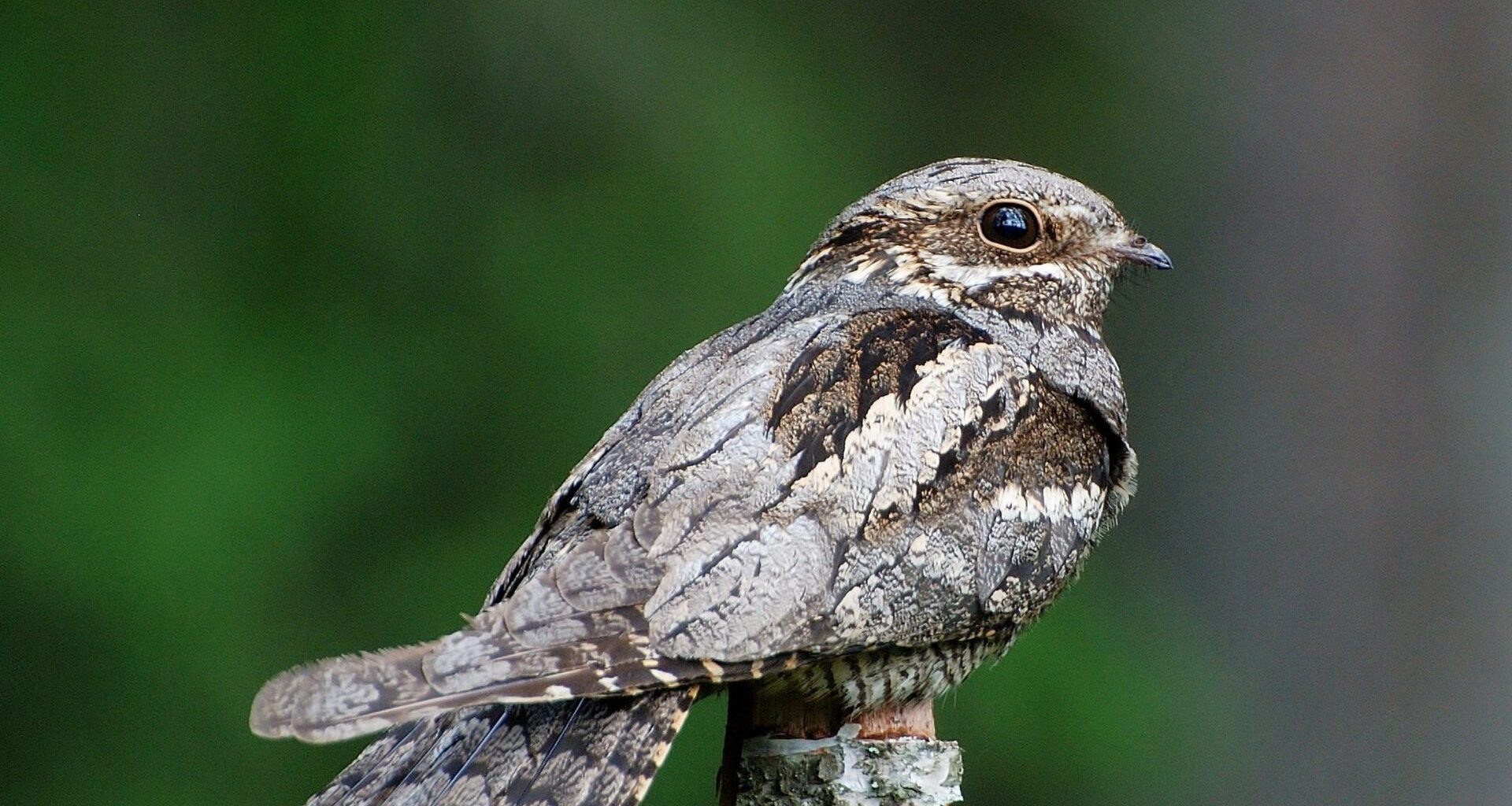
Nightjars appear to balance two very different flight needs. Their broad wings help with slow hunting but lose lift efficiency at speed.
When a bird migrates long distances, its wings are expected to be built for low-cost cruising. The European nightjar doesn’t fit that expectation.
Its broad wing tips appear suited to the slow flight it needs to catch insects at dusk, and they make lift less efficiently once the bird speeds up. One pair of wings is doing two jobs.
New wind tunnel measurements show what that costs.
They come from researchers at Lund University in Sweden, who flew three nightjars, a small sample that describes this species rather than birds in general.
Christoffer Johansson, an associate professor in Lund’s Department of Biology is the study’s lead author.
“This runs counter to the intuitive image of a long-distance migrant as a perfectly optimized flying machine. Instead, the nightjar’s wings appear to be a compromise between several different demands,” said Johansson.
Measuring the air behind a bird
Nightjars spend the daylight hours resting motionless, often on the ground where they also nest. At twilight they take to the air to catch insects on the wing, flying slowly enough that they can even hover in still air.
Across species, wing shapes tend to track how a bird flies. That makes a species needing two flight styles a useful test.
Five nightjars were captured in summer 2016 and trained to fly in Lund’s wind tunnel. The three that flew steadily across a range of speeds took part in the experiments, and all of the birds were released afterward.
The tunnel blew air past the birds at about 6 to 25 mph (2.6 to 11 meters per second).
Behind each bird, cameras photographed tiny particles in the airflow 640 times a second, which let the team map how the wings had pushed the air around.
High-speed cameras also filmed the birds under infrared light. A computer program tracked 17 points on the wing, body, and tail through every wingbeat.
Broad wing tips lose efficiency at speed
A wing holds a bird up by pushing air downward. At the tip, some of that air spills around the edge and curls into a spinning tube that trails behind the bird, called a wingtip vortex.
Most birds leave one of these behind each wing. At cruising speeds, the nightjars usually left two, side by side and spinning the same way, a pattern not described in earlier studies of bird wakes.
Two vortices mean the wing is pushing air down unevenly along its length, and uneven pushing wastes energy. On a scale where a perfectly even push scores 1, the nightjars averaged 0.72 during the downstroke.
The score dropped further at the highest speeds. It also puts the nightjar in the range the same method has measured in bats, which are generally considered less efficient fliers than birds.
The authors pointed to the wing tip itself. Its three outermost flight feathers form an almost square tip with gaps between them, and that abrupt change in wing width is one way a second vortex could form.
Slow flight suits the nightjar’s wing
Although their wings become less efficient at generating lift as they speed up, nightjars don’t necessarily use more energy to travel a given distance.
The energy nightjars needed to cover a given distance fell steadily as they sped up.
What declined was the efficiency of making lift. At cruising speed, lift takes only a small share of the total power a bird spends, so a weaker lift system may not cost much.
A broad, slotted wing tip has been suggested as a way to make extra lift at slow speeds, and the slow-flight measurements fit that idea.
At the slowest speed tested, the double vortex was less obvious, and the birds needed less power than a standard flight model predicted.
The birds also changed posture as they slowed down. They tilted their bodies up, flattened the angle of their wingbeat, and tilted and spread their tails more, changes the authors tied to holding up the bird’s weight.
The upstroke pushes the bird forward
A flapping bird gets most of its lift on the downstroke. When birds do put effort into the upstroke, scientists have mostly thought of it as a way to add lift.
The nightjars didn’t follow that pattern at cruising speeds. Near the end of the upstroke, the outer part of each wing pushed air backward, which drives the bird forward, at the cost of some downward force on the bird.
The force records showed thrust often rising and falling twice in a single wingbeat instead of once. The second, smaller peak stood out at every speed the team tested.
Upstroke thrust like this had been described before in bats and insects, and computer models and airflow measurements have suggested it in hummingbirds.
Wings that stay spread make thrust
Most birds tuck their wings partway in on the upstroke. The nightjars kept theirs about 80% as wide on the way up as on the way down, close to common swifts and a little below hummingbirds.
Nightjars have long hand wings, the outer part of the wing beyond the wrist. The authors proposed that folding and spreading such a long section every wingbeat would sweep it rapidly back and forth, which may add drag.
By the authors’ reasoning, a wing that stays spread swings its tip up fast instead. Unless the wing tilts sharply, that upward swing pushes air backward, so the upstroke makes thrust.
Swifts use a similar strategy
When the team reexamined older wake recordings of the common swift, another bird with long hand wings, they found the same backward push on the upstroke at higher speeds.
In earlier studies, birds with shorter hand wings showed no sign of it.
“What’s interesting is that the same type of aerodynamic solution seems to appear in quite different animals,” Johansson said.
“This suggests that the upstroke does not have to be merely a passive or lift generating part of the wingbeat. It can be actively used to generate thrust when the wings cannot be folded very much.”
Flying robots with flapping wings may face the same limit on how far their wings can fold, so the nightjar’s solution may be relevant to their design too.
What remains unknown
Only three birds flew in this study, all in a wind tunnel, and the team measured the air behind them rather than the forces on the wings.
At slow speeds, a wing can run into air it disturbed a moment earlier, which may have made the slow-flight power look lower than it really is.
The exact conditions that produce a double wingtip vortex in a flapping wing are still unclear. The authors wrote that future computer models or robotic wings will be needed to work that out.
How nightjars handle the lost efficiency on migration is open too.
They’ve been seen mixing flapping with gliding and flying close to the water while crossing large bodies of water, habits that may lower the cost of the trip.
across flapping flight.
Johansson’s team now wants to find out whether other birds and flying animals use a similar upstroke to generate thrust.
This could reveal whether the strategy is unique to nightjars or more common among flying animals.
The full study was published in the journal PLOS Biology.
—–
Like what you read? Subscribe to our newsletter for engaging articles, exclusive content, and the latest updates.
Check us out on EarthSnap, a free app brought to you by Eric Ralls and Earth.com.
—–