
I have spent too many hours this week thinking about a single tweet, but some things stay with you. It was posted by a man called Alvin Sng who works in a San Francisco AI company: “My wife: Can you read our baby a book? Me: I can just play an audiobook from my phone. My wife: But then it won’t be in your voice. Me: I can train a voice model. Parenting hits different when you work in AI.”
He later deleted the tweet and claimed he was joking. But the reason it attracted a backlash was because it seemed almost too perfect an illustration of the detachment from the human experience that only those honed by the weirdness of Silicon Valley and the hubris of San Francisco could ever think clever. Or too perfect a satire.
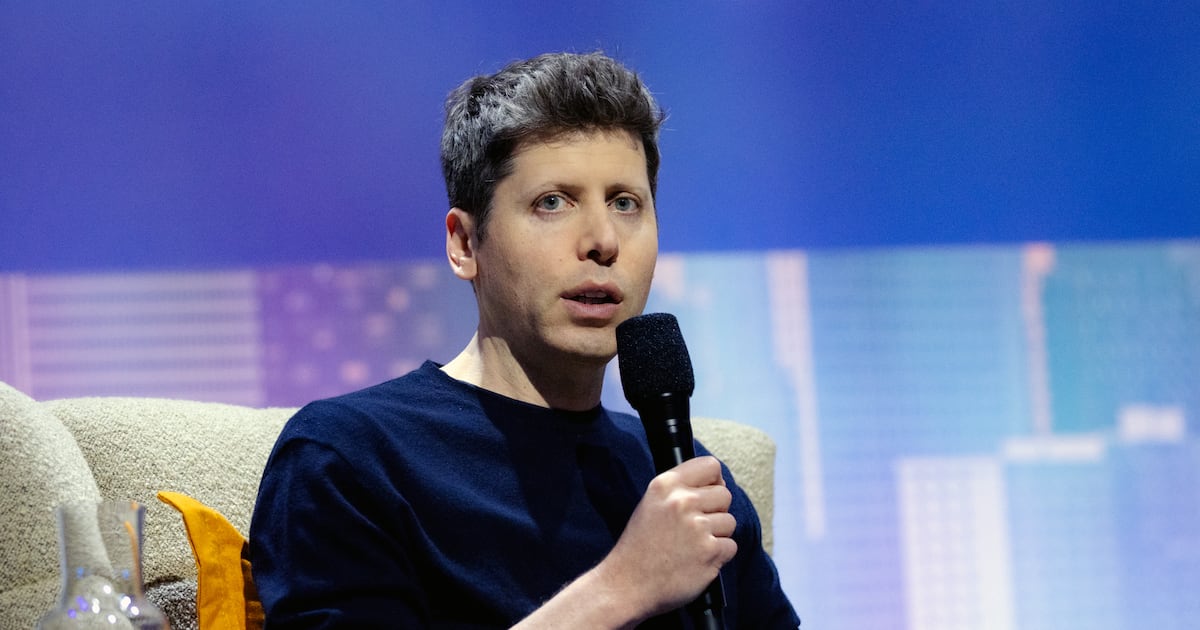
He might have been joking, but parenting does seemingly hit different when you work in AI. Last year, OpenAI boss Sam Altman appeared on an American chatshow. “I cannot imagine having gone through figuring out how to raise a newborn without ChatGPT,” he said.
On to the Mount Rushmore of AI spoofers and grifters shall Altman’s face one day be carved. Or for expediency’s sake, 3D printed. He is a man famous for telling people what they want to hear, a trait catalogued in Karen Hao’s book, Empire of AI. His self-satisfaction about utilising an LLM to raise his child wouldn’t even make the top 20 of his all-time nonsense.
Here’s one of my favourites: “Number one: We are close to creating a genie that can grant any wish. Number two: we are going to make sure that our first wishes broadly benefit humanity, and that we kinda get the world to a place where a lot more people have a lot more wishes,” Altman said with a straight face on a podcast earlier this year. If you said that deep in the grips of an acid trip at 5am at a music festival you would be gently escorted back to your tent by the medical staff.
“We believe that the world should accept some bad things happening for the benefits of this technology,” he said on a Politico podcast last week. How about: no?
That there are many people out there who don’t want to think for themselves is not a revelation. That there are those who believe AI as a replacement for thinking is cool is nothing new either. That there are billionaires pushing AI as though it’s a drug – these people who have sweeping powers over how we live our lives, who influence policy, whose technology keeps doing dodgy things it should not do, and who are narrating their glorious missions while sounding like utter lunatics – is, however, of considerable concern.
The harvest of such attitudes does not merely reap small beans. Of course, there’s the money at stake; the venture capital funds and banks and lenders and debt ploughed into AI companies – a growing black hole at the heart of the US economy so deep that it could eventually necessitate the bailout to end all bailouts. There are the hyperscale data centres juicing every electricity grid to the max, sucking up drinking water and burning diesel and gas to power the apparently infinite mission of AI for everything (whether people want it or not).
[ Legal risks pile up for Altman as OpenAI uncovers dozens of hacksOpens in new window ]
But the frenzy to offload human connection and thought to machines is bigger than even those things. It’s existential. It’s about not understanding the beauty of attention as a form of care – even though so many tech people work within the attention economy. It’s a mindset that views human interaction as an unnecessary friction that needs to be smoothed over. It invents engineering “solutions” to “problems” that don’t exist and internalises the neoliberalist message of outsource everything. It is this: how can I replace me? And then high-fiving oneself when that has been achieved.
This worldview promotes misguided concepts around efficiency and strives to “invent” hacks and workarounds, while actually adding more steps to a basic gesture. You cannot just sleep; you must track it. You cannot experience a moment; you must document it. You cannot do the work to create, you must offload such a process to a “tool”. This is framed as efficiency, this shedding of all the pesky and awkward states of what it is to be a person with a mind. What you’re left with is not AI becoming human, it’s humans becoming AI.
[ ChatGPT maker OpenAI scraps release of new AI model over safety concernsOpens in new window ]
This tech mindset around “efficiency” is also coming for democracy, as analysed in Gil Durán’s book, The Nerd Reich: Silicon Valley Fascism and the War on Democracy. The two trends reinforce each other. Frankly weird tech overlords, prancing along a spectrum from libertarianism to techno-feudalism to outright tech-fascism, champion tech that offers the masses a workaround for thinking, connecting and interacting. If the collective capacity for critical thinking is diminished, how much easier would it be for the anti-democratic goals of, say, Peter Thiel to be achieved?
It is not enough to brush off an aversion to the messy joy of the human experience as brainless and depressing. Stupidity is dangerous, sure. But there exists something more perilous: stupidity that considers itself smart.