
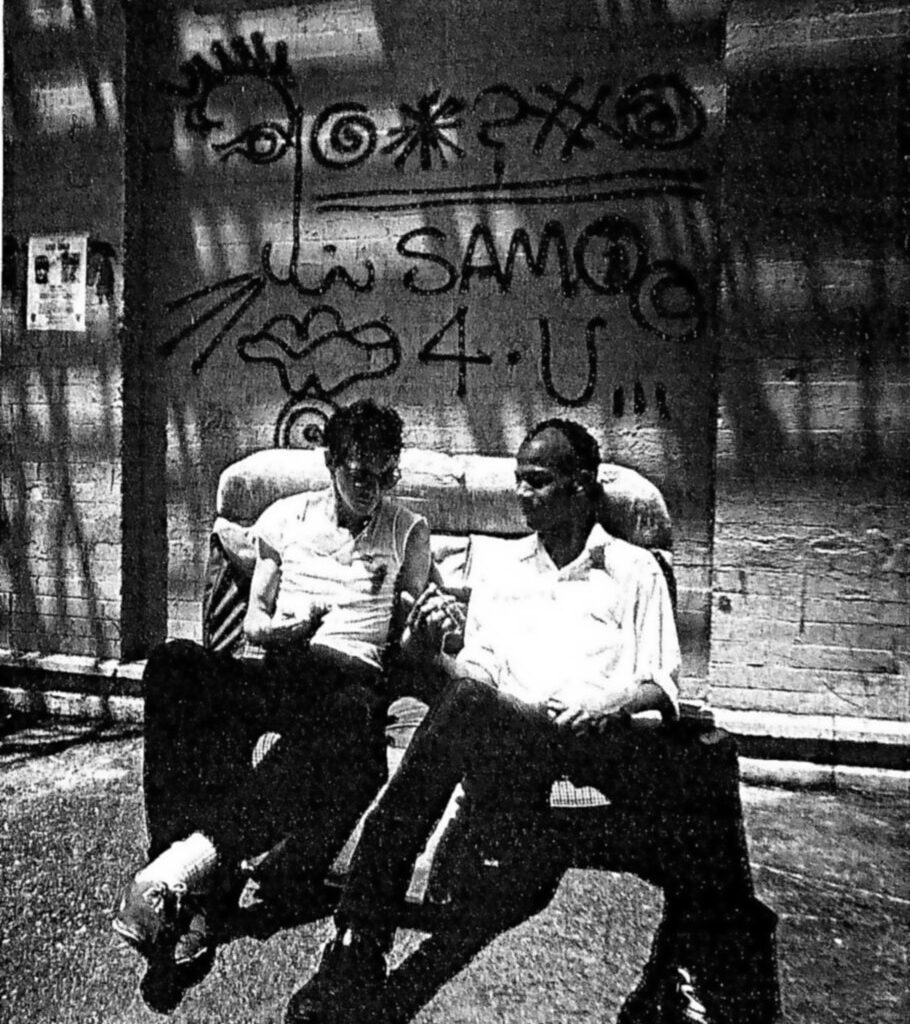
“Mostly, I think you can say consumerism and the idea of mass-produced individuality is what Samo© was making fun of. Thinking that you’re so unique when you’re just wearing a hip uniform kind of thing,” Al says. Al saw Basquiat elevate to a fine art world while Al remained on a street level, continuing his individual practice of tagging Bomb One across the city (a nickname he had gotten from “blowing up” on someone in a game of tag). “I worked for artists. I was around art from a very young age, but I wasn’t trying to be friends with Andy Warhol. I had no desire for that.”
Graffiti in many ways is similar to branding and identity making. The process of tagging is a kind of mark making, in an artistic and territorial sense, and tagging can be a way of creating a persona, an alias, an identity – one that can hold significant ideas. It’s also important in the way that citizens can sew something into the fabric of a city, to make private property feel more public. “I think it often is a way of claiming some sort of ownership: ’This is my area.’ For us New York graffiti artists, it was definitely that,” says Al. “It’s accessible in terms of adventure, camaraderie – delinquent, sneaky, risky behaviour. It gives you a sense of pride.”
10 years after Samo©’s resurrection from the dead, Al has switched his painting material from hype to legacy, especially in the shadow of Basquiat’s death, which has annoyingly followed Al his entire career. With news of a film titled Samo Lives coming out, which will chronicle the youth of Basquiat and Al (who will be played by Top Gun: Maverick’s Danny Ramirez), hopefully Al will get his long-due flowers, but nevertheless, he is doing it on his own terms. “This is a new era. It’s a more adult era, it’s more articulated, it’s an older voice,” says Al. “I felt it was my obligation to tell that story. And I can do it with authority, because there’s no other person on planet Earth that can tell you that story.”