
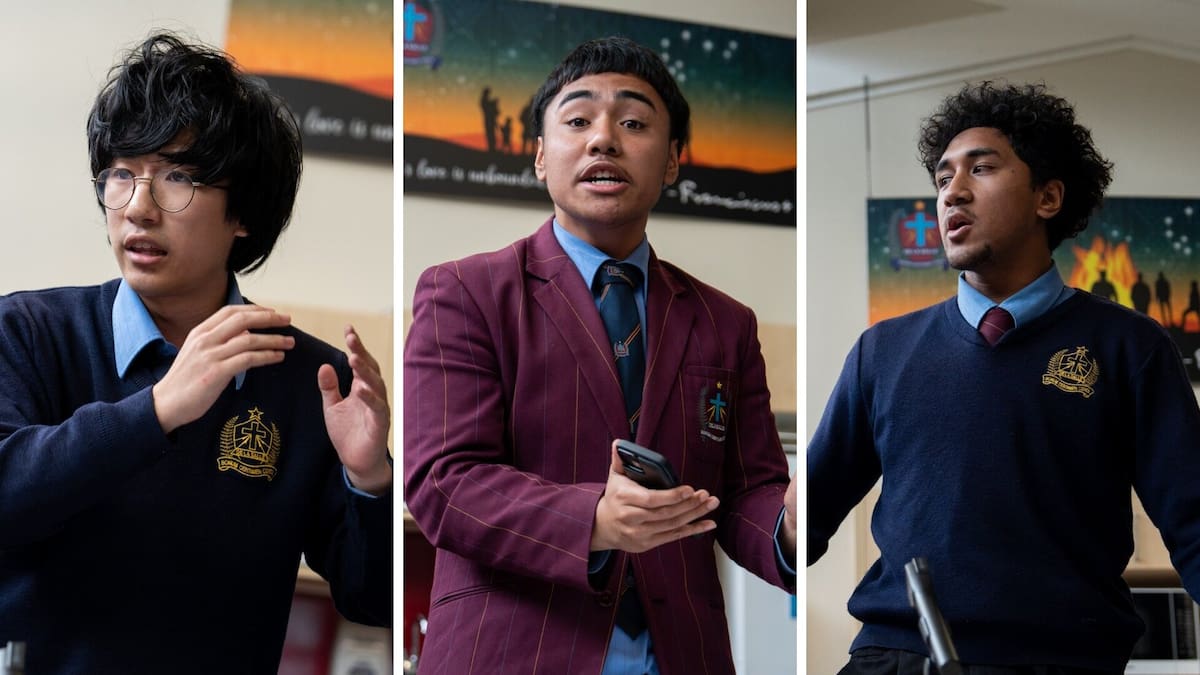
And the squad is on a roll.
Last year, at the Model United Nations Assembly that hosted 100 teams in Auckland, De La Salle took out the top three prizes.
Following that success, they flew to New York for the World International Model UN Assembly in February – and are now fundraising for the upcoming South East Asia Model United Nations in Thailand in January.
A special teacher with a familiar name
De La Salle principal Myles Hogarty told the Herald that teacher and debating coach Otto Wendt is the driving force behind the school’s 60-strong debating squad, and one of the secrets to their success.
Wendt is the nephew of literary giant Albert Wendt, one of the region’s most decorated novelists, poets and academics.
Year 13 student Elijah Wilson is one of De La Salle’s top debaters. Photo / Annaleise Shortland
“I never really gave much thought to the fact that Albert Wendt is my uncle, and that I hail from the same family lineage as renowned Pasifika writers such as Albert and Lani Wendt Young,” Otto Wendt told the Herald.
“Their work has always been a source of inspiration to me, not simply because of what they have written, but because of what their presence represents.
“They remind us of the power of seeing Pasifika people telling Pasifika stories.”
‘My critical thinking was getting better’
Year 13 student and academic prefect Elijah Wilson initially played rugby – but gave it up to focus on the one thing he was starting to get a real knack for: debating.
Leroy Lauvao presents his case as fellow students Tevita Lutui, Elijah Wilson and Frankie Truong watch on. Photo / Annaleise Shortland
“I realised I like talking about issues. I like arguing.
“At first, I was pretty nervous because I wasn’t good at speaking out. I was very shy … but then I saw my critical thinking was getting better.”
As part of their debating game plan, students expand their general knowledge by reading, researching and keeping up with current affairs.
“You have to know what you’re talking about,” Elijah said. He is preparing to study for a conjoint law and commerce degree at Auckland University next year.
He also made a point of acknowledging Wendt, who he described as a teacher who truly cared for his students.
“We were always known as the rugby school or sports – they always outshone the extracurriculars and the academics.
“But over the years, our success in debates with Mr Wendt … competing and actually winning events, we’re starting to become more known for debating.
“I think that’s good because it shows other people, specifically brown people, that you’re not just set to play a sport. You can do other things like debating.”
De La Salle’s head debate teacher Otto Wendt is also a De La Salle old boy and member of a prominent literary family. Photo / Annaleise Shortland
Of the 982 boys who attend De La Salle, 95.2% are of Pacific descent – and the champion squad is known for its island humour and wit in competition, Wendt said.
“Nothing is watered down. They bring their South Auckland flavour to debating. They revel in their identity and don’t have to put it aside to succeed in debating.
“As amazing as they are on the sports field … and the cultural spaces at PolyFest, they can do the same in debate.”
Since 2018, the school has achieved regular success in Auckland-based competitions in particular.
Its junior teams are just as good as the seniors. Last year they made the grand final – up against 40 teams from 18 schools – in the Junior Championships, eventually won by Saint Kentigern College.
Wendt believes debating is, at its heart, storytelling.
“It’s the ability to stand before others and say: This is what I believe. This is what I have seen. This is how I understand the world. And my voice deserves to be heard.
“Oratory is not something we need to introduce to Pasifika young people. It is already within us. For centuries, our ancestors have used language to preserve histories, pass down knowledge, resolve conflict, challenge ideas, celebrate achievement and strengthen communities.
“Long before our young people ever stood behind a lectern in a debating competition, they came from cultures where the spoken word carried immense mana.”
The success is contagious
Auckland Schools’ Debating chair Zachary Wong said diversity is important in debating, showcasing perspectives from all parts of society.
De La Salle senior student Iosefo Tominiko gives an impassioned argument. Photo / Annaleise Shortland
“Debating is about being persuasive and people can be persuasive in really different ways – a kind of humour, different perspective or a strong emotional storytelling piece is really important for that success.”
Wong said De La Salle’s success has created a ripple effect on other South Auckland schools – others have now started debating teams.
Last year, the Southside Debating Competition was launched – an interschool debating tournament for South Auckland secondary schools. Participating schools this year included Tangaroa College, Manurewa High, Māngere High, Papatoetoe High and Pukekohe High.
De La Salle principal Myles Hogarty described the debating squad as a beacon for the college. The boys involved were inspiring role models for younger students, he said.
He acknowledged that Pasifika cultures and history were steeped in oratory traditions, so it made sense that the boys could hold court.
“They put in the hard work. They come in on the weekends, stay in the evenings to practise and get tutored by some of our old boys. It’s a perfect example to the rest of the school about what hard work does for you – you get the results.”
Hogarty said Wendt’s passion for debating was behind the students’ ultimate success.
“I hesitate to say I’m surprised that these guys are good – why shouldn’t they be good? They’re as good as any kid in Auckland. Well, they’re better, actually, because they’ve won everything.”
Vaimoana Mase is the Pasifika editor for the Herald’s Talanoa section, sharing stories from the Pacific community. She won junior reporter of the year at the then Qantas Media Awards in 2010 and won the best opinion writing award at the 2023 Voyager Media Awards.