
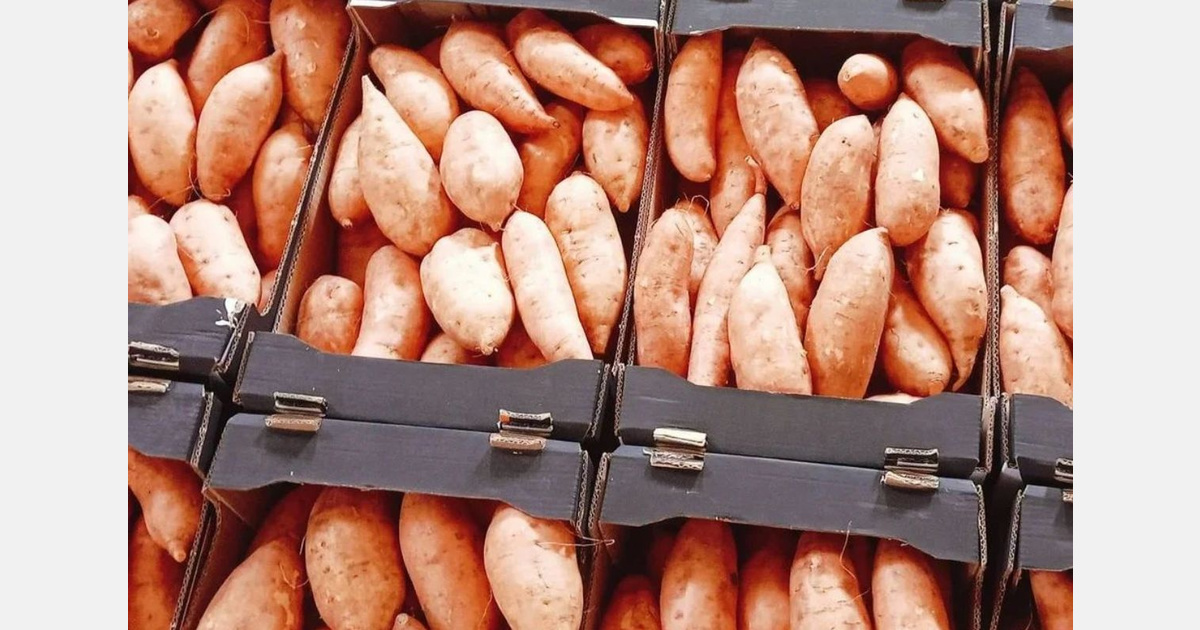
Egyptian sweet potato exports have surged while global production has contracted sharply for two decades, and Egypt now lands more volume in Europe than any other origin. Ahmed Hassan, Managing Director of South Perspective Advisors LTD, explains the structural shifts behind this, how the market is structured, and what lies ahead for Egyptian exporters and European importers alike.
China’s retreat, Africa’s rise
“Between 2005 and 2024, global sweet potato production fell from 127.8 million tonnes to 90.9 million. That is a contraction of almost 29% in nineteen years. Behind that curve, almost everything about this crop has changed,” Hassan says.
The major change lies in China’s production decline, he points out. “Chinese production fell from 102.5 million tonnes in 2005 to 51.4 million in 2024. China’s share of global production has fallen from 80% to 56%. This is not poor performance, but the reallocation of land to higher-value uses as the country becomes wealthier.”
 © SPA
Africa has grown into part of that space, he adds. “African production doubled over the same period, from 14.2 million tonnes to 28.5 million. But it is worth being precise about the scale: Africa added 14.4 million tonnes while China gave up 51.2 million. Africa has replaced a little over a quarter of what China withdrew. The world genuinely has less sweet potato than it did; and almost none of the African tonnage reaches international markets in any case.”
Hassan is careful not to draw the obvious conclusion. “That contraction did not create the current position of Egyptian origin in the European market, and I would not claim it did. The Chinese decline was domestic staple production leaving the land; it never touched this trade. Europe’s appetite grew on its own – EU and UK imports were up 9.5% in 2024 – and Egypt happened to be ready.”
Where the value sits
As for where the value is concentrated, Hassan points to the Netherlands: “On UN Comtrade figures, the Netherlands imported 189,415 tonnes in 2024 at an average of $0.82/kg and exported 157,512 tonnes at an average of $1.15/kg. The country re-exports roughly 83% of everything it imports, on a spread of $0.33/kg. The Netherlands is the world’s leading exporter of sweet potato by value, at around $181 million, even though it barely grows any itself.”
 © Youness Bensaid | FreshPlaza.com
He stresses that this spread is not simply a margin to grab by bypassing the middleman. “It covers substantial costs: consolidation of product from multiple sources, the cold chain and large-scale repacking, practical knowledge of a dozen destination markets, and the assumption of inventory and credit risk that the buyer would otherwise carry on its own balance sheet. None of this is specific to this crop, and the situation persists because the conditions that give rise to it – fragmented supply at origin and fragmented demand across Europe – also persist.”
Egypt’s position still surprises many in the industry, Hassan continues. “The United States export more sweet potato by volume than any other country and realizes $0.77/kg. Yet in the market, Egypt now competes on delivered cost as well as on volume. Across the three seasons to August 2026, British customs data puts Egyptian fresh sweet potato at £0.53 per kilo landed against £0.65 for American product, with Egypt at 48% of UK imports against 39% for the United States. And in calendar 2025 Egypt became Britain’s largest supplier outright for the first time, at 51% against 35%. The story is not that Egypt is cheap. It is that Egypt has become the default origin while still being read as the budget one.”
Hassan says last season’s figures support his reading. “The Egyptian General Organization for Export and Import Control reports that 355,069 tonnes of sweet potato were exported during the 2024–25 season, a 54.1% increase on the previous season, with the European Union accounting for nearly 56% of the total – and GOEIC counts the United Kingdom separately, outside that figure. The area under cultivation has risen 33.3% since 2021, and production 16.8%.”
 © SPA
That share can be checked from the other side of the trade, Hassan continues. “European customs records for the same season show 194,903 tonnes arriving in the EU-27 from Egypt, which is 54.9% of GOEIC’s total – within a point of what Cairo reports. Add the 57,274 tonnes Britain recorded, and Europe as a whole took about 71% of everything Egypt shipped that season. Two independent statistical systems agreeing to within a percentage point is rarer than it should be in this trade.”
“The published statistics on Egypt disagree with each other, and in both directions. FAO’s series has Egyptian production at well under half a million tonnes, which cannot be reconciled with exports of 355,000 – and Egypt’s own customs return to UN Comtrade for 2024 shows 128,000 tonnes of exports when European import records alone show nearly 199,000 tonnes arriving from Egypt that year. Anyone working from a single source on Egypt will get the wrong answer. The mirror data – what importing countries record receiving – is the number I trust,” Hassan continues.
“The next decade will not reward passivity”
Looking ahead, Hassan envisions a market that will “not tolerate passivity.” He argues, “If production stabilises and grows at around 1.2% a year from here, the world reaches roughly 104 million tonnes by 2035, still well below where it stood in 2005. This is not a wave just anyone can ride. For twenty years suppliers succeeded by being responsive, while Europe was discovering this crop and China was pulling out. From now on, growth will not make up for anyone’s mistakes.”
Hassan addresses his advice directly to Egyptian suppliers: “Grading discipline determines who will be able to sell their volume. The shift of Class II into processing, foodservice and the ethnic trade is not a downgrade; those are the segments the volume is heading for. Same dry matter, same colour, irregular size: none of it matters once the product is peeled and cut. A supplier offering only Class I in cartons is fighting for the smallest share of a slow market.”
The second half of that advice concerns timing rather than grade, he adds. “Programmes take priority over the spot market, and the calendar is ruthless. European buyers set their programmes months before the season opens. Arriving at the start of the season means fighting over what is left. In Britain, the window is still narrow: Egyptian arrivals run from August, peak between September and January – 68% of the year’s volume – and are close to absent from May to July, which is 4% of it. June alone is a third of one per cent. American supply runs on exactly the opposite calendar; October is Egypt’s largest month and the month American arrivals bottom out. The two origins do not so much compete as hand over to one another, and knowing which half of the year you are selling into changes the entire conversation.”
The window is no longer where it was
The one thing Hassan says has changed materially in the past two seasons is the shape of the Egyptian year in continental Europe. “On the mainland the narrow window is already going. Egyptian arrivals into the EU-27 between April and July were 14,398 tonnes in 2024, 31,437 in 2025 and 93,030 in 2026. That is six and a half times in two years. May alone went from 3,352 tonnes to 34,667.”
He explains what that means. “Two seasons ago the April-to-July shoulder was 17% of Egypt’s EU volume; last season it was 30%. Storage and curing are what did it, and the effect is that Egypt is no longer only a winter origin on the continent, even though it still is in Britain. If you are a European buyer who has always treated Egypt as a September-to-January supplier, that assumption is now a season out of date. And if you are an Egyptian exporter still selling only into the old window, you are competing in the most crowded part of your own calendar.”
 © SPA
As for whether the structure of the trade ( being value concentrated in redistribution rather than production) is likely to change, Hassan is cautious. “I don’t expect conditions to shift significantly in the short term. What a supplier at origin can take is narrower than the spread and more durable than it: grade discipline, and being early enough to be in the programme.”
As for his own role in the sweet potato value chain, Hassan specifies, “The produce is exported directly by our company in Egypt, which packs and ships at origin. At South Perspective Advisors Ltd, registered in the United Kingdom, we handle marketing and the commercial relationship in Europe, and advise on market access, specifications and trade finance. Buyers can contract with us in the United Kingdom or directly in Egypt, whichever suits their procedure. Sweet potato is among the many products we market.”
For more information:
Ahmed Hassan
South Perspective Advisors
WhatsApp: +44 7310 299839
Email: [email protected]
www.spadvis.com/sweet-potato