
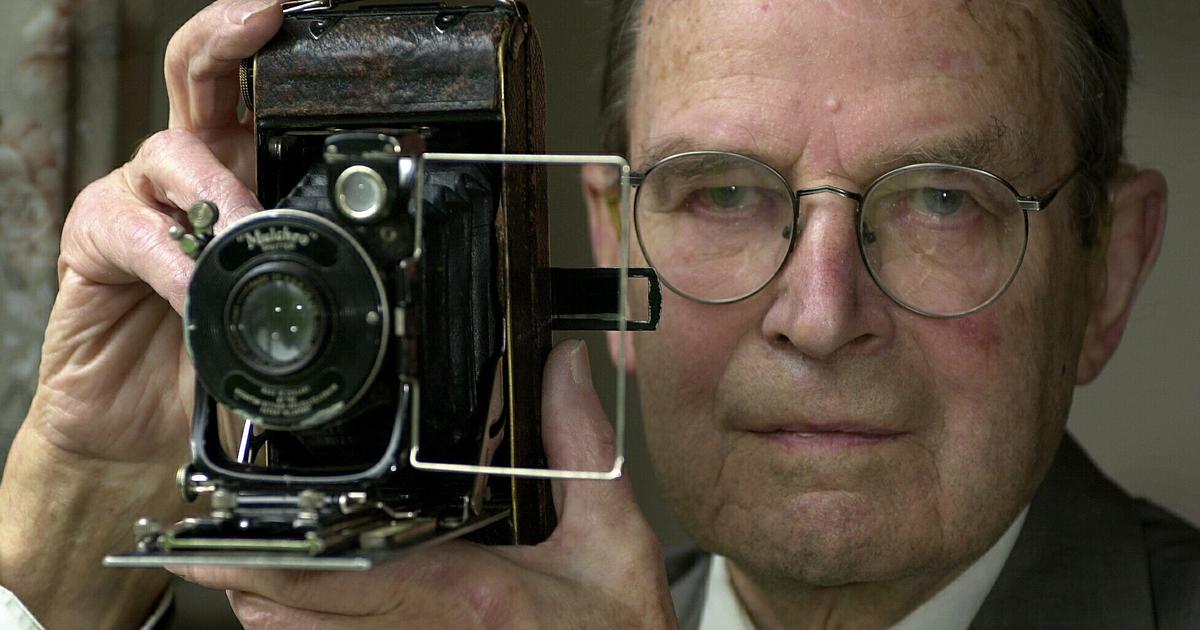
Many of you will have known or heard of George Plunkett, a true gentleman and a photographer, who took thousands of pictures of Norwich and across Norfolk during his lifetime.
Over the years he helped me time and time again with information about various “mysterious” photographs and newspaper cuttings from readers.
A picture George Plunkett took of Bawburgh Hall, which was built for the Jerningham family and stood from 1634 to 1963 (Image: George Plunkett)
He was a familiar figure on his bicycle – he didn’t drive – taking pictures of the city and county.
Often buildings, landmarks or streets due to be demolished in the name of “progress,”
George Arthur Frank Plunkett was born in the city during 1913.
His father Frank made cardboard boxes for the shoe trade while his mother Lily collected insurance premiums door-to-door and took in sewing and dressmaking.
The ruins of St Lawrence Tower and the east end of St Mary’s Church in South Walsham. The 14th century tower collapsed in 1971 (Image: George Plunkett)
In 1925 George won a scholarship to City of Norwich School before starting work as a junior clerk at Norwich Public Health Department in Churchman House, St Giles Street, where he spent more than 40 years.
Then in 1931 he acquired a box camera and began taking photographs across the city.
He soon wanted better equipment and persuaded his father to buy an Esign Carbine No 7 folding camera for his 19th birthday.
It cost over £5, almost a month’s wages, and lasted for no less than 75 years during which he took more than 8,500 photographs.
During the Second World War he served with the RAF in North Africa and Italy before returning to work at the Public Health Department where he met and fell in love with Margaret (Peggy).
They were married and had two sons, Philip and Jonathan.
George was an award-winning member of the Norwich and District Photographic Society and a prominent member of the Norfolk and Norwich Archaeological Society.
He was also an excellent writer and historian.
The fishing fleet from the Haven Bridge in a photograph George took in 1933 (Image: George Plunkett)
He kept a huge collection of articles in the Evening News over the decades and George was always ready to help historians in their work.
During his lifetime George was able to take photographs which illustrated how the city and county were changing over the decades.
Looking west from the top of Norwich Cathedral Spire (Image: George Plunkett)
While he accepted there was a need for “slum clearance” in the city George believed too many fine buildings were demolished in the name of progress.
In 1987 his first book Disappearing Norwich was published followed by Rambles in Old Norwich and following his death in 2006 Plunkett’s Pictures of Norwich and Norfolk was published.
A photograph of the Norwich Hippodrome on St Giles’ shortly before it was demolished to make way for a multi-storey car park in 1960 (Image: George Plunkett)
His son Jonathan said: “Father was a loving, gentle and kind man and we all miss him.
He was also a man who loved Norwich with all his heart.”
A surface brick shelter being built in the Haymarket, Norwich, before the Second World War. What would Sir Thomas Browne think? (Image: George Plunkett)
You can see for yourself.
Jonathan established a website so we can all enjoy looking at his wonderful photographs.
Just click on georgeplunkett.co.uk.