
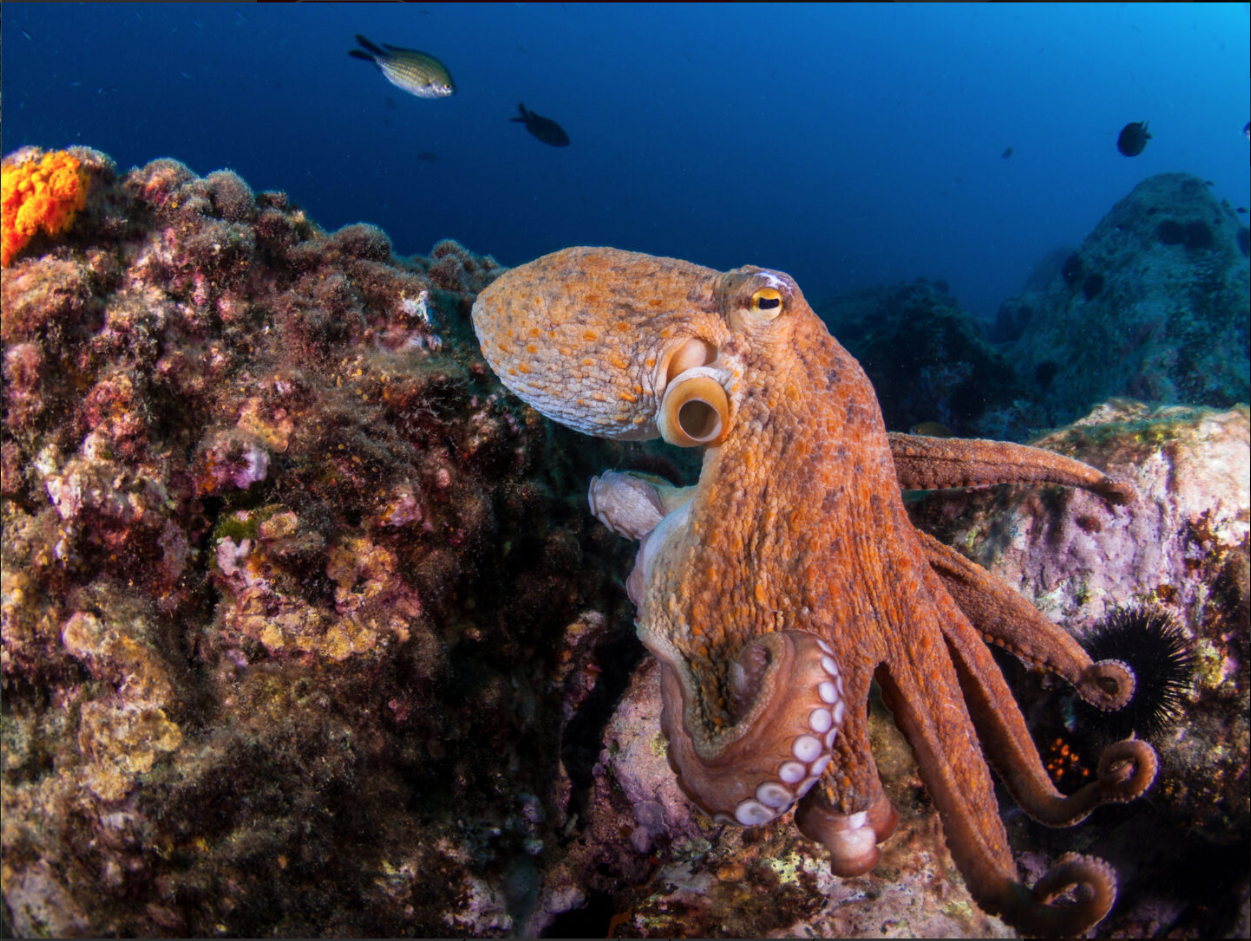
 Uploaded to DailyKos by Ed Tracey
Here at Top Comments we strive to nourish community by rounding up some of the site’s best, funniest, most informative commentary, and we depend on your help!! Here’s how to submit nominations in DK6: If you see a comment by another Kossack that deserves wider recognition, please send it either to topcomments at gmail dot com or via kosmail to topcomments- either search for user @topcomments, or click that link then click “send message”!) by 9:30pm Eastern for inclusion in that day’s diary. Please, please include a few words about why you sent it in as well as your user name (even if you think we know it already :-)), so we can credit you with the find! It’s especially helpful if you include a link to the comment you’re nominating… hover over the comment and you’ll see Share and Report options. Click Share, then choose ”copy url” and paste that into your message to us.
Certain species of octopus are known to be extremely intelligent, based on their behavior. They can figure out how to open jars and solve puzzles, and in captivity, they douse nearby humans by aiming their jets with remarkable accuracy. I read a book, Other Minds by Peter Godfrey-Smith, which points out that octopi are the only non-vertebrate organisms to display intelligence, and because the architecture of their nervous systems are so different from vertebrates, they could be the closest example of an alien intelligence that can be found on Earth. Unlike vertebrates, who have all their cognitive abilities localized in one central location (the brain), which then communicates with the rest of the body through nerves, the full nervous system of octopi is widely distributed throughout their bodies as semi-independently operating ganglia. Hence, the right tentacle may not know what the left tentacle is doing.
The question of how and why the octopus in particular managed to evolve intelligence, however, remains. There are two recent studies that offer possible clues. One of these was recently published in Current Biology, and featured in Scientific American. This story starts with the discovery that the sequence of a certain strand of RNA associated with the ribosomes of octopi display a mutation never seen before. In all other organisms for which this piece of RNA has been studied, the RNA sequence is identical. For octopi, it’s different.
Ribosomes are the molecular machinery within a cell that manufactures proteins. Enzymes within the nucleus of a cell read a segment of DNA coding for a needed protein and transcribe the code to a segment of RNA (called messenger RNA, or mRNA). The mRNA is sent out of the nucleus to the ribosomes, which then read it as the instructions for making a particular protein. However, just like full-scale manufacturing, the ribosomes can make mistakes resulting in useless proteins. Groups of these bad proteins may then clump together into aggregates that are often toxic to the organism.
Remarkably, the mutation that has occurred in octopi, and apparently nowhere else, causes the output of their ribosomes to be much more accurate than any other organism. When the corresponding gene was inserted into E. coli, the bacteria produced far fewer aggregates of bad proteins than it normally does.
But what does the accuracy of protein production have to do with the evolution of intelligence?
Though the advantages are obvious, it’s unclear why octopuses alone evolved this rRNA break. It seems exclusive to shallow-water octopus species, which split off from their deep-water counterparts roughly 100 million years ago to colonize a highly complex environment. Faced with more predators, prey and competition, their nervous systems rapidly ballooned to meet the new demands. And neurons, being long-lived, are especially vulnerable to protein clumps, according to the new study’s co-lead author Rishav Mitra, a postdoctoral fellow in Bellono’s lab. By preventing misfolded proteins, he says, the rRNA break “might help these neurons to work well.”
It is also noted that the growth of octopus intelligence happened only after this mutation occurred, which suggests that the mutation made the evolution of intelligence possible, or at least easier. Otherwise, there is no obvious direct connection. However, the authors do note that a number of neurological diseases in humans, such as Alzheimer’s and Parkinson’s, are associated with clumping of misfolded proteins. It may be possible to apply the results of this research to treat these diseases.
The second bit of research into the possible origin of octopus intelligence has to do with the various ways that DNA arrange themselves within the nucleus, and ultimately lead to reshuffling of genes into unexpected locations and associations. This research was published in Nature Communications and featured in phys.org and Yahoo News.
It is well known that DNA forms a double helix, but in order to fit into the cell nucleus, that double helix has to be bundled and wrapped in other ways as well. Hundreds of millions of years ago, the common ancestor of octopi, squid, and cuttlefish changed the way it stored its DNA in three dimensions, such that genes that, in other organisms, are located far apart from each other were placed in close contact. One of these unrelated genes could then jump from its current location to be next in sequence to the other one. As such, the locations of various genes in these cephalopods are often quite different from where they are found in most other species, and this kind of genetic reordering could have a profound effect on how the organism evolves. The researchers called this effect regulatory entanglement.
The team mapped the folded DNA of a bobtail squid, a cuttlefish, and a California two-spot octopus. The broad layout of the DNA stayed largely the same across all three. The smaller connections between distant DNA spots differed widely between species, body tissues, and stages of development, and many sat near genes tied to key cephalopod traits, including the nervous system.
The octopus stood out. Its DNA showed signs of more rearrangement than the squid and cuttlefish, which the authors say created more connections between regions that once sat far apart.
Thus, the higher level of regulatory entanglement in octopi may have been a stronger driver to increase the size and flexibility of its nervous system, resulting in a creature with a high level of intelligence.
However, the broader message of this research is that the 3-D structure of how the DNA is stored can have an unexpectedly profound effect on the function of those genes, and on the evolution of the species.
On to the Comments:
From brillig:
In kos‘ unsettling diary Daily Kos targeted by Iranian propaganda effort, A Citizen had supremely good advice about trust and diaries.
Comment link in case my embedding it borks: https://www.dailykos.com/stories/2026/10/9/800109870/announcements/daily-kos-targeted-by-iranian-propaganda-effort/?__vfz=medium%3Dcomment_share%7Csharer_uuid%3D00000000-0000-4000-8000-0a012e756c65#vf-01a1220b-f35f-78c4-8667-5e3565870204
From A Pagan in Arizona:
This comment from Steveoreno on Pedro Molina’s cartoon calling out rape culture in the US.
Diary: https://www.dailykos.com/stories/2026/10/10/800108453/cartoon/not-just-boys/
We’ll get straight to the point: The financial hardships that Daily Kos is facing this year are tough.
We continue to be paywall-free. We continue to be supported by our readers, not billionaires or corporations. But we need to bring in more revenue. We are leaning on our community more than ever to help make ends meet.