
Loper said department staff obtained a search warrant for Bolingford’s address, and found “several supermarket meat trays packed with dolphin flesh” in a freezer.
Bolingford told the Herald he did not believe he had done anything wrong.
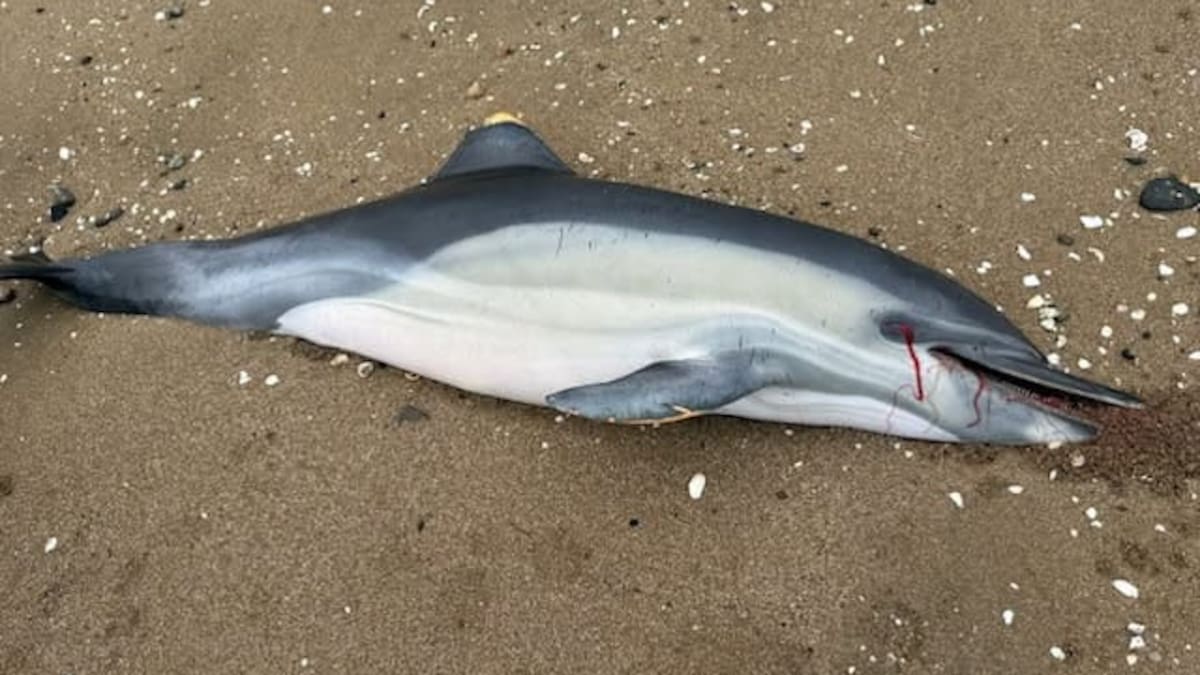
The butcher and recreational fisher said after finding the dead dolphin on the beach, he tried to return it to the ocean and cut two pieces of flesh from it “so it would sink”.
He said he threw one piece into the ocean and took the other home for “mouse traps”.
“I cut it off on one side and cut it off on the other side so that it would not float in the water,” he told the Herald.
The beach-cast dolphin at Thornton Bay in Coromandel before its flesh was removed. Photo / Department of Conservation
Loper disputed Bolingford’s account and said he had “changed his story” several times.
“When he was challenged by members of the public, he stated he believed the animal was a shark – a claim he later revised to suggest he believed it was a tuna.
“He also claimed to have returned the animal’s remains to the sea, which was clearly not the case. He initially said he’d taken the animal’s parts for fish bait, which he later changed to claim it was for mouse traps.”
Loper said the dolphin flesh recovered from Bolingford’s property weighed 2.71kg. Bolingford disputes that amount.
“Photographic evidence obtained by DoC and the post-mortem clearly showed the animal was a dolphin and the physical evidence located at his property demonstrated he had taken much more than ‘the two little pieces’ he has claimed,” Loper said.
Common dolphins found in New Zealand waters belong to the species now known as the short-beaked common dolphin. Photo / Alan Gibson
Loper said it is a breach of the Marine Mammals Protection Act 1978 to touch or interfere with any part of a dead protected marine mammal.
Bolingford said he wasn’t aware of the rules and believed he was doing the “right thing” to protect the community from the dead animal.
“They’ve got dogs and [the dead dolphin] could’ve poisoned one of the dogs or damaged one of their children.
“Common sense would tell you, throw it back in the water.”
Bolingford, who is Ngāi Tahu, said his decision to move the dolphin was also influenced by advice from his grandmother that such animals “belong in the sea”.
“If I hadn’t done anything with that, she would have turned over in her bloody grave.”
While Bolingford said he returned the dolphin to the ocean, Loper said a witness reported seeing him drag it to the water’s edge and leave it at the high-water line.
After the dolphin parts were recovered, Loper said the man “contacted local iwi about taking the pieces of the animal”.
“Their representative made it clear they did not support his actions and that he should not have done so.”
Loper said that at the conclusion of the investigation, two $400 infringement notices were issued – “one for taking the meat from the dolphin and one for possessing it”.
Loper said DoC staff “take an extremely dim view of this type of offending”.
“We’re astonished and disappointed the man felt he had the right to do this.
Bolingford said he had sought advice about challenging the infringement notices.
Loper said anyone who found a dead protected marine mammal on a beach should call 0800 DOC HOT so staff could liaise with iwi on the appropriate response.