
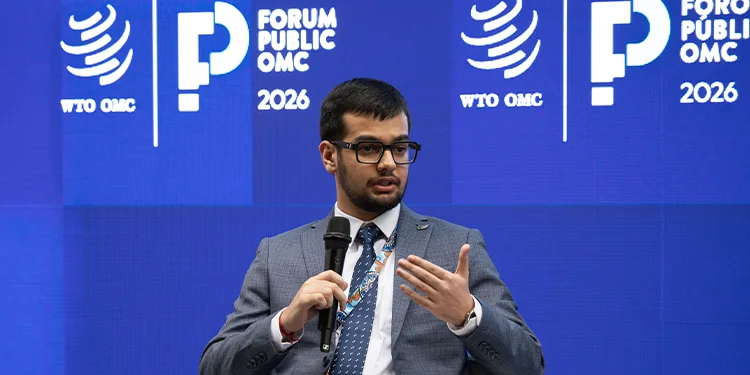
Akshat Sharma grew up moving between schools in rural Himachal Pradesh, India, as his mother’s teaching assignments took them across the state. The schools changed. The approach rarely did.
“Every school looked the same on the inside—different buildings, different teachers, same everything-is-theory structure,” he recalls. “I was a curious kid who wanted to build things, do things practically, not just memorize them. That door just never opened, no matter which school I walked into.”
Raised by a single mother who supported him through every move, Sharma began addressing that gap at 17. Nearly four years of research, relationship-building, and testing in schools led to Brevon Education—the education technology company he formally incorporated in February 2025. Today, his mother serves as Brevon Education’s director.
Sharma’s work has taken him from classrooms in India to projects with the United Nations and, eventually, the World Trade Organization Public Forum in Geneva. It wasn’t a straight path. But one experience helped him bring greater structure to the work he was already pursuing: Harvard Business School Online’s Core Business Essentials program, formerly known as the Credential of Readiness (CORe).
The program combines three foundational courses—Business Analytics, Business Strategy, and Financial Accounting—with workplace-dynamics lessons and a capstone project. For Sharma, who passed the program with High Honors, the coursework became a set of practical tools he could apply while continuing to build a company, lead international work, and manage the demands of a growing portfolio of commitments.
Diving Into HBS Online Without Pressing Pause
By the time Sharma discovered Core Business Essentials, he was already putting his ideas into practice.
Brevon Education delivers a 10-year AI and robotics pathway, comprising 212 project-based modules across 14 grade-level tracks, to Central Board of Secondary Education schools. Students build increasingly sophisticated skills as they progress: A Grade 1 student might begin by building mechanical systems, while a Grade 7 student could train AI vision models, and a Grade 10 student could deploy an autonomous system. The fee-based, grant-independent model is designed so the program can serve school communities with vastly different resource levels.
Before Brevon Education became a formal company, Sharma spent years researching the education gap, building relationships with schools, and learning what worked. Once the company incorporated, he continued to handle nearly every part of the business himself—from compliance, pricing, and sales to teacher training, delivery, and ongoing support.
At the same time, Sharma was leading international campaigns for the United Nations and building analytical systems for the United Nations Development Programme (UNDP).
He wanted a stronger grounding in business—but stepping away from that work to pursue a traditional degree wasn’t an option.
“Core Business Essentials gave me actual Harvard-level rigor in a format that let me keep building while I learned,” Sharma explains. “I could test what I’d just studied against live work within days.”
Financial aid helped make that opportunity possible. With Sharma self-funding his venture, an 80 percent discount made the program more financially accessible.
“I’ve always thought of it as Harvard betting on me,” he says. “I wanted that bet to pay off, so I made sure I actually used what I was learning—not just completed it.”
Turning Business Theory Into Better Decisions
The courses did more than add new concepts to Sharma’s toolkit. They gave him language and structure for instincts he had developed through years of building Brevon Education under real-world constraints.
Business Analytics changed how Sharma evaluates information by introducing him to hypothesis testing.
“Stop asking what the data shows; ask what it actually proves,” Sharma explains. “Understanding that correlation isn’t causation changed how carefully I read my own program results.”
Concepts such as willingness to pay and willingness to sell also gave Sharma a framework for understanding earlier business decisions.
“I set Brevon’s pricing purely out of constraint,” Sharma says. “Rural schools couldn’t pay Delhi or Mumbai prices, so I had to find something that worked. Studying willingness to pay and elasticity later gave me the theory for what I had already lived. Then I watched the same idea play out on a completely different scale.”
Financial Accounting felt just as relevant to Sharma’s experience as a founder. The cash flow statement, in particular, was not an abstract accounting exercise. It reflected the day-to-day reality of keeping a growing business running.
“Your operating cash flow is often negative when you’re starting out,” he notes. “So, survival is a financing problem and an efficiency problem, happening at the exact same time.”

Akshat Sharma
Bringing HBS Online Lessons to the United Nations
The most direct test of what Sharma was learning came during his Core Business Essentials journey, when he took on a major analytical project for the UNDP’s Regional Bureau for Arab States.
Working across a multimillion-dollar, 20-country program spanning governance, gender equality, conflict prevention, and climate security, Sharma built a system connecting individual project outputs to broader regional goals. He then developed a dashboard that senior leaders could use to monitor progress, identify gaps, and allocate resources.
Business Analytics changed how Sharma approached the work from the ground up.
“I stopped treating the mapping as documentation and started treating it as diagnosis,” he explains. “Before, I might have just recorded that an output had happened. After, I was asking whether that output actually moved the needle on the outcome it was meant to serve—and flagging clearly where it didn’t, rather than letting activity quietly stand in for progress.”
Across a 20-country portfolio with widely varying reporting quality, that distinction mattered.
“It’s the difference between a dashboard that looks busy and one that’s actually honest,” Sharma says.
His host supervisor’s official evaluation rated every dimension of his work “Excellent,” specifically noting how he went beyond meeting requirements to identify opportunities for improvement.
“That’s proof of something,” he reflects. “Studying the material and using it in the same breath.”
Learning Without Stepping Away From the Work
Like many founders who enroll in HBS Online courses while running active businesses, Sharma found that the format didn’t compete with his work—it accelerated it.
The fully online structure allowed him to fit his studies around United Nations deadlines, Brevon Education’s operations, and the demands of building a company. More importantly, he could apply what he learned almost immediately.
Applying Business Insights on the World Stage
The strategic thinking and analytical discipline Sharma developed through Core Business Essentials soon carried into one of his biggest career opportunities: the World Trade Organization Public Forum in Geneva, where he served as one of seven WTO Young Trade Leaders selected from more than 1,300 applicants worldwide, representing India.
The lessons from Core Business Essentials shaped how he approached the opportunity. Instead of starting with assumptions about what prevents small businesses from competing globally, Sharma argued for identifying the barriers through data first. It was the same evidence-first mindset he applied while building the UNDP dashboard: understand the problem before designing the solution.
“Prove where the real barrier is before you propose a fix,” he explains. “That’s genuinely what I argued in Geneva.”
That approach informed his thinking about education and global trade as well. Instead of assuming what prevents education services and innovations from reaching new markets, Sharma advocated for first understanding where regulatory, financial, and other barriers exist.
Ideas around willingness to pay helped Sharma understand why promising innovations can struggle to reach new markets. A product designed to be affordable in one market, for example, can quickly become too expensive when tariffs, regulatory costs, and legal uncertainty are added.
At the Public Forum, he served as a discussant for “Back to the Future: Lessons from the Uruguay Round,” a session reflecting on the negotiations that ultimately led to the creation of the WTO. He also joined his fellow Young Trade Leaders for a panel on accelerating growth through services trade and met with the WTO director-general and several deputy directors-general.
For Sharma, being in those conversations represented more than a professional milestone.
“I found myself sitting beside a former WTO deputy director-general and the actual negotiators who built this institution,” he reflects, “being asked—as someone who grew up nowhere near a room like that—to help critique it constructively. This is the kind of place I always saw myself going, because I believed in myself, in the work I put in to get here, and in having something real to contribute—not just for my own path, but for something bigger than me.”
Finding the Language to Lead in Bigger Rooms
Ask Sharma about Core Business Essentials’ greatest personal impact, and he doesn’t point to a specific framework or course module. He points to a shift in how he could articulate ideas and instincts he developed through years of experience.
“Core Business Essentials gave me a real language for instincts I’d already been carrying for years—and let me use that language in front of people who’ve spent entire careers in trade policy and economics,” he says. “’I know this works’ became ‘Here’s exactly why, and here’s the proof.’ That shift is what changed which rooms I actually get to walk into now.”
That confidence extended to how Sharma represented himself and his ideas on the world’s most consequential stages—from his work with the United Nations to WTO panel discussions and conversations with global trade leaders.
“That combination—the instincts I built the hard way and the frameworks that finally named them—is the actual reason a kid from a village classroom in Himachal Pradesh ended up on a panel at the WTO,” he says. “I finished this program right in the middle of that whole stretch happening. That’s not a coincidence.”
Moving From One Opportunity to the Next
Sharma sees the influence of Core Business Essentials extending well beyond any single project or stage. The frameworks he developed have become part of how he builds Brevon Education, approaches international program work, and thinks about the future of education technology.
His advice for anyone who sees HBS Online programs as financially or professionally out of reach is simple.
“Financial aid exists for exactly the person I was—self-funding something real, with zero room to waste anything,” he says. “Don’t let the price tag be the reason you never ask. And don’t let your title stop you either. I took this while still building a company from a small office in Himachal Pradesh—not from anywhere that looked ‘ready’ for Harvard.”
Reflecting on his decision to enroll in Core Business Essentials, Sharma offers another tip: “The right time to start never really arrives on its own. So just start.”
A village classroom in Himachal Pradesh. A company built from the ground up. An 82-country UN youth campaign. A regional dashboard built for the United Nations. And, eventually, a seat at the table in Geneva. HBS Online didn’t create that path for Sharma, but it gave him new tools, frameworks, and language to help navigate where it led next.
Looking to build the business fundamentals to match your real-world instincts? Explore Core Business Essentials and download our brochure to learn more about the program. Interested in enrolling in an HBS Online program but concerned about affordability? Explore HBS Online’s payment and financial aid options to find a path that works for you.