
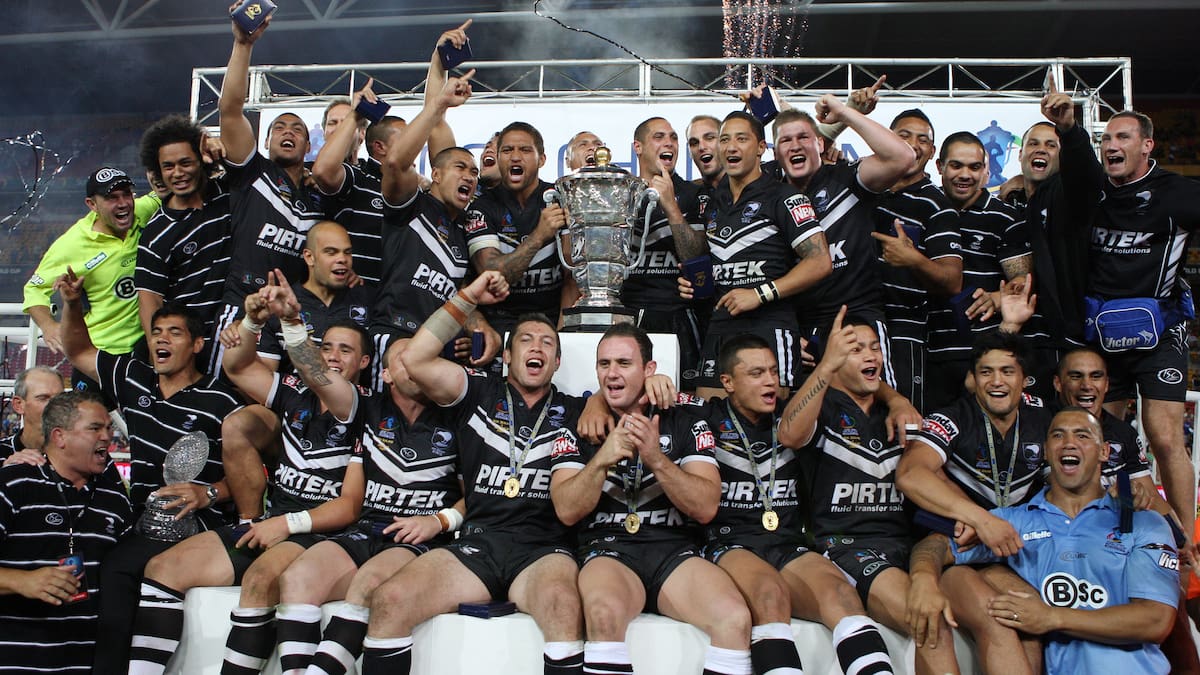
Nobody gave the Kiwis a chance when they ran out on to Suncorp Stadium to contest the 2008 Rugby League World Cup final against Australia.
They were paying more than $6 to win in some markets, and 20-1 to win by more than 13 points. Australia were paying as little
as $1.11, which was understandable, considering they assembled one of the best teams ever on paper.
Billy Slater, Israel Folau, Greg Inglis, Darren Lockyer, Johnathan Thurston, Cameron Smith, Petero Civoniceva, Glenn Stewart and Paul Gallen were just some of the names on the team sheet. Future legends and immortals filled their side and the odds were heavily in their favour for a 10th World Cup crown.
But sport is the ultimate form of reality TV and the script was flipped on its head to go down as the greatest night in New Zealand rugby league history, with the Kiwis claiming a 34-20 win to win their first and, to date, only men’s World Cup crown.
“I still can’t believe we won the World Cup,” Manu Vatuvei told the Herald. “We were underdogs.
“We went in there, we had trust in each other. Everyone was on board on what we wanted to do. We knew what we can do. Things happened and we were champions.”
Centre Jerome Ropati described it as the highest honour of his career.
“I was quite grateful considering that we weren’t the greatest team on paper, and I would even argue today [that] was probably the greatest Aussie side,” Ropati told the Herald.
“It was the highest level of footy up against the highest competition that you could have and we just managed to pull it off.”
For Lance Hohaia, the memories of what the Kiwis achieved still give him pins and needles to this day.
Speaking to the Herald from his home in Michigan, Hohaia recalled the moment the final whistle sounded.
“I actually finished the game with the ball and when the whistle blew, the first thing I did was look around at all of my teammates and they all had the same expression that I did on my face,” he said.
“To achieve something like that as a group and on the world stage and after everything that everyone had written us off essentially, Australian media said it was in the bag for the Australian team was special and they were all pretty dejected.”
Halfback Nathan Fien told the Herald he looks back on the tournament with fondness.
“It’s a part of my career and my life and in my footy playing career that I definitely cherish and will remember forever,” Fien said. “It was a really cool part of New Zealand rugby league at that time.”
What made the victory even more remarkable was how far the team had come in the space of 12 months.
After a disastrous 58-0 defeat to the Kangaroos in the Centenary test in Wellington, the Kiwis were swept aside by Great Britain on a disastrous tour, which led to the resignation of Gary Kemble as coach in early 2008.
Former Kiwis captain Stephen Kearney was appointed coach, with Wayne Bennett brought in as his “advisor”.
Wayne Bennett (from left), Nathan Cayless and Stephen Kearney with the Rugby League World Cup. Photo / Photosport
Together, Kearney and Bennett helped transform the Kiwis and, after losing their tournament opener to Australia, they bounced back and delivered when it mattered most in the final.
The decider, played in front of 50,599 fans on November 22, 2008 , was a roller-coaster, producing some of the most memorable moments in New Zealand rugby league history as the Kiwis came from behind to stun the heavily favoured Kangaroos.
For edge forward Bronson Harrison, the World Cup triumph was the culmination of a journey that had taken him from personal heartbreak to the pinnacle of the international game.
Harrison had not initially been selected in the World Cup squad. But after an eye-catching performance for the New Zealand Māori against the All Golds in the lead-up to the tournament, he was called up after Sia Soliola was forced to withdraw through injury.
Speaking to the Herald, Harrison acknowledged his form had not been where it needed to be.
The recent death of his grandfather and mentor, Joe Gwynne, a former Kiwis selector, had hit him hard. Playing for the Māori, however, helped reignite his motivation, giving him an opportunity to honour Gwynne.
“I didn’t go in there into the end of the year expecting to be there and I don’t think that my form warranted it,” Harrison said. “I just took that opportunity and I know how much it meant to my family.
“When I was in mourning, I wasn’t training the best, I wasn’t doing the right things but like it helped get me back on track representing New Zealand Māori and playing against the All Golds there was just nothing for me to lose.
“There was no expectation that it was going to lead to a New Zealand call-up on my end and they called me into the squad and even then there wasn’t expectation that I was even going to get a game.”
Adding to the occasion was that a week earlier, the Kiwi Ferns won their third World Cup title, with a 34-0 victory over Australia.
Nathan Fien (from left), Benji Marshall, Lance Hohaia, Jerome Ropati and Manu Vatuvei during the Kiwis’ 30-6 defeat to Australia in the tournament opener at the Rugby League World Cup. Photo / Photosport
The Kiwis’ journey to the final
The Kiwis squad selected for the tournament was a reflection of experience, connection and youth.
Only a handful of players who featured in the record defeat to Australia a year earlier were part of the squad, while Nathan Cayless, Benji Marshall, Jeremy Smith and Fien brought plenty of experience and leadership.
There was also a strong Warriors core to the team, following the club’s incredible run to the preliminary final earlier that year including Simon Mannering, Sam Rapira, Hohaia, Vatuvei, Ropati and Fien.
Ropati felt his connection with Vatuvei helped him secure a regular spot in the team.
“I think Manu got me in the Kiwi team, just got me over the line to be in the team, to be honest,” Ropati said. “There was Steve Matai, who was a left centre, who got pushed to the right side just to accommodate me and Manu.”
There were some notable absentees from the Kiwis’ World Cup squad who had featured in the Anzac test earlier that year, including Sonny Bill Williams, who had walked away from rugby league to pursue an opportunity in rugby union in France.
The team assembled in Auckland to prepare for the tournament, with some players first featuring in the All Golds-New Zealand Māori match in New Plymouth, a testimonial for the retiring Ruben Wiki, before the Kiwis played a test against Tonga at Mt Smart Stadium.
There was plenty of excitement ahead of the World Cup, but that was quickly extinguished in their tournament opener, when they suffered a 30-6 defeat to Australia in Sydney.
“That was a very disappointing one for us and that was probably the catalyst for Wayne [Bennett] to give us a bit of a rocket after that game,” Hohaia said.
“He told us to stop feeling sorry for ourselves and allowing Australia to bully us like a big brother. From that point on, we trained really hard, we did a lot of extras, we spent a lot of time together off the field enjoying each other’s company.”
The result was so significant that local media were declaring that they should already start engraving Australia’s name on to the World Cup trophy.
The Kiwis responded emphatically in their next match, thrashing Papua New Guinea 48-6 on the Gold Coast.
The tournament’s unusual format meant the result effectively secured New Zealand a place in the semi-finals, with three teams from Group A progressing.
They still had to face England, who had also beaten Papua New Guinea and lost to Australia, in what was effectively a preview of their likely semi-final meeting.
England raced out to a 24-8 halftime lead in Newcastle, but the Kiwis roared back to claim a 36-24 win, with Vatuvei scoring four tries – the most by a New Zealander in a World Cup match.
Kiwis forward Bronson Harrison. Photo / Photosport
The match also gave Harrison, playing his first test in three years, and several others an opportunity to stake their claims for the knockout stages.
Harrison seized his chance.
“I was like, ‘I’m just going to give it everything I’ve got’,” Harrison said. “I came off the bench and we were losing, and just a couple of little things went my way and played a good game.
“I was looking to celebrate pretty hard, so I thought that was going to be my only game that I was going to get. It was just a little, subtle comment from Nathan Cayless. He said, ‘Oh, maybe don’t celebrate too hard. The way you played today, you might get selected for the next game’.”
That game also saw New Zealand try some new combinations. Fien had started the tournament as the starting hooker with Thomas Leuluai at halfback, however the pair switched roles.
The win gave the Kiwis a psychological boost heading into their semi-final against England in Brisbane, a venue where they had lost their previous eight internationals.
It was at this point that Bennett started to show his value as a coach and leader, and that left Fien feeling confident earlier than most they could win the World Cup.
“Wayne just has this way of making you feel invincible and making everybody feel like if they just do their role then something very special’s in front of us,” he said.
“I remember walking out of that meeting just going holy shit, you know, we’re not just going to win this semi-final, we’re actually going to win the whole World Cup.
“He had such a calming influence and it was one of those talks you get from a coach that you just have goosebumps and tingles for weeks.”
That confidence came through as they came flying out the gates to eventually claim a 32-22 win and book their place in a second successive World Cup final.
Australia reached the final after beating Fiji 52-0 and the media were that confident, they started a “Bash Benji” campaign, which he later revealed upset his mother.
“We try to stay away from that stuff but we’re all human and we have phones and TVs obviously, so we see that stuff and our families talk to us,” Hohaia said.
“There was a ‘Bash Benji’ campaign going on and they were going to throttle him and they were going to bomb the crap out of me and I was going to drop every ball that came my way and our forwards were not going to get any go forward and they were just going to be too classy for us.
“That’s the confidence of the Australian media I guess and their team didn’t necessarily deter us too much in in our determination to overcome all that stuff. It just gave us some resolve and that’s part of our motivation, too right, is to prove people that we deserve to be in the final … ”
The Kiwis perform the haka before the 2008 Rugby League World Cup final. Photo / Photosport
The first 60 minutes
Before a ball was kicked, there was tension in the air as the Kiwis delivered their most iconic haka, led by Adam Blair.
After they started, Australia advanced and New Zealand followed suit to the point where the players’ faces were almost touching – and the crowd loved it.
Issac Luke was staring down David Williams, Blair was in the face of Paul Gallen while Marshall challenged Cameron Smith, who was standing arm in arm with Folau.
The game kicked off and it was clear a physical encounter was brewing, but it appeared New Zealand might be falling into a similar trap as before when Marshall missed a chance to score, losing control as he attempted to ground the ball, while he also failed to find touch from a penalty.
The game opened up in the 12th minute when Slater burst through a hole after Marshall slipped while attempting to make a tackle, before Slater threw the pass back inside to Lockyer to score.
The Aussies scored almost immediately afterwards when Williams made a break down the right wing to go over untouched under the posts.
They could have added a third try, but like Marshall, Lockyer lost control attempting to ground the ball.
Despite trailing by 10 points, Ropati said Bennett had urged the team not to panic.
“They would start real fast, blow teams off in the first 20 but it was that next 40 minutes, either side of halftime, [that] was crucial,” Ropati said. “That’s where Wayne said we could get them.
“If you can just absorb everything even to the fact where you accept that they’re going to just rain tries on you, just accept it, just deal with it, try and stop as much as you can and then in the 20 minutes either side of the half, you’re going to get joy.”
The Kiwis had weathered the storm and they eventually got on the board when Jeremy Smith charged over from close range.
It was a four-pointer many of the players described as a game-changing play.
New Zealand were back on the attack and it appeared Marshall had lost the ball attempting to step his way through the defence, but the ball bounced perfectly for David Fa’alogo to pick it up, going on a big run then passing it to Ropati to score.
David Fa’alogo passes the ball to Jerome Ropati to score. Photo / Photosport
Ropati admitted at the time he crossed the line that he was unsure if the try would stand, but after a lengthy review, it was deemed Anthony Laffranchi had stripped the ball, the try was given and the Kiwis led 12-10.
Australia would have the last say before the break, though, when they moved the ball through the hands and eventually Lockyer found his way over for his second try and a 16-12 lead.
For Ropati, a significant moment in the match came right after halftime, when Craig Fitzgibbon dropped the ball on the second tackle.
“We looked at each other and went man, these guys are capitulating,” Ropati said.
“Wayne said to us, if you stay with them around that 60-minute period, they’ve never been at that position before, they’ve never been under that pressure for years as a team and they’re not going to know what to do.”
Fitzgibbon’s mistake allowed the Kiwis to get on the attack and Vatuvei crossed the line shortly after, but he didn’t ground the ball while making contact with the corner flag, which back then cancelled out any potential try.
But it didn’t take them long to regain the lead when Hohaia made a daring run, stepping through the defence to score.
That put the Kiwis back in front, leading 18-16, and they went into the last period of the game full of confidence, but expected Australia to throw everything at them.
Little did they know that what was ahead was two of the most audacious moments ever seen on a football field that would lay the platform for their historic win.
Benji Marshall’s try for the Kiwis in the Rugby League World Cup final. Photos / Photosport
The game-changing final quarter that sealed victory
Just as the clock ticked over the 60-minute mark, Marshall kicked early in the set and stabbed the ball down towards the left wing.
Slater caught the ball on the full with an audacious one-handed grab and opted to take a risk by making a daring dash along the sideline instead of taking the ball infield.
However, there was no space to make a run and after being pushed by Vatuvei towards the sideline, Slater flung the ball infield. However, there were no Kangaroos teammates there and Marshall swooped on the pass to score and make it a 22-16 game.
Ropati said Slater had a history of making similar plays against him and Vatuvei for the Melbourne Storm against the New Zealand Warriors, but this time it didn’t work.
“He has this little right-foot, left-foot step and that kick there for some reason I could read that Billy was going to take a risk and try go outside Manu,” Ropati said.
“I know how Manu thinks and he thought the exact same thing. Manu almost showed him a little bit of the outside and sure enough, being the high-risk, high-reward type of guy that Billy is, he tried to take Manu on the outside, but Manu pushed his hips and that’s what made him throw the ball back inside.
“We had no idea he was going to throw it back inside but we kind of sensed that he was going to do that. I think Manu did a good job of showing him a little bit, tempting him with a little bit of space on the outside, knowing very well that that’s where he was going to go and he made the right play.”
Kiwis fullback Lance Hohaia scores in the Rugby League World Cup final. Photo / Photosport
New Zealand didn’t respond well after scoring and Australia got a penalty and took advantage of the field possession to respond through Inglis to again reduce the gap to two points.
But in an almost carbon-copy sequence of events, the Kiwis then got a penalty to get them out of danger and went back on the attack.
Being the star Slater was, his error received plenty of public scrutiny, however it was not fair for him to cop all the blame, with Joel Monaghan’s mistake proving more costly.
On the last tackle with 10 to play, the Kiwis ran a deliberate rehearsed play where they shifted the ball infield to Marshall, who then passed it back down the short side to Fien, who put in a grubbed kick deliberately for Hohaia who was on his inside shoulder chasing through.
Monaghan came flying off his wing to get the ball, but misread the direction of the kick and it went straight through his hands after its second bounce. Instead of turning around to chase it, he deliberately tackled Hohaia, preventing him from scoring.
“It was just basically to make Billy Slater think that the ball was going in the opposite direction and then try and catch their winger off guard, which was Monaghan,” Hohaia said.
“I knew that I’d got to be get my timing right if I wanted to get to that ball before that winger, I had to get my timing right off Fieney’s kick and I sprinted after it.
“It was an ugly bounce for poor old Joel Monaghan, right, and the ball was kind of bouncing in the vicinity where I felt like I probably could have got to that pretty quickly but I never got the chance.”
After a lengthy review by the video referee, the Kiwis were awarded a penalty try, which was pivotal as it meant the conversion would be taken from in front of the posts, giving New Zealand a two-score buffer.
Fien said the play was something they were saving for a big moment.
“It was definitely a penalty try and something that we had planned and in the biggest moment,” he said.
“That was a really key moment which pretty much put us on top and pretty much put the nail in the coffin, so to speak, or give us a real good chance of holding up that cup and putting one hand on the trophy.
“It was something that Benji sort of identified and we were able to work through and it was awesome that it come off in a really big moment like a World Cup final.”
Australia threw everything at the New Zealanders, but another freakish play sealed the game for the Kiwis.
Manu Vatuvei. Photo / Photosport
Marshall kicked cross-field towards Vatuvei and the ball was batted back, ricocheting off the legs of Fa’alogo and Williams before Smith came in, deliberately kicking it. The ball burst out and into the hands of Blair, who crossed the line.
It was another moment that required the assistance of the video referee and Kearney could be seen with his head on the desk in the coaches’ box, while Bennett’s arms were in his head.
When the try was awarded, the majority of the 50,000 fans in the stand erupted with applause, knowing that New Zealand were about to win the World Cup. Even the England fans were cheering the Kiwis.
“There were a lot of moments in the game and it was back and forth,” Vatuvei said.
“Australia had awesome big players in their team, but we just knew what we could do. We just trusted on what we trained for.
Jerome Ropati celebrates victory over Australia. Photo / Photosport
“It’s just like boxing, you trust on what your coaches give you. You just train and put it on repeat all the time. When it comes to game day, it just happens. It happens just like that because you do it so consistently.”
Minutes later, the Kiwis were champions, confirming the trophy would be in the hands of a new nation for the first time since 1975.
“The black-and-white ball is underway,” legendary commentator Ray Warren said.
“Stephen Kearney, his assistant Wayne Bennett have pulled off a rugby league miracle.”
The front page of the Herald on Sunday, November 23, 2008.
The aftermath of a famous win
The result marked Australia’s first defeat to the Kiwis since the 2005 Tri Nations final.
That result was monumental, but this was far more significant.
Today, trying to find articles from Australian media on the match online is virtually impossible, but luckily there are references to what the papers said in the following days.
Sydney’s Sunday Telegraph described it as the “upset of the century”, while the Brisbane Sunday Mail ran with the headline “Silly Billy: Australia throws away the World Cup”.
Slater came under the biggest barrage of criticism for his costly error, but the focus quickly shifted to Australia coach Ricky Stuart, who launched a verbal attack on Australian Rugby League chief executive Geoff Carr, alleging that there had been a conspiracy for them to lose, and he took aim at the referees for awarding Ropati’s try and the penalty try to Hohaia.
Stuart later apologised and resigned from his role.
But the moment belonged to New Zealand, even though Australia captain Darren Lockyer was awarded player of the match.
Hundreds of New Zealanders welcomed the team home at Auckland Airport, with Ropati admitting he was surprised by the size of the turnout.
“It was a shame that we couldn’t come back as a team,” Ropati said. “It was kind of a shame that we couldn’t really get together as a team to celebrate it back here at home.
“I could only wish that the Aussie-based players could see how much it affected us back at home. But that was crazy.”
Kiwis Manu Vatuvei (left) and Simon Mannering celebrate their World Cup win. Photo / Photosport
Ropati walked through the terminal alongside Vatuvei, holding the trophy that had seemed so far out of reach just weeks earlier.
“Coming back with the trophy was awesome,” Vatuvei said. “There were a lot of good memories. I was just blessed enough to be in the team. We had a good time and learnt a lot.”
Eighteen years on, the World Cup remains a source of pride for the players who helped deliver one of the greatest moments in New Zealand rugby league history.
Harrison recently hung his World Cup final jersey back up in his house after moving, and said it was something he hoped to pass down to his children.
Hohaia also keeps his medal and playing jerseys, occasionally sharing memories of his career with his children.
“We were flipping through some photo albums actually, having a laugh about the good old days,” he said.
“My World Cup medal, I still have that, obviously. I showed my kids that. I’ll cherish that for a long time. I keep all the important jerseys that I’ve worn and it was an awesome achievement and a memory for a lifetime.”
Fien only recently looked at his jersey and medal, something he often pulls out around the NRL grand final.
“Having a look at those medals and you get those, those warm fuzzies I suppose of back in the day and you try and sort of talk to your kids about it and they just look at you like you’re a bit silly,” he said.
“We loved being over there in Auckland, loved our time at the Warriors and love representing New Zealand. It truly is some of the best footy that I played in my career.
Nathan Fien would go on to join Wayne Bennett at the St George Illawarra Dragons and win the 2010 NRL premiership. Photo / Photosport
The Wayne Bennett effect
The inclusion of a super coach like Bennett was massive in the Kiwis’ success.
By 2008, Bennett had already established himself as one of the greatest coaches in rugby league history, having won five State of Origin titles with Queensland, a Tri Nations final with Australia and six premierships with the Brisbane Broncos. Nearly two decades later, he remains a prominent figure in the game.
For many of the players, the World Cup was the only opportunity they had to work under Bennett, who brought a different dynamic to the coaching staff alongside Kearney.
While Bennett had a sympathetic side, he could also be stern when the situation demanded it.
Bennett was described as the coach who brought a calming influence, while Kearney was the connection piece who brought the players and the culture sides together, while also running the day-to-day stuff.
Ropati remembers that being particularly evident after the Kiwis’ opening defeat to Australia.
“Losing to the Aussies wasn’t the hardest bit, it was the video session directly after it,” he said with a laugh.
“Wayne Bennett took us through that and it was about two hours, the most painful session I’ve been through.
“We came off that field thinking, ‘Nah, this is kind of typical’. It was disappointing, we put our hearts out there, but we thought, ‘Nah, this is a great Aussie side’.
“But after the session, we realised we missed so many opportunities and the things Wayne pointed out, we came away thinking we have a good shot at this World Cup.”
Hohaia remembers Bennett setting high standards and making sure everyone understood they had to be met if New Zealand were to win the World Cup.
“I was a little surprised that he said yes [to joining the Kiwis set-up],” Hohaia said. “Wayne is a staunch Australian and for him to do that goes to show the kind of love that he has for our nation and our country and our people, which I thought was really cool.
“We bought into that as well and appreciated having Wayne. He was fantastic for us at that time and he just brought a different dynamic to the coaching staff, a different eye and a ton of rugby league experience and a huge amount of knowledge for Australian rugby league and the way that they play, which helped us a lot.
“He’s actually a funny guy, he’s got a great sense of humour, he knows how to have a laugh, he can laugh at himself, we can give him shit and he can laugh about it.
“He spent some time on the bus, he hung out in the back seat with all the boys and he just really got rugby league and rugby league people. I think that made it kind of easy for us and there was no awkwardness about him being in the camp.”
Wayne Bennett celebrates with Kiwis players after winning the Rugby League World Cup. Photo / Photosport
While Bennett helped bring the squad together, he also played a significant role in preparing individual players for the biggest game of their careers.
For Harrison, that meant helping him deal with the pressure of going from a late inclusion in the squad to starting in the World Cup final. Having lost his grandfather shortly before the tournament, Harrison had already been dealing with plenty away from the field.
As the final approached, he was also struggling to sleep, with the magnitude of the occasion beginning to sink in.
An honest conversation with Bennett proved pivotal.
“I found it really difficult to sleep actually leading in, just from where I’d come from, like not playing much game time,” Harrison said.
“He’s like, ‘Mate, how have you been, struggling with sleeping?’ I was like, ‘Yeah … six weeks ago, this is the last place I was expecting to be.’ It was just like a whirlwind for me.
“He said, ‘Well, man, I’ve watched you. You should take a lot of confidence out of it because you’ve worked hard the whole time you’ve been here and every time we’ve asked you to put that jersey on, you’ve done yourself proud.’
“What it did for my confidence was it just made me believe, ‘Oh, this is where I’m meant to be’.”
Bennett also gave Harrison a clear role for the final, telling him to put pressure on the playmakers and trust the players inside him to cover their defensive responsibilities.
“That gave me confidence in my role. He wanted me to apply pressure to Thurston and Lockyer, whoever was on my side, to make them pass the ball early and just get in their face a little bit as a back-rower, not let them get to my outside and trust my middle to fill up on the inside,” Harrison said. “That was something that I really bought into.”
Fien had previous experience with Bennett in the Origin scene when he made his lone appearance with Queensland in 2001.
Bennett also tried recruiting Fien to the Brisbane Broncos for the 2005 season, but his call to him came hours too late as he had just put pen to paper on a move to the Warriors.
While he didn’t get his hands on him then, he would lure the utility to the St George Illawarra Dragons, where he played a role in their 2010 premiership triumph.
“I remember sitting in his room just chatting around different aspects of my personal life and what was going on over at the Warriors,” Fien said.
“I’d been told that while I was signed for the following year with the Warriors, beyond that I wasn’t going to be re-signed.
“We were able to sort of just map out a few bits and pieces and it was all about taking each game and actually using it to put myself in the shop window if that makes sense and just playing for my career, so to speak.”
The New Zealand Kiwis team lineup for the anthems prior to the Rugby League World Cup final. Photo / Photosport
Can the Kiwis conquer the world again?
Eighteen years on, the challenge facing New Zealand is different, but some of the same questions remain.
Can they win a second World Cup?
Since 2008, the tournament hasn’t been a happy hunting ground for the Kiwis. In 2013, they were thumped by Australia in the final, losing 34-2.
Four years later on home soil, they suffered a historic pool-play defeat to Tonga before being knocked out in the quarter-finals by Fiji, going down 4-2 in Wellington – in a match that featured no tries.
At the most recent World Cup in 2022, they were eliminated by Australia in the semi-finals, while Samoa made history by reaching their maiden World Cup final.
Australia will start as hot favourites to defend their title, although there are notable omissions from their squad, including Nathan Cleary.
Tonga have named a powerful side, Samoa will be formidable again and England will also be in the mix.
However, based on the form they showed in 2025, the Kiwis have every reason to believe they can win it all.
Their forward pack is formidable. Naufahu Whyte and Erin Clark are arguably the best in their respective positions, yet the depth available to coach Stacey Jones means they may not even be guaranteed starting spots.
The inclusion of Kalyn Ponga adds another layer of intrigue to a side with plenty of firepower.
Jones is also keen to draw on the experience of those who have represented the Kiwis before, hoping to bring some of the successful teams of the past closer to the current group.
“One thing I’m big on is making sure that any old boys who are around are part of this,” he said.
“Stephen Kearney, who’s in charge of our leadership mentor role, reaches out to a lot of the old boys and we did a really good job last year when we had players come in and talk to the group.
“That 2008 team did something special and we’re hoping that we can replicate that. If there’s an opportunity to get some of those boys around this group, we will.”
Kiwis coach Stacey Jones. Photo / Photosport
Hohaia doesn’t get to watch as much rugby league as he would like, being based in the US, but is still confident the Kiwis can get the job done.
“I think the Kiwis are a real chance this year and I’m pretty excited about it,” he said. “I’m excited for Stacey too because I think he’s a good motivator. He gets what the Kiwis are about.
“He was somebody that I looked up to growing up and then I got to play alongside Stace. I consider him a great mate, so I’m excited to see how they go.
“I’m a little jealous I’m not back home because I’d love to be a part of that set-up and just be connected to the group again, but I’ll be watching with interest for sure and I’m pretty excited to see how the team goes.”
Harrison said he’s excited to see what the Kiwis will be able to do as they look to write their names in the history books.
“The boys donning the jersey at the moment like they make you proud and I think they make the whole country proud,” he said.
“I’m stoked that they’re putting that jersey in a better place every time they don it so hopefully they deliver those results. I’m going to be backing those Kiwis all the way.”
Fien has worked with a number of the Kiwis players in his role as an assistant coach with the Dolphins, including Jeremy Marshall-King, Kodi Nikorima and Jamayne Issako, and he feels the New Zealand team are destined for big things.
“Just looking at the forward pack, it’s phenomenal,” he said. “I know Jeremy Marshall-King quite well and I know he’s going to really enjoy playing with that forward pack and any momentum that they’re able to create.
“They’ve got the strike out wide and the creativity with Jahrome [Hughes] and Kodi [Nikorima] in the halves and obviously Kalyn [Ponga] at the back and you’ve got even a superstar like Keano Kini just sitting there waiting to go as well.
“It’s a really well-rounded squad and I’m really hopeful that they can do something special, just like what we did back in 2008,” Fien said.
“Hopefully they’re able to do that because I’m kind of sick of being the only Kiwi halfback to hold up the trophy.”
Ben Francis is an Auckland-based reporter for the New Zealand Herald who covers breaking sports news.
SaveShare this article
Reminder, this is a Premium article and requires a subscription to read.
Copy LinkEmailFacebookTwitter/XLinkedInReddit