
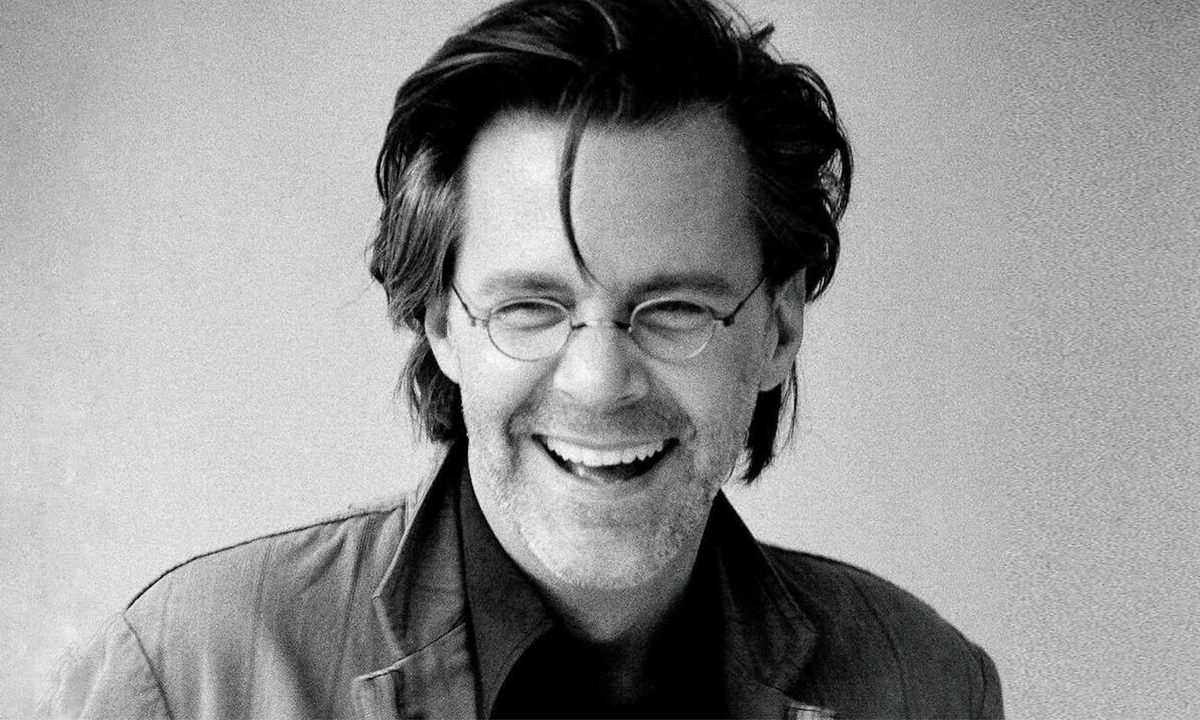
Peter Nagy, the US-born gallerist and artist whose experimental taste shaped Indian contemporary art, has died, aged 67. Nature Morte, the Delhi- and Mumbai-based gallery he founded, confirmed his death yesterday (13 October) on social media, writing that “he passed away after a long illness”.
Nagy came of age as an artist in the 1980s East Village scene in New York. Embracing ideas of neo-conceptualism, post-minimalism and even institutional critique, while ironically adopting the aesthetics of Pop Art, he made work that addressed rampant consumerism and a rapidly digitising image culture.
Early black-and-white collages, paintings and vinyl works of his were exhibited in 2020 at Jeffrey Deitch gallery in New York, in collaboration with Magenta Plains. These included his anti-commodity Xerox series—large paper collages of brand logos and advertisements—while his Cancer paintings “applied the pathology of cancer to the production of signs, creating ‘cells’ by sandwiching logos and other graphic elements until defamiliarised and abstracted”, according to the Jeffrey Deitch gallery exhibition notes.
This self-conscious engagement with contemporary art discourse and appetite for the avant-garde equally informed Nature Morte, the gallery Nagy co-founded in 1982 in New York with the artist Alan Belcher. Exhibitions it held in its early years featured now hugely influential figures like Gretchen Bender, Vito Acconci and Not Vital alongside several Pictures Generation artists such as Cindy Sherman and Sherrie Levine.
Eventually Nagy closed the New York gallery and began travelling to New Delhi, where he moved in 1992, re-opening Nature Morte as a commercial venture and curatorial project for contemporary South Asian art in 1997.
From the time he moved to India until his death, Nagy remained one of the few foreign-born dealers of South Asian contemporary art. He is credited with bringing the New York model of the art gallery to India, and it was in part this outsider perspective that made him so adept at identifying artists whose work would translate onto the global stage. He compared this to how “Pierre Matisse, Ileana Sonnabend, and Leo Castelli brought the European model to New York before I was born”, in a 2022 interview with Artnet.
Working at the start of the new millennium as a generation of South Asians artists were experimenting with form and concept—and buoyed by a rapidly growing Indian art market—Nagy played a leading role in launching the careers of some of the subcontinent’s biggest art stars. Nature Morte counts among its 41-strong artist roster some of the region’s most influential names, including Jitish Kallat, Raqs Media Collective, Reena Saini Kallat, Bharti Kher and Imran Qureshi.
Of India’s leading galleries, Nature Morte’s programme has been one of the most experimental and peripatetic, having launched outposts in collaboration with New York’s Bose Pacia gallery in Kolkata (2006-09) and in Berlin (2008-13). In recent years, Nature Morte has notably brought major international names to India, whose market remains domestically focused, including Alicja Kwade and Ai Weiwei who have both held their first exhibitions in the region at the gallery. Nature Morte has maintained a number of locations across Delhi throughout its run. Presently it operates a space in Delhi’s Gulmohar Park, which it opened earlier this year, and one in Colaba, Mumbai, launched in 2024.
Nature Morte’s Instagram post announcing Nagy’s death says that “he lived exactly as he chose: fearlessly, irreverently and wildly free. He had no patience for convention for its own sake, and endless patience for ideas.” The galleries remain open in line with Nagy’s wishes. “Peter was clear that, when the time came, the gallery should not close its doors in mourning,” the post says.