
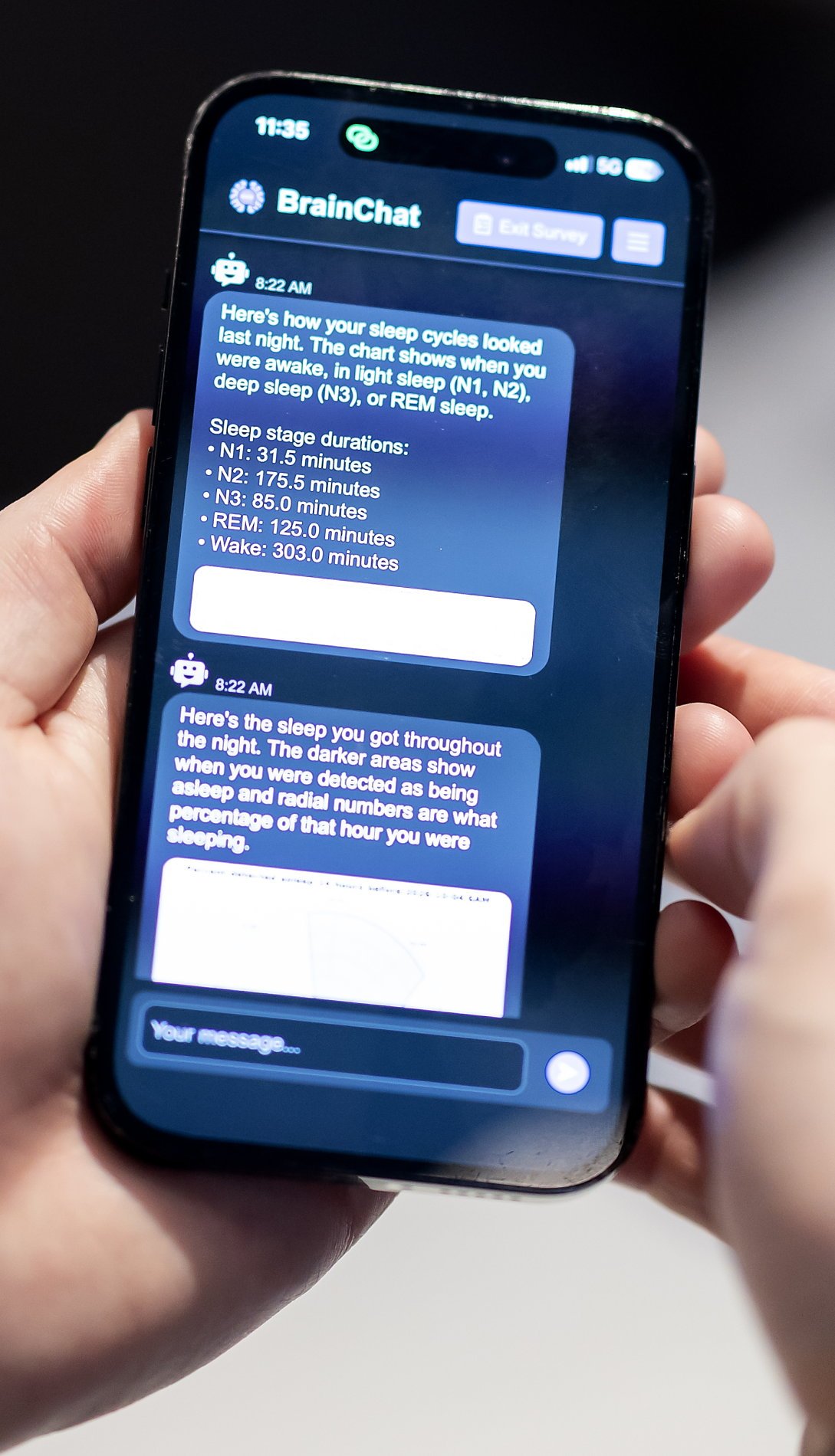
The BrainChat app on a smartphone
Image source: University of Pennsylvania
Through an app on their phone, patients could ask questions about their brain activity, request visualizations of trends in their data, report symptoms, and receive alerts or surveys throughout the day. Patients could receive information such as text, charts, and other visual formats. Similarly, the device could contact the patient when it saw changes that might be of interest to the patient, and learn “on the fly” based upon patient responses.
Researchers analyzed 1,307 messages exchanged between patients and the system during the study period. Most interactions involved discussions about seizure events, sleep, mood, energy levels, and other factors that can influence seizure activity. Patients were also surveyed three times daily about sleep, anxiety, mood, well-being, and other symptoms. Several participants said the platform helped explain patterns they had previously observed but struggled to understand.
One participant reported that the system helped “solidify what I felt to be true between some of my episodes and emotions.” Others said they valued access to sleep information and the possibility of receiving warnings before major seizures.
Beyond this communication, patients could also teach the system about their condition, noting which seizures the program correctly identified, and which were false alarms. This allowed the system to substantially improve its ability to accurately identify seizures. Clinicians could also converse with the system to review the program’s assessments and add in their own notations of true seizures and false alarms, further improving its accuracy. This was done via a smart “expert in the loop” algorithm that reduced the need for expert input to high-value annotations.