
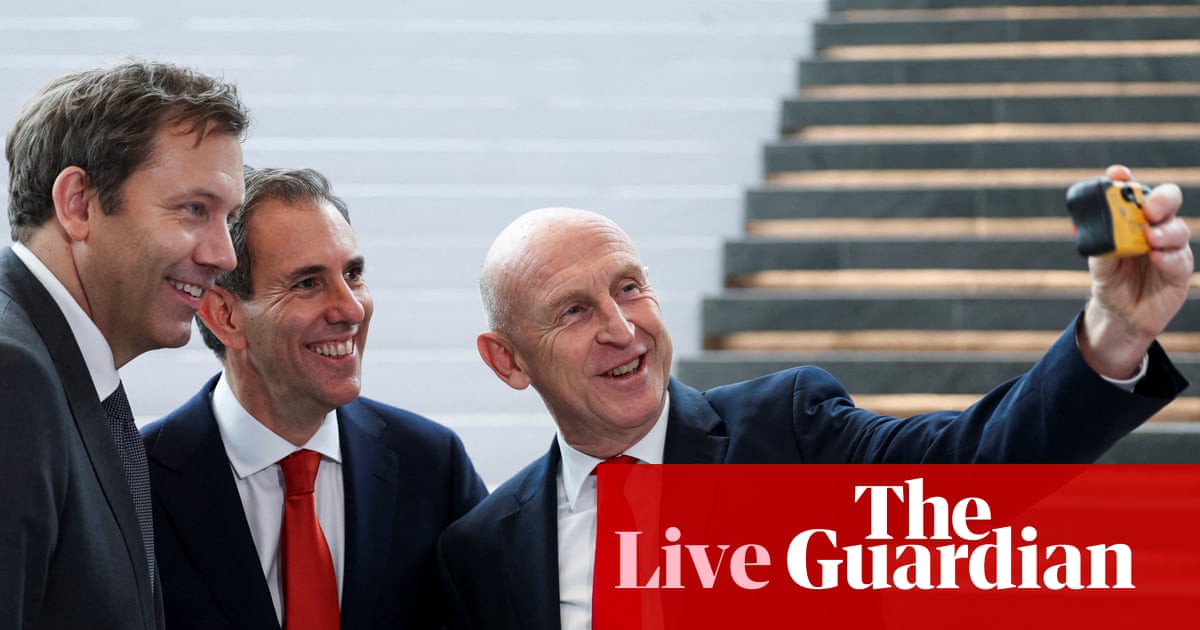
Healey quizzed about bank tax plans Heather Stewart
Over at the IMF’s annual meeting in Bangkok today, chancellor John Healey is meeting with UK journalists now, including my colleague Heather Stewart.
Healey, who should be cheered by the news that the UK economy grew unexpectedly in August, was asked whether he plans to impose new taxes on the bank sector, and replies:
double quotation mark“I don’t want anybody to try and read in or second guess what [we may] do in two weeks’ time.
My observations on the banks are just that people too often see them as a big distant financial institutions, when they are hardwired into the economic fabric of this country and our future prospects.
That said, you know I’ve got decisions to take in the in the budget, and I will. I’ll set those out in two weeks’ time.
Healey added that his “special responsibility as Chancellor is to protect the resilience of the British economy for the future” – echoing what he told Sky News a few minutes ago.
The chancellor also welcomed the IMF’s support for the UK’s fiscal plans.
Updated at 05.09 EDT
Key events
Closing post
Time to wrap up.
The US inflation squeeze has intensified, with new data showing that US producer prices rose in September at the fastest pace in more than four years.
With higher energy costs hitting the US economy, the producer price index advanced 1.3% from a month earlier — the most since March 2022. On an annual basis, prices were 6.3% higher.
The data helped to push down shares on Wall Street, as an accelerating sell-off of AI-linked shares has hit global markets.
South Korea’s benchmark Kospi 200 index, which is heavily skewed towards the companies that make memory chips, fell more than 8% overnight to a six-month closing low, triggering circuit breakers that brought trading to a halt at various points.
Some of those semiconductor stocks, such as SK Hynix and Samsung Electronics, plunged nearly 11% and 9.5% respectively. The index closed at a six-month low, down 8.1%.
US stocks fell further when trading resumed on Thursday. The Nasdaq dropped another 1.4% at the start of trading, with Dell, which makes datacentre servers, and Coherent, which manufactures components for AI datacentres, leading the early fallers.
The UK rallied, though, helped by the news that Britain’s economy kept growing.
Figures from the Office for National Statistics showed gross domestic product (GDP) rose by 0.1% last month, compared with 0.4% growth in July. That confounded a forecast by City economists of a 0.1% contraction.
With less than a fortnight before the budget, the ONS reading represents a surprise boost given that the Middle East war is rattling the global economy and hitting British households and businesses with a surge in energy costs.
John Healey has promised to use his first budget in a fortnight’s time to offer consumers and businesses a “breathing space” while sticking to Labour’s fiscal rules.
Speaking to journalists in Bangkok, where he has been attending the International Monetary Fund annual meetings, the chancellor said he was conscious of rising costs.
Healey also hailed the contribution that UK banks make, calling them part of the ‘jewel in the crown’ – amid speculation that he could impose higher taxes on them in the budget.
He told reporters:
double quotation markMy observations on the banks are just that people too often see them as a big distant financial institutions, when they are hardwired into the economic fabric of this country and our future prospects.
Some Labour MPs want the chancellor to raise taxes on the gambling sector.
Updated at 10.59 EDT
US lawmakers unveil bill to hold Wall Street’s ‘Epstein-connected’ bosses to account Kalyeena Makortoff
US lawmakers have unveiled a new bill to hold Wall Street’s “Epstein-connected” bosses to account for helping finance the late sex offender’s crimes.
It came as top Democratic senator Elizabeth Warren condemned the UK bank Barclays for “dodging responsibility” over its failure to vet former boss Jes Staley and his ties to the once well-connected billionaire.
A bipartisan group of politicians, led by Warren and House representative Robert Garcia, are introducing a bill on Thursday known as the Epstein Wall Street Records Act. The bill follows a months-long investigation into the financier, who died in prison in 2019 while awaiting trial on child sex-trafficking charges.
If passed, the bill would force regulators including the Federal Reserve and the Securities and Exchange Commission to investigate “Epstein connected” financial firms and executives for potential breaches of banking, investment or illicit funding laws; and fine or even ban wrongdoers from the US financial sector.
ShareFTSE 100 hits five-week high
The UK stock market is continuing to benefit from turmoil elsewhere.
The FTSE 100 share index is now up 1.1% at 10,843 points, its highest level since 8 September.
Kathleen Brooks, research director at XTB, says US assets are acting like a ‘harbour in the storm’:
double quotation markA stronger economy, combined with a resilient FTSE 100, which is the best performing major index so far this week, is good news for the pound and the Gilt market. As other markets crash and burn, the pound is the top performing G7 currency this week, and the Gilt market is the best performer amongst its peers on Thursday. When the AI trade sells off, the UK is the harbour in the storm.
The US economy is continuing to hold onto workers, despite inflationary pressures.
The number of Americans filing new claims for unemployment support remained low last week, at 199,000 – 1,000 more than a week earlier.
Coherent Corp, the US manufacturer of lasers, engineered materials, and optoelectronic components for AI data centres, is also caught up in the sell-off – its shares are down 9%.
Share Jennifer Rankin
Europe has to take action to curb soaring oil and gas prices to prevent people from turning to populists and extremists, a senior EU official has said.
Dan Jørgensen, the European commissioner for energy and housing policy, said EU governments could choose actions to make fossil fuels cheaper as long as they were “targeted” and “temporary” so as not to derail the continent from its goal to tackle the climate crisis by drastically cutting carbon emissions.
Our Europe Live blog has all the details:
Dell (-9%) are leading the fallers on the S&P 500, as doubts persist about the AI boom.
That adds to their 11% drop yesterday, after analysts at Barclays raised concerns that enterprise spending on artificial intelligence won’t justify the AI buildout.
ShareWall Street opens in the red
Stocks are dropping on Wall Street at the start of trading, as inflation worries and AI angst hit share prices.
Tech stocks are leading the sell-off, pulling the Nasdaq index down by 1.3%.
The broader S&P 500 share index has dropped by 0.5%.
This morning’s jump in the US PPI index will have raised concerns about inflationary pressures.
Traders are also reacting to the sell-off in Asia-Pacific markets overnight, where South Korea’s Kospi hit a six-month low overnight (see earlier post).
Share Julia Kollewe
On the AI front, AstraZeneca has entered into a new collaboration with a Californian AI therapeuticscompany called insitro, aimed at identifying novel targets to develop medicines for liver and heart disease.
The collaboration will focus on the areas of metabolic dysfunction-associated steatohepatitis (MASH), a serious liver disease, and cardiomyopathies, diseases of the heart muscle.
Insitro has created a virtual human to generate large-scale human and cellular data with AI-enabled target identification and medicine design. The deal is worth $1.46bn, with $40m paid upfront by AstraZeneca. The Californian company also has partnerships with US drugmakers Bristol Myers-Squibb and Eli Lilly.
Sharon Barr, executive vice resident and head of biopharmaceuticals research & development at AstraZeneca, said:
double quotation mark“We know that disease biology is incredibly complex, and one of the most critical decisions in R&D is selecting the right target. This strategic collaboration underscores our commitment to maximising the potential of cutting-edge AI to tackle the root cause of disease.
Partnering with insitro, we will use advanced AI to identify the biological drivers of disease to support the rapid discovery of high-quality novel targets, advancing our ambition to deliver the next generation of medicines to patients faster.”
Today’s jump in wholesale US inflation increases the pressure on the US Federal Reserve to raise interest rates soon.
Waleed Said, technical analyst at GivTrade, says the increase in core PPI means the energy shock from the Iran war is spreading, adding:
double quotation markA firmer Fed is more likely but the market pricing about a one in three chance of a hike in October so don’t overreact to the headline but a rate hike in December does seem imminent.
ShareUS PPI inflation driven up by soaring gasoline
Tin hats on!
New data from the US has shown that producers are hiking prices at their fastest rate in almost four years, and much faster than expected.
Ths increase was driven by a surge in energy prices, which more than wiped out a drop in egg prices.
The Producer Price Index, which measures how much goods makers and services firms charge for their wares, jumped by 6.3% in the year to September. That’s the largest 12-month increase since December 2022, when it rose by 6.4%.
On a monthly basis, prices climbed by 1.2% in September alone, a sign that inflationary pressures rose last month.
The report shows that goods prices jumped by 2.6% in September alone, the largest increase since data were first calculated in December 2009.
That was driven by the rise in motor fuel; The Bureau of Labor Statistics reports:
double quotation markHalf of the September increase in the index for final demand goods can be traced to prices for gasoline, which jumped 20.3 percent. The indexes for diesel fuel, fresh and dry vegetables, jet fuel, residential electric power, and crude petroleum also rose. In contrast, prices for chicken eggs dropped 39.7 percent.
Alarmingly, core PPI also jumped. Prices for final demand less foods, energy, and trade services rose 5.0% in the year to September.
PPI is an important measure, as increases in producer prices tend to be passed onto consumers, who already experienced a jump in inflation last month:
ShareEU pushing for action over trade deficit with ChinaJennifer Rankin
The EU is set to call for further action to curb the bloc’s vast trade deficit with China, widely blamed for job losses and factory closures across the continent.
EU leaders meeting in Brussels on Thursday to discuss the trade deficit with China – which hit €360bn in 2025 – are expected to call for “new instruments to better address these imbalances” according to a draft statement.
The European Commission, which negotiates trade policy on behalf of the 27 member states, agreed a deal this month with Beijing that will see the EU limit hybrid car exports from China to 350,000 vehicles a year, potentially halving Chinese market share.
EU countries have welcomed the deal, but think it is not enough and want steps to protect other industrial sectors, such as chemicals, plastics and machinery.
The debate has sharpened since Germany – long reluctant to use trade defences against China – converted to a more hawkish position amid pressure from German industrial leaders, who are laying off workers and closing factories.
Germany and France last week called for better use of existing trade defence measures, including urgent action in the chemicals and plastics sectors.
The EU’s two biggest economies are also seeking “a diversification instrument” that would cut off access to the EU market when faced with severe imbalances. Dubbed the “kill switch”, the law is intended to be country agnostic, but is clearly aimed at China.
Member states have welcomed the deal negotiated by EU trade commissioner Maroš Šefčovič on hybrid cars, but are sceptical as to whether Beijing will stick to it. China would adhere to the agreement because they began to realise “they are killing their customers” , Šefčovič was reported to have said, according to a senior EU diplomat.
The EU diplomat highlighted the urgency of the situation from the EU’s point of view: “We don’t have much time because every month that goes by, thousands of jobs are lost.”
ShareUK government says it is minded to intervene in Sky-ITV deal
Media news: The UK government is ‘minded to intervene’ in Sky’s£1.6bn deal to buy ITV’s broadcasting and streaming arm.
Lisa Nandy, secretary of state for Digital, Culture, Media and Sport, has told parliament she believes there are public interest grounds for intervening in the deal.
They include ‘the need for free expression of opinion in news media’, the need for a pluratity of views in the news, and the need for a wide range of broadcasting which is “of high quality and calculated to appeal to a wide variety of tastes and interests.”
Back in July, Sky said the deal was a chance to create a “UK-focused national streaming champion”.