
Flury, S. R. et al. The low-redshift Lyman continuum survey. I. New, diverse local Lyman continuum emitters. Astrophys. J. Suppl. Ser. 260, 1 (2022).
Carr, C. A. et al. Establishing the geometry of Lyman continuum escape. HST proposal, cycle 31, ID no. 17443 (2023).
Cen, R. Physics of prodigious Lyman CONTINUUM LEAKERS. Astrophys. J. Lett. 889, L22 (2020).
Flury, S. R. et al. The low-redshift Lyman continuum survey. II. New insights into LyC diagnostics. Astrophys. J. 930, 126 (2022).
Carr, C. A. et al. The effect of radiation and supernovae feedback on LyC escape in local star-forming galaxies. Astrophys. J. 982, 137 (2025).
Flury, S. R. et al. The low-redshift Lyman continuum survey: the roles of stellar feedback and interstellar medium geometry in LyC escape. Astrophys. J. 985, 128 (2025).
Izotov, Y. I. et al. Low-redshift Lyman continuum leaking galaxies with high [O III]/[O II] ratios. Mon. Not. R. Astron. Soc. 478, 4851–4865 (2018).
Chisholm, J. et al. The far-ultraviolet continuum slope as a Lyman continuum escape estimator at high redshift. Mon. Not. R. Astron. Soc. 517, 5104–5120 (2022).
Morton, D. C. Oxygen VI in stellar winds. Mon. Not. R. Astron. Soc. 189, 57–68 (1979).
Hillier, D. J. UV spectroscopy of massive stars. Galaxies 8, 60 (2020).
Rivera-Thorsen, T. E. et al. The sunburst arc with JWST: I. Detection of Wolf-Rayet stars injecting nitrogen into a low-metallicity, z = 2.37 proto-globular cluster leaking ionizing photons. Astron. Astrophys. 690, A269 (2024).
O’Connor, E. & Ott, C. D. Black hole formation in failing core-collapse supernovae. In APS Meeting Abstracts Vol. 2011 L11.005 (APS, 2011).
Sukhbold, T., Ertl, T., Woosley, S. E., Brown, J. M. & Janka, H. T. Core-collapse supernovae from 9 to 120 solar masses based on neutrino-powered explosions. Astrophys. J. 821, 38 (2016).
Carr, C., Scarlata, C., Panagia, N. & Henry, A. A semi-analytical line transfer (SALT) model. II: The effects of a bi-conical geometry. Astrophys. J. 860, 143 (2018).
Carr, C. et al. Testing SALT approximations with numerical radiation transfer code. I. Validity and applicability. Astrophys. J. 952, 88 (2023).
Hayes, M. et al. O VI emission imaging of a galaxy with the Hubble Space Telescope: a warm gas halo surrounding the intense starburst SDSS J115630.63+500822.1. Astrophys. J. 828, 49 (2016).
Carr, C. A. et al. Evaluating mass outflow rate estimators in FIRE-2 simulations: toward a self-consistent framework for spectral-line-based predictions. Astrophys. J. 990, 220 (2025).
Jaskot, A. E., Oey, M. S., Scarlata, C. & Dowd, T. Kinematics and optical depth in the green peas: suppressed superwinds in candidate LyC emitters. Astrophys. J. Lett. 851, L9 (2017).
Jaskot, A. E., Dowd, T., Oey, M. S., Scarlata, C. & McKinney, J. New insights on Lyα and Lyman continuum radiative transfer in the greenest peas. Astrophys. J. 885, 96 (2019).
Martin, C. L., Peng, Z. & Li, Y. Resolving the mechanical and radiative feedback in J1044+0353 with Keck Cosmic Web Imager spectral mapping. Astrophys. J. 966, 190 (2024).
Komarova, L. et al. Power-law emission-line wings and radiation-driven superwinds in local Lyman continuum emitters. Astrophys. J. 994, 192 (2025).
Jecmen, M. C. & Oey, M. S. Delayed massive-star mechanical feedback at low metallicity. Astrophys. J. 958, 149 (2023).
Carr, C., Scarlata, C., Henry, A. & Panagia, N. The effects of biconical outflows on Lyα escape from green peas. Astrophys. J. 906, 104 (2021).
Heckman, T. M. et al. On the escape of ionizing radiation from starbursts. Astrophys. J. 558, 56 (2001).
Heckman, T. M. et al. Extreme feedback and the epoch of reionization: clues in the local universe. Astrophys. J. 730, 5 (2011).
Borthakur, S., Heckman, T. M., Leitherer, C. & Overzier, R. A. A local clue to the reionization of the universe. Science 346, 216–219 (2014).
Bait, O. et al. Low-redshift Lyman continuum survey (LzLCS). Radio continuum properties of low-z Lyman continuum emitters. Astron. Astrophys. 688, A198 (2024).
Amorín, R. et al. Ubiquitous broad-line emission and the relation between ionized gas outflows and Lyman continuum escape in green pea galaxies. Astron. Astrophys. 682, L25 (2024).
Li, Z. et al. Synergistic radiative transfer modeling of Mg II and Lyα emission in multiphase, clumpy galactic environments: application to low-redshift Lyman continuum leakers. Astrophys. J. 991, 49 (2025).
Komarova, L. et al. Emission-line wings driven by Lyman continuum in the green pea analog mrk 71. Astrophys. J. Lett. 920, L46 (2021).
Rivera-Thorsen, T. E. et al. The sunburst arc: direct Lyman α escape observed in the brightest known lensed galaxy. Astron. Astrophys. 608, L4 (2017).
Vanzella, E. et al. High star cluster formation efficiency in the strongly lensed sunburst Lyman-continuum galaxy at z = 2.37. Astron. Astrophys. 659, A2 (2022).
Secunda, A., Cen, R., Kimm, T., Götberg, Y. & De Mink, S. E. Delayed photons from binary evolution help reionize the universe. Astrophys. J. 901, 72 (2020).
Kimm, T. & Cen, R. Escape fraction of ionizing photons during reionization: effects due to supernova feedback and runaway OB stars. Astrophys. J. 788, 121 (2014).
Ma, X. et al. No missing photons for reionization: moderate ionizing photon escape fractions from the FIRE-2 simulations. Mon. Not. R. Astron. Soc. 498, 2001–2017 (2020).
Rosdahl, J. et al. LyC escape from SPHINX galaxies in the epoch of reionization. Mon. Not. R. Astron. Soc. 515, 2386–2414 (2022).
Choustikov, N. et al. The physics of indirect estimators of Lyman continuum escape and their application to high-redshift JWST galaxies. Mon. Not. R. Astron. Soc. 529, 3751–3767 (2024).
Deng, Y. et al. Rigel: simulating dwarf galaxies at solar mass resolution with radiative transfer and feedback from individual massive stars. Astron. Astrophys. 691, A231 (2024).
Peeples, M. S. et al. Figuring out gas & galaxies in enzo (foggie). I. Resolving simulated circumgalactic absorption at 2≤z≤2.5. Astrophys. J. 873, 129 (2019).
Smith, A. et al. The physics of Lyman-α escape from disc-like galaxies. Mon. Not. R. Astron. Soc. 517, 1–27 (2022).
Ferrara, A. Super-early JWST galaxies, outflows, and Lyα visibility in the epoch of reionization. Astron. Astrophys. 684, A207 (2024).
Renzini, A. A transient overcooling in the early Universe? Clues from globular clusters formation. Mon. Not. R. Astron. Soc. 525, L117–L120 (2023).
Silich, S. & Tenorio-Tagle, G. Gas expulsion versus gas retention in young stellar clusters. II. Effects of cooling and mass segregation. Mon. Not. R. Astron. Soc. 478, 5112–5122 (2018).
Gray, W. J., Oey, M., Silich, S. & Scannapieco, E. Catastrophic cooling in superwinds: line emission and non-equilibrium ionization. Astrophys. J. 887, 161 (2019).
Danehkar, A., Oey, M. S. & Gray, W. J. Catastrophic cooling in superwinds. II. Exploring the parameter space. Astrophys. J. 921, 91 (2021).
Oey, M. S. et al. Nebular C IV λ1550 imaging of the metal-poor starburst Mrk 71: direct evidence of catastrophic cooling. Astrophys. J. Lett. 958, L10 (2023).
Green, G. M. et al. Galactic reddening in 3D from stellar photometry – an improved map. Mon. Not. R. Astron. Soc. 478, 651–666 (2018).
Cardelli, J. A., Clayton, G. C. & Mathis, J. S. The relationship between infrared, optical, and ultraviolet extinction. Astrophys. J. 345, 245 (1989).
Chisholm, J. et al. Constraining the metallicities, ages, star formation histories, and ionizing continua of extragalactic massive star populations. Astrophys. J. 882, 182 (2019).
Saldana-Lopez, A. et al. The low-redshift Lyman continuum survey. Unveiling the ISM properties of low-z Lyman-continuum emitters. Astron. Astrophys. 663, A59 (2022).
Saldana-Lopez, A. et al. The VANDELS survey: the ionizing properties of star-forming galaxies at 3 ≤ z ≤ 5 using deep rest-frame ultraviolet spectroscopy. Mon. Not. R. Astron. Soc. 522, 6295–6325 (2023).
Leitherer, C. et al. Starburst99: synthesis models for galaxies with active star formation. Astrophys. J. Suppl. Ser. 123, 3–40 (1999).
Leitherer, C. et al. The effects of stellar rotation. II. A comprehensive set of Starburst99 models. Astrophys. J. Suppl. Ser. 212, 14 (2014).
Meynet, G., Maeder, A., Schaller, G., Schaerer, D. & Charbonnel, C. Grids of massive stars with high mass loss rates. v. from 12 to 120 M⊙ at z = 0.001, 0.004, 0.008, 0.020 and 0.040. Astron. Astrophys. Suppl. 103, 97–105 (1994).
Pauldrach, A. W., Hoffmann, T. L. & Lennon, M. Radiation-driven winds of hot luminous stars. XIII. A description of nlte line blocking and blanketing towards realistic models for expanding atmospheres. Astron. Astrophys. 375, 161–195 (2001).
Leitherer, C. et al. A library of theoretical ultraviolet spectra of massive, hot stars for evolutionary synthesis. Astrophys. J. Suppl. Ser. 189, 309–335 (2010).
Kroupa, P. On the variation of the initial mass function. Mon. Not. R. Astron. Soc. 322, 231–246 (2001).
Ferland, G. J. et al. The 2017 release cloudy. Rev. Mex. Astron. Astrofis. 53, 385–438 (2017).
Reddy, N. A., Steidel, C. C., Pettini, M. & Bogosavljević, M. Spectroscopic measurements of the far-ultraviolet dust attenuation curve at z ~ 3. Astrophys. J. 828, 107 (2016).
Huberty, M. et al. CLASSY. X. Highlighting differences between partial covering and semianalytic modeling in the estimation of galactic outflow properties. Astrophys. J. 975, 58 (2024).
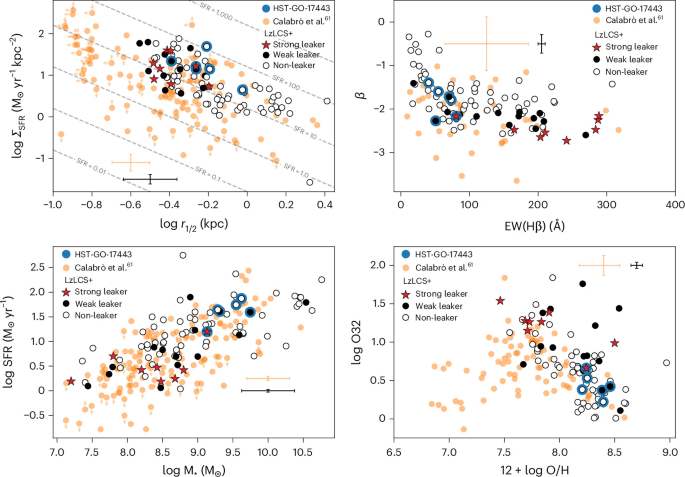
Calabrò, A. et al. Evolution of the star formation rate and ΣSFR of galaxies at cosmic morning (4 < z < 10). Astron. Astrophys. 690, A290 (2024).
Ploeckinger, S. & Schaye, J. Radiative cooling rates, ion fractions, molecule abundances, and line emissivities including self-shielding and both local and metagalactic radiation fields. Mon. Not. R. Astron. Soc. 497, 4857–4883 (2020).