
Council strategic transport and infrastructure team leader Sarah Dove told the committee a recent law change created opportunities for councils to manage congestion through pricing.
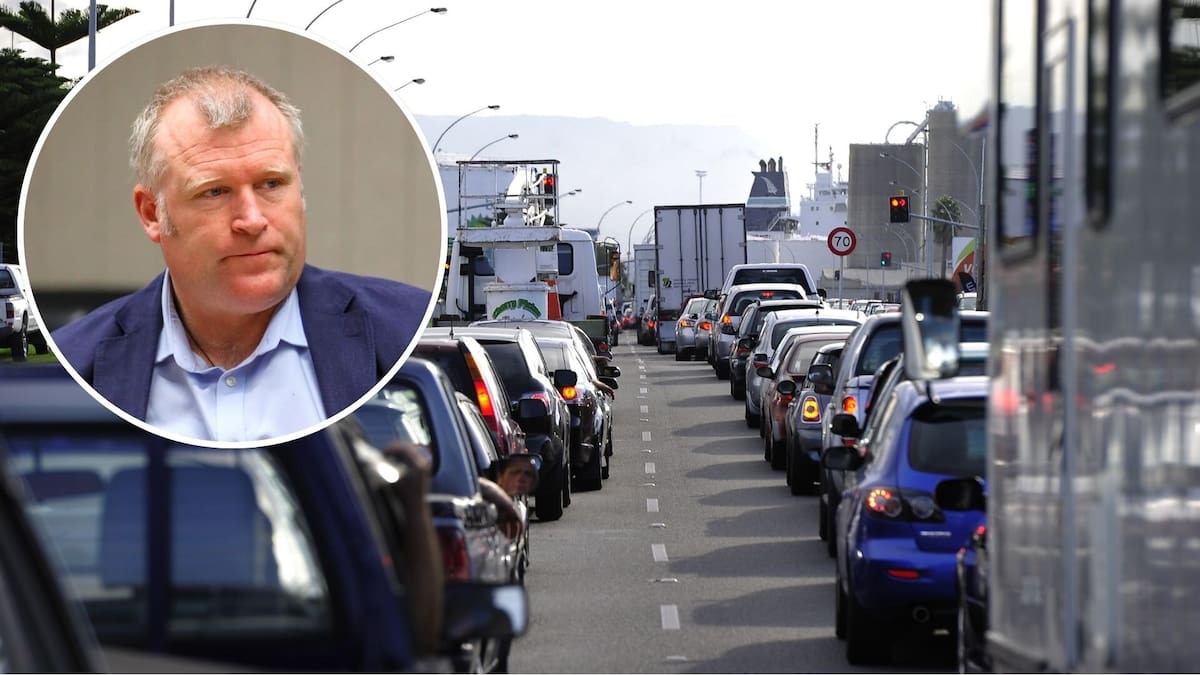
Morning peak traffic on Turret Rd. Photo / George Novak
The Land Transport Management (Time of Use Charging) Amendment Bill will take effect next month.
It allows councils to investigate charging road users during peak traffic hours to encourage travel at different times or by other modes, reducing peak traffic and improving travel time reliability.
Council staff recommended spending $300,000 over the next three years on a joint investigation with regional and national partners.
The focus would mainly be on time-of-use charging while considering potential tolling options.
Any future decision to introduce a charging scheme would require further consideration, consultation and approval.
Drysdale said he supported allocating the $300,000 to the study.
“We are tolled more than anyone in the country, there are other ways and I think we should look at all the options.”
Tauranga Mayor Mahe Drysdale. Photo / Alyse Wright
He said the cost of major transport projects, including Connecting Mount Maunganui, Cameron Rd stage two and 15th Ave to Turret Rd could total $800m to $1 billion.
“Which, in a rates capping environment, is going to be really tough for us to do them all.”
He said Tauranga’s roads were good, except for two hours in the morning and evening when “everyone wants to travel on the same bit of road”.
“If we can shift some of that demand out, then I think that’s worth considering. $300,000 now could save us $300m in the future, and I think that’s a good investment.”
Bethlehem councillor Kevin Schuler agreed, adding it was natural the public would have a negative response in the first instance when discussing extra charges.
Arataki councillor Rick Curach said comparisons to other countries with congestion charging were problematic because of differences in income.
Tauranga City councillors Glen Crowther and Rick Curach.
“New Zealand has been falling over quite a number of years in terms of household income and personal income to a point where people are just surviving.”
Congestion charging would “make hardship even worse”.
“So, the problem with implementing this in a New Zealand circumstance would only make hardship even worse.”
He said there needed to be well-functioning public transport as a genuine alternative to private vehicles.
Matua-Otūmoetai councillor Glen Crowther said about 81% of 1100 submissions in 2024 opposed time-of-use charging, and 78% opposed the council working with NZTA on a business case.
Pāpāmoa councillor Steve Morris said the community had already shown its opposition.
“I ain’t up for it. I don’t think our community is up for it. I want this to end here.”
Pāpāmoa ward councillor Steve Morris and Welcome Bay Councillor Hautapu Baker. Photo / David Hall
Welcome Bay ward councillor Hautapu Baker said while the Government was “shouting no new taxes” for the upcoming election, this was a “travel tax in disguise”.
Dove said Auckland had been looking at options and was expected to be the first New Zealand city to progress a scheme under the new legislation with three shortlisted design options.
Crowther said Auckland had five times the Bay of Plenty’s population but received 33 times the public transport investment for 2024-27.
He said public transport must improve before congestion charging was considered.
Tauranga City councillor Rod Taylor. Photo / David Hall
Committee chairman and Te Papa councillor Rod Taylor said rates caps would force difficult spending decisions and suggested the Government should fund the study.
The committee voted 6-4 against including the investigation funding in the 2027-37 Long-Term Plan
Drysdale, Schuler, Tauriko ward councillor Martin Rozeboom and tangata whenua representative Arthur Flintoff voted to include the funding.
Previous Tauranga proposal
NZTA and the council studied a variable road-pricing concept in 2023.
Dubbed SmartTrip, it proposed variable charges across Tauranga’s roading network based on peak travel times, with lower costs when demand was less.
The priced network included State Highways 2, 29 and 29A, Turret Rd, Chapel St and, when it opened, the Takitimu North Link.
A variable road pricing concept example from 2023. Graphic / Tauranga City Council
The peak-time charge would be $2, plus 15c per kilometre travelled.
Heavy vehicles would pay $5 plus 38c per kilometre. The charges would replace existing tolls.
It was projected to improve peak travel times by 20% and generate $88m annually for transport improvements.
Plans for further investigation were dropped after a public outcry.
– LDR is local body journalism co-funded by RNZ and NZ On Air.
Ayla Yeoman is a Local Democracy Reporting journalist based in Tauranga. She holds a Bachelor of Arts majoring in communications, politics and international relations from the University of Auckland, and has been a journalist since 2023.