
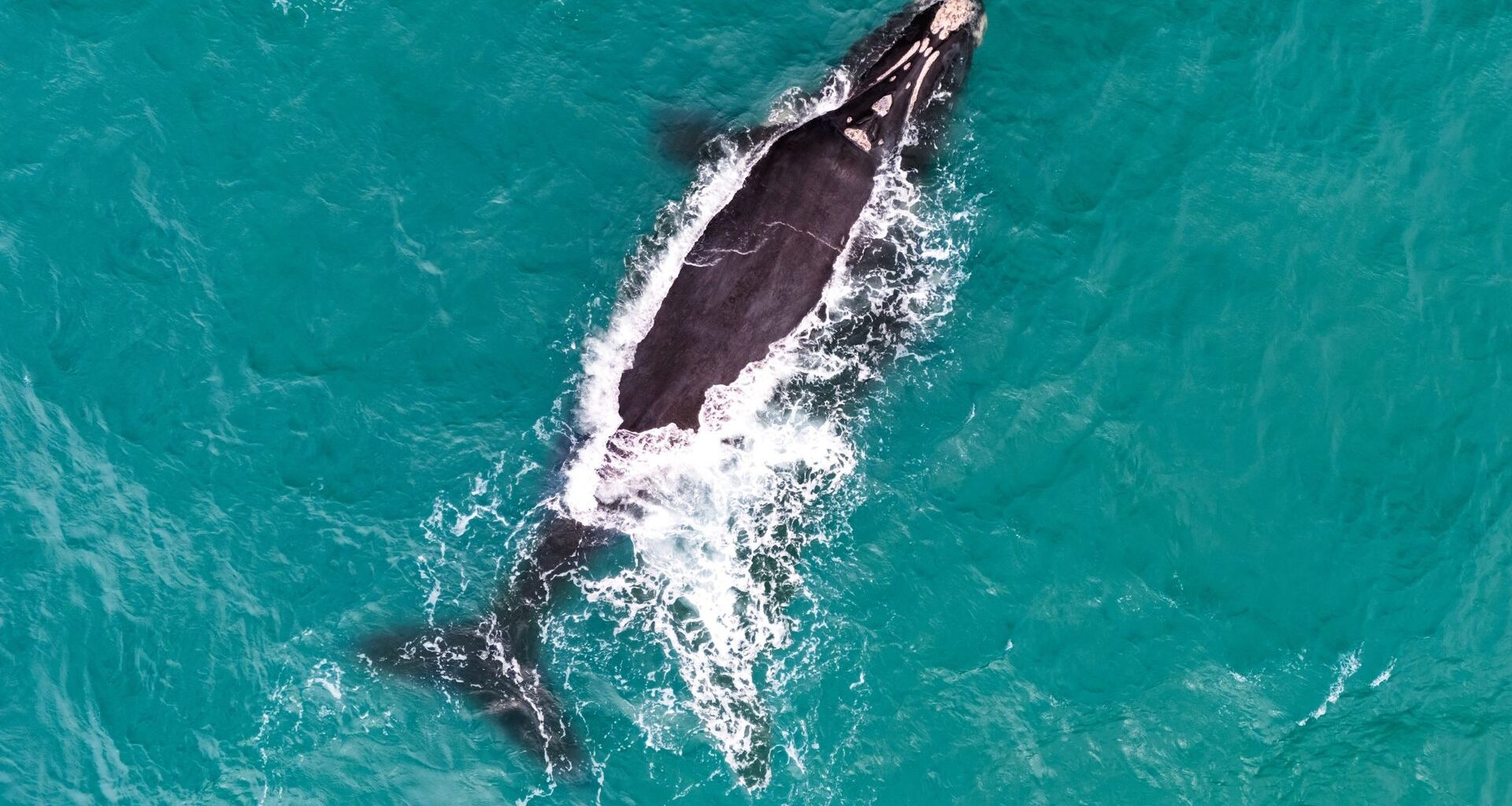
Some southern right whales take a longer route toward Antarctica but still reach their feeding grounds on time.
Southern right whales leaving New Zealand’s Auckland Islands face a long swim to their feeding grounds south of Australia. Some make that journey even longer by heading toward Antarctica first.
The surprising part is that this detour does not seem to make them late.
Whales taking the longer route leave earlier and reach the feeding grounds around the same time as those that travel more directly.
These journeys offer a glimpse of how whales find their way across a vast ocean.
They also suggest that the animals can change routes, a flexibility that may become valuable as ocean conditions change.
Two routes to food
Southern right whales, known in Māori as tohorā, gather around the Auckland Islands to socialize, mate, and give birth.
They spend roughly May through September there, then travel toward waters south of Australia to feed.
Researchers led by Leena Riekkola and Xuelei Zhang studied these journeys with colleagues at the University of Auckland.
Between 2020 and 2022, the team attached satellite tags to 25 whales.
Twenty-one tags provided enough information to map the outward migration.
Ten whales headed west or northwest, taking a fairly direct route toward their feeding grounds.
The other 11 first swam south or southwest toward Antarctica before turning northwest. On a map, their journeys looked roughly like the letter L.
Leaving early buys time
The whales taking the detour left in late July on average. Those following the direct route waited until late August, giving the first group about a month’s head start.
Only 16 tags continued sending information until the whales reached their feeding grounds.
Among those animals, the longer trips averaged 64 days, while the direct journeys took 42 days.
Despite spending about three extra weeks traveling, the detouring whales arrived at roughly the same time as the others.
Both groups reached the area in early October on average, with no clear statistical difference in their arrival dates.
Their timing matched the seasonal peak in phytoplankton, the tiny algae that support much of the ocean’s food web.
The researchers suspect the whales may be timing their arrival to this productive season, although the tracking records cannot prove that.
Why take the detour?
An early start explains how a whale can spend longer traveling and still arrive on time. What remains puzzling is why it would swim farther in the first place.
The researchers think the routes may reflect different ways of balancing time and energy.
Riekkola compared those possible choices to a road trip, where some travelers may conserve energy while others try to make up for a late start.
Whales on the direct route swam slightly faster, but the difference was small.
The team’s statistical tests gave mixed results, so it is unclear whether that extra speed mattered much to the animals.
Body size, sex, and body condition did not clearly explain the routes either.
Those comparisons were limited because some measurements were missing and all the tagged whales were mature animals in good condition.
Whales can change routes
The tracking records also showed that a whale’s route is not necessarily fixed.
Five animals provided information from two outward migrations in consecutive years.
Three took the longer route both times. The other two followed the direct route one year and the detour the next.
One whale that switched was a female traveling with a calf during the first year.
Researchers presumed she had no calf the following year, raising the possibility that having a youngster alongside her influenced the journey.
Only two tagged whales were mothers with calves, and both left later and traveled directly.
That is too few to establish a pattern, but following more mothers could help explain how caring for a calf affects migration.
Finding an ocean path
The longer journeys had another feature in common: many whales turned north in similar ocean conditions.
Most made the turn near the southern edge of the Antarctic Circumpolar Current, which flows around Antarctica, and above shallower seafloor.
Their turning points also matched a particular range in the angle of Earth’s magnetic field. Sea ice offered a weaker clue, because most whales turned well away from its edge.
Any of these features might help researchers understand how whales navigate.
For now, though, a match on a map does not show that the animals actually use it to find their way.
Learning from other whales
Southern right whales tend to return to feeding grounds their mothers took them to.
That makes their ability to switch routes especially interesting, because a whale may eventually travel a different way from the one it learned as a calf.
Other whales could play a part in that learning. In 2020, two tagged animals followed closely matching paths for about 250 miles (400 km), possibly remaining near enough to hear each other.
Researchers need to follow more whales over several years to understand how they learn and change routes.
Study co-author Emma Carroll, an associate professor at the University of Auckland, sees potential value in that ability to adjust.
“A population that can adapt its behavior has a better chance of coping with changing seas,” said Carroll.
The study is published in the journal Proceedings of the Royal Society B.
—–
Like what you read? Subscribe to our newsletter for engaging articles, exclusive content, and the latest updates.
Check us out on EarthSnap, a free app brought to you by Eric Ralls and Earth.com.
—–