
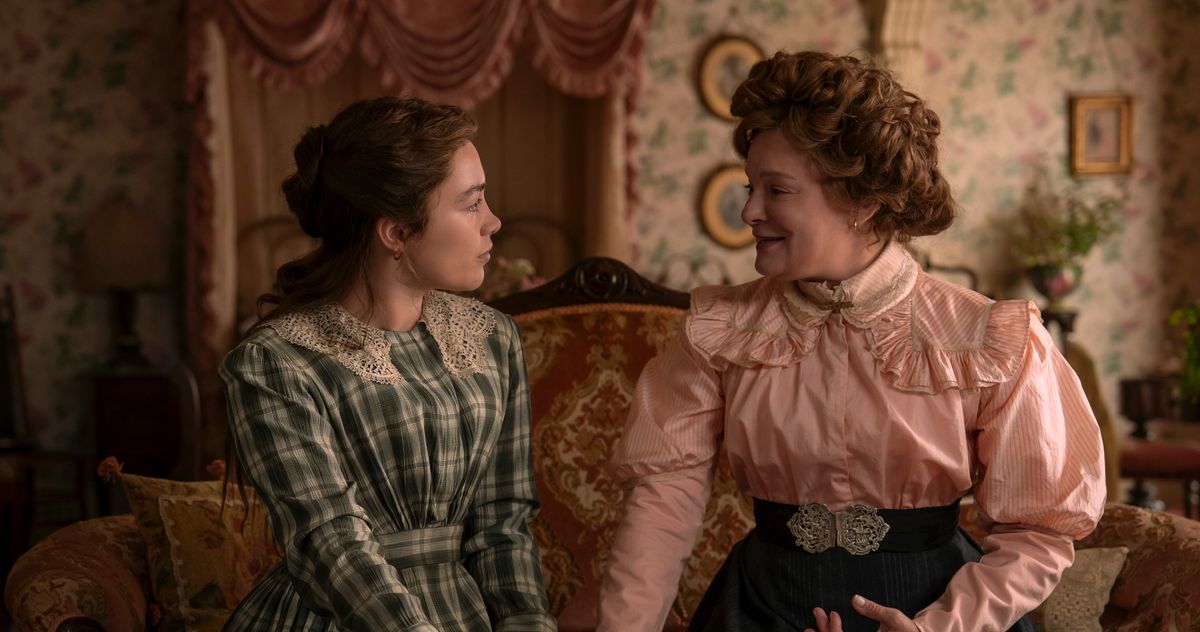
“When you see yourself in the mirror and go, ‘Man, this is good. I can work with this,’ you know it’s going to be a lot of fun,” says the East of Eden actress.
Photo: Geoffrey Short/Netflix
Spoilers follow for East of Eden, which premiered on Netflix on October 1.
John Steinbeck wrote Cathy Ames, the antagonist of his novel East of Eden, as the embodiment of original sin, and in Zoe Kazan’s Netflix adaptation, Florence Pugh deftly channels the character’s ambition and cynicism. She swindles, steals, and drives a man to suicide. As a teenager, she kills her controlling parents by setting their house on fire so she can run away. Later, after giving birth to twins, she shoots her husband, Adam (Christopher Abbott), in the shoulder and abandons him and their sons. It all leads to “Kate,” episode four of the seven-episode limited series, a complete portrait of Cathy’s capacity for cruelty. Now going by that nickname, Cathy appears on the doorstep of a respected brothel run by the warm madam, Faye (Martha Plimpton). Kate smiles and cajoles her way to Faye’s side, taking over the day-to-day operations of the house and even calling the madam “Mother.” Over the course of a year, she surreptitiously and steadily tortures her new benefactor before poisoning her to death with arsenic and lead.
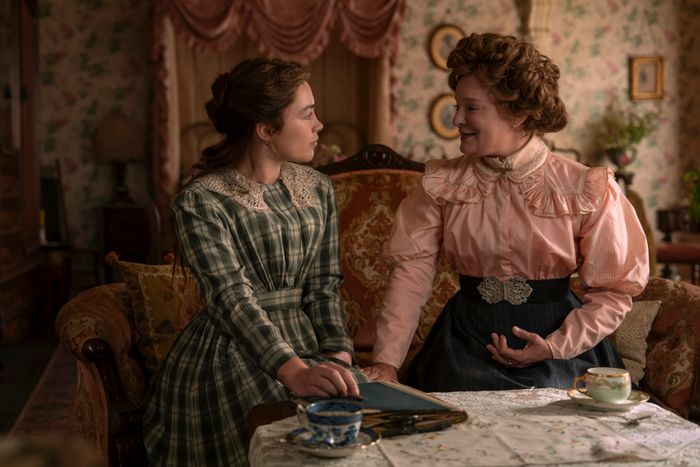
By the end of the episode, Faye is in the ground, Kate has taken over the brothel, and the Rolling Stones’ “Paint It Black” is playing over the credits. Kate tends to tell herself (and us, via her narration) that she acts in self-defense, but that justification doesn’t hold when all Faye wanted was to provide for the young woman. Plimpton is an industry legend with a slew of awards and nominations for her stage and screen work, and though she has played contemporary moms on sitcoms like Raising Hope and The Real O’Neals, Faye is a world away from those matriarchs. Under a red wig and swathed in the mutton-sleeve gowns of the early 20th century, Plimpton’s Faye is genial and unsuspecting, a madam who genuinely believes the men who visit her brothel should be accommodated and the girls who work there protected. She’s slightly mischievous — Plimpton’s characters nearly always are — but what makes her downfall so tragic is that she suspects Kate only when it’s too late, and even when she does, she is ashamed she doubted the girl she considers her daughter.
Faye is a victim of Kate’s relentless avarice and her worldview that no one is really good; her murder cements Kate’s transformation into a monster, someone who — within Steinbeck’s timshel, or “thou mayest,” framing of human choice in the novel — chooses to hurt others. “She’s a funny sort of character,” Plimpton says of Faye. “She’s an avatar for the innocence of the businesswoman in that period of time. And Kate comes along to say ‘No, I’m going to take this. You’re not being careful enough.’”
How did Faye come to you?
I had just landed in Paris. I was getting ready to take my mother on a two-week trip — we were going to drive from the South of France back up to Paris and then on to London. My agent called me and said Zoe had asked if I would do this. I had seen the film but never read the book. I ran over to the American bookstore near Notre-Dame and bought a copy and started reading it. I was like, Obviously, I’ll be there. It shoots in New Zealand? Twist my arm.
Before East of Eden, the last thing I saw you in was Task, and the next was season two of The Lowdown. What opportunity did Faye provide that felt different from these two contemporary law-enforcement characters?
It’s a period piece, which is not something I’m normally asked to do on film or in television. It’s an incredibly rich and compelling and wonderfully allegorical novel, and the character of Faye is a very guileless woman who cares very deeply about her girls and believes very strongly that it is possible to run a brothel as a beautiful, romantic, elegant place and that sex in this brothel, with these girls who are precious to her, is something any man would feel lucky to experience.
There’s a side to her that’s very lonely and very much wants to have a family. You don’t get the sense she has ever felt there was someone she could really depend on. That’s completely different from playing a sheriff or an FBI agent. And there are similarities, in a way, in terms of female independence and one’s options in that area as the years have progressed. It excited me enormously to play someone of this period and in this line of work who was not your typical sort of bawdy bordello madam but who is, as Steinbeck imagined her, a woman of graceful taste. Regardless of what her background might have been, she has managed to make a good living for herself. That’s no small feat. There’s a tendency to see a place like this as a house of ill repute, and she would like to contradict that.
I’m curious how you built Faye — how she looks, moves, and sounds. What was important for you in that process?
Having done period work onstage but never onscreen until this, I found it a little challenging. It’s one thing to play a person from the 19th to the early-20th century onstage, where you can be a little broader in your delivery. On film, you’ve got to be more subtle about it and not be quite so loud, for lack of a better word. What was important to me was the clothing, the hair — I’m a hair actor, and when I get the hair right, it’s usually a big clue for the character. The costumes were all bespoke. The corsets, the atmosphere, the design of this is so completely fantastic. Every single department head working on this is at the top of their field. That was it, and having a notion of what Faye’s aspirations are and how a woman of that time goes about gaining independence and relative wealth.
From the book, I remember Faye is described as getting along with everyone, and she donates to a variety of causes in the town. The contrast between that and what Kate does later, in preparing blackmail material on all the brothel’s clients, is so stark.
Depending on one’s interpretation of the novel — there are many, and Zoe’s version is just one — if Kate is the serpent, or the side of humanity that chooses violence, then the allegorical role Faye plays is one of gentility. She wants to provide. She is a figure that Kate finds an opportunity to slowly destroy.
I love the moment when Faye says to Kate, “Do you think you’re the only one with secrets? You think I use the name I was born with?” She has compartmentalized parts of herself.
Absolutely. We never landed on a full backstory for Faye because I wanted her to remain a cipher or at least not have too much specificity about her; she’s good at what she does because she doesn’t reveal much. She knows how to talk to men, but there’s this other side of her that’s yearning to be a mother and have a family — not necessarily wanting to be a mother in a home with a husband. Clearly, that never appealed to her.
One defining scene of this episode is when Faye celebrates Kate with a “party for my dear daughter.” When Kate gets drunk, she reveals more of her true nature, and Faye says to her, “You look strange.” How did you want to play the arc of Faye through this party as she begins to see Kate differently?
We rehearsed it quite a bit, which was really lovely. It’s physically challenging; it goes over a whole night. They get drunk, there are confrontations. Faye’s not sure she can trust her own eyes. It’s not so much that Kate looks different, but something in her nature has changed. A shadow has come over her. When you’re drunk and you’re perceiving something like that, it can be very disconcerting and really set you off-balance. Faye’s having these wonderful reveries about Paris and all the things she’s going to do with her beautiful young daughter, and they’re both probably going to quit the brothel and be these wonderful ladies of leisure. That’s the fantasy Faye is in the middle of when Kate just suddenly becomes a stranger. For me, I don’t want to sound glib, but it’s really simple when you read the script and the book and you let both of those things inform and tell you where you need to go and what you need to do. That’s all I was thinking about — maintaining whatever faith was possible with the original novel amid this adaptation.
After Faye gets drunk at the party, Kate basically conducts physical and psychological torture on her. Tell me about filming that and the register you found for what Faye is feeling.
There were certain things we filmed that didn’t make it. For example, the knitting needle that goes into a breast and then there’s a description about it going up my petticoat. We did shoot that, but it got cut, I imagine because it was too much. They had an intimacy coordinator there who was lovely and dear, but I’m not sure completely necessary for that particular stuff. I was playing drunk and out of it. If I weren’t, I don’t see how Kate would be able to do that. There’s a lack of consciousness that’s really important because otherwise Faye would say “Get the hell off me.” She’s guileless; she’s not stupid. She thinks it was all a dream because she just can’t conceive that her precious girl, her child, her daughter, would do something like that.
What can you tell me about Florence as a scene partner?
She had this in her brain for several years before we shot it. She comes extremely prepared and is wonderfully game. She is ready for pretty much anything, and it’s not mindless. It’s very specific and very purposeful. She has a great sense of humor, and she’s really smart. That’s the best kind of scene partner you can get.
The final death sequence is intense. Kate goes so far, and the image of Faye in death — so still and blue — is so disturbing.
We had contact lenses for the pinhole eyes, which are due to the specific chemical Kate is giving her. They were fantastic. You can’t see out of lenses like those, which is kind of nice. It’s helpful because you are helpless in a weird way. You have no sight, and you are literally at other people’s mercy. And the makeup and the prosthetics — when you see yourself in the mirror and you go, “Man, this is good. I can work with this,” you know it’s going to be a lot of fun. And then being given the chance to lie there in the bed and contemplate what’s happening to her, which she is completely unaware of — for a flash, just for a moment, she suspects. Faye says, “The more you wait on me, the worse I feel,” and then she feels shame for even saying such a thing. These are all rich, exciting, interesting things to play that I don’t normally get a chance to play. All of us felt that way about this project — that there were things here we just don’t normally get a chance to chew on. It’s not your everyday project.
In the series, we follow Kate through the years and see that she thinks about Faye. She is to a certain degree haunted by what she’s done, which is different from the book, in which she never really thinks about Faye again. As someone who has read the book, how would you describe the impact Faye has on Kate over the years?
They’re two different things, the novel and the series. Faye plays a lingering role in Kate’s — I wouldn’t call it remorse or guilt but something. There’s something there that’s not really present in the novel. Some reinterpretations come into play in our version that tell a slightly different story from the novel’s. That said, I think it’s possible that were Steinbeck to have written this at another time, or if women had a different sort of societal edge than they had when he wrote this, I think he might have explored that a little more. That’s purely a guess. One thing is literature, and another thing is a TV show. The extraordinary feat that Zoe, with Florence’s help, has achieved is in examining, from a — to put it shallowly — modern perspective, a character who has been a sort of symbol for a lot of things. She’s less of a symbol and more of a full human being in this version.
Sign up for the Vulture Daily
An entertainment newsletter for the pop-culture obsessed.
Vox Media, LLC Terms and Privacy Notice