
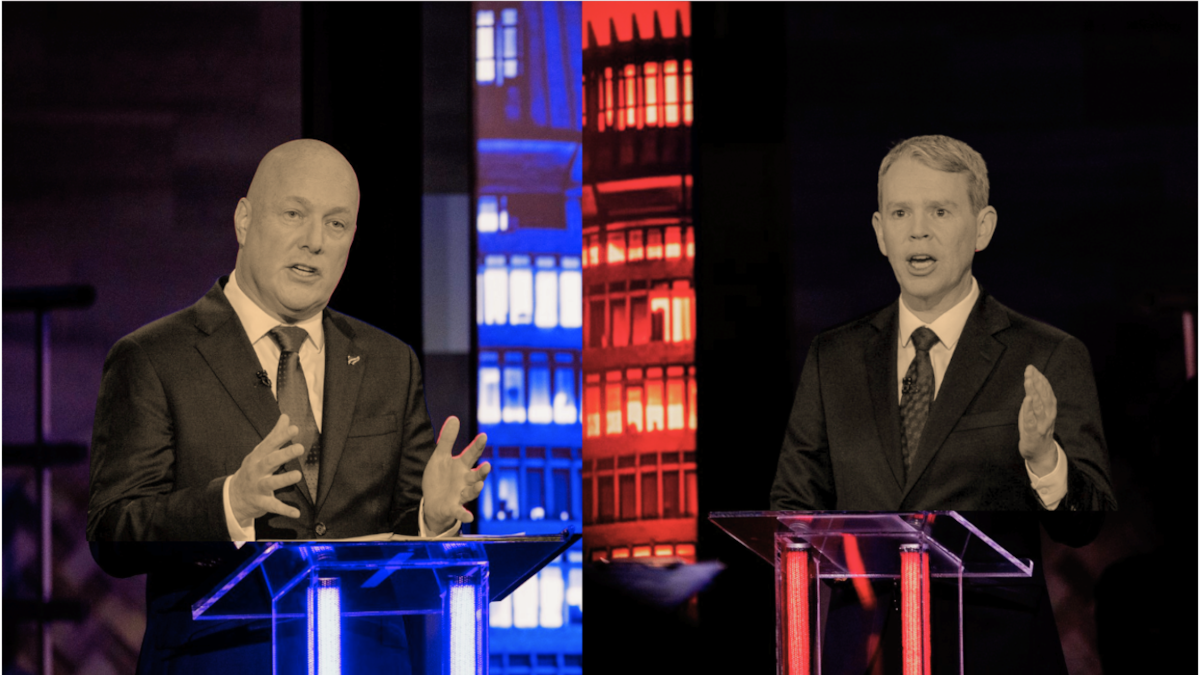
Even when their combined support was in the 60s, New Zealand was still led by a party with at least a third of voters behind it. This election could well mark the first time the biggest party in government has support in the 20s.
“We’re definitely heading into unprecedented territory, in terms of what so-called minor parties can get out of post-election negotiations,” Victoria University of Wellington associate professor in politics Lara Greaves said.
This is partly a progression of ongoing voter dealignment, where people are becoming less rigid in how they vote according to class or occupation; for example, farmers ticking blue and manual labourers ticking red. Recent social changes have seen certain issues, such as climate change, become so prominent that some voters look for new political homes.
Massey University politics professor Richard Shaw said the current voter landscape was “a logical playing out of movements of voters”.
“The 2D left-right spectrum, where votes are normally distributed across a bell-shaped curve with the mythical median voter representing where the plurality lies – that curve doesn’t exist anymore.
“That’s been disaggregated. It’s sort of lumpy.”
Other factors contribute to the collapse of main party support – not unique to New Zealand – including lower trust in institutions, foreign interference, an information landscape that promotes polarisation, and a perception – rightly or wrongly – that the status quo is doing little to improve people’s lives.
Shaw said it was not inconceivable for the numbers to fall in a way that leads to an existential reckoning for both National and Labour.
“They’re major parties in the sense that they’re the two biggest ones, but they are way less major as far as processes of government formation and portfolio allocation and day-to-day government management are concerned.”
This makes the crystal ball for what the next Government looks like murkier than ever. Several contributing factors include:
whether Opportunity crosses the 5% threshold;who holds their ground in post-election negotiations, including how back-trackable various bottom lines, rule-outs and campaign promises are;how strong the overhang is, if there is one, and in which direction; and, of course, how the votes fall on November 7.
Jonathan Boston, Victoria University emeritus professor of public policy, said this was shaping to be one of the most complex of governing arrangements.
“In particular, will Opportunity hold the balance of power or not? If so, then the Government might involve four parties, whether in coalition or some other arrangement. And the major parties will be much weaker politically than at any time under MMP and, indeed, for almost a century.”
He said this complicated post-election talks, “partly because both major parties have a number of major policy differences with potential coalition partners/support parties and partly because their political capital will be low”.
We’ve had one term of this coalition. What might it look like with a weaker National Party? Photo / Mark Mitchell
A weakened Luxon?
So how are voters to navigate what could be the new normal?
They can be traditional and vote for the party whose policies they like the most, but the chance of one party’s platform dominating the next government agenda is the smallest it’s ever been. Voters could also speculate on what a right or left bloc might agree on, after post-election talks.
“It’s a fool’s game, but we do it anyway because it’s sort of fun to do,” Shaw told the Herald.
One of the key questions, if the coalition is returned, is how many senior ministers on its party list National might lose. On current polling, Nicola Willis, Chris Bishop and Paul Goldsmith are all at risk, even more so if the Mowbray-Brash overhang strategy is effective.
“If [Christopher] Luxon is sitting in coalition negotiations and many of his senior people are gone, he’s in a really weak position. I’m unsure how long he would last,” Shaw said.
Luxon is already seen as being pushed around by Act leader David Seymour and NZ First leader Winston Peters, so how would he manage them with most of his kitchen Cabinet gone?
National list candidates Nicola Willis, Chris Bishop, Paul Goldsmith and Gerry Brownlee might not be returned to Parliament this election, depending on how the numbers fall.
National’s influence might then hinge greatly on who the next Finance Minister is, or whether the Prime Ministership is shared.
The latter was floated in NZ First’s post-election talks in 1996 with Labour and National, though Peters has said that proposal came not from him but from someone in his team. He ultimately went with Jim Bolger and National, after they accepted his request to be Treasurer.
Shaw said that Peters might have Treasurer or Finance Minister, or even a period as Prime Minister, in his sights again if the coalition were re-elected.
“Maybe [the coalition] then winds up being a little more economically nationalist, and even further right on culture wars and issues of conscience and so on.
“Then, in 2029, it really becomes quite existential for National. It’s not only going to be struggling to hold its own in the coalition, but its party organisation is going to have an absolute job on its hands trying to figure out what it is.”
Another destabilising possibility for National would be if it won the most seats of any party, but needed Opportunity to form a Government.
If Luxon stood firm on his ruling out of Opportunity, does someone in the newly formed National caucus immediately try to roll him?
Christopher Luxon has ruled out Opportunity and its leader Qiulae Wong (pictured). Does that mean he won’t pick up the phone if he needs her to form a Government after November 7? Photo / Mark Mitchell
The fiscal straitjacket on the left
As for Labour, its fiscal plan has moved it so close to National that it could almost be seen as an endorsement of Nicola Willis’ economic agenda.
It also does little to dispel the perception that it’s hard to tell Labour and National apart.
Labour does have a clutch of campaign promises to differentiate it from National, though they raise questions over how it can stick to its fiscal track while restoring pay equity, hiring more nurses and protecting public services.
Leader Chris Hipkins has repeatedly promised that the only new tax next term would be a targeted capital gains tax, but on current polling, he would need the Greens and Opportunity to have the numbers to govern, and maybe Te Pāti Māori too.
The Greens want a tax-free income threshold that has an annual cost of more than $5 billion, funded primarily from a wealth tax, as well as a jobs programme costing $6b and a public services restoration costing $3b. Opportunity wants a universal income, primarily funded from a land tax that would net $24b.
None of these are bottom lines, but that doesn’t mean there are no tensions on the left over what a fairer tax system should look like.
Labour’s CGT is the kind of reform that wouldn’t turn off swing voters in the centre, but those further left (including within Labour) want to see more redistributive economics and inequality reduction.
And Labour seems to be losing this debate. Its support has been diving at a time when, after another National caucus attempt to roll Luxon, it should have been expected to lift.
The Greens appear to be benefiting, currently polling higher than ever at about 15%, while disgruntled Labour voters are in part helping Opportunity to crest the 5% threshold.
How would Greens co-leaders Chlöe Swarbrick and Marama Davidson negotiate in post-election talks with Labour leader Chris Hipkins if he refused to budge on Labour’s fiscal plan?
Hipkins is adamant that he would hold his ground on tax in post-election talks, which would box a governing left bloc into a tight fiscal corner. Fortunately for him, Opportunity’s bottom lines wouldn’t necessarily cost so much as to unravel Labour’s fiscal trajectory.
But the Greens don’t have bottom lines, and their current level of support suggests a degree of leverage they’ve never had before.
“We never view the Greens as hard bargaining or as ferocious or cut-throat as the parties of the right, which is quite interesting because I imagine there are probably some people in that party who are good at that kind of politicking,” Greaves said.
Even if its negotiating team failed to budge Hipkins from his CGT-only tax stance, any proposed Labour-Green agreement would face a further hurdle: Green Party members must ratify it, giving them an effective veto. How would they respond to a proposal with little money for any of the ambitious wishes on which the Greens are campaigning?
“At that point, they’re damned if they do [for signing up to a term of minimal economic change], damned if they don’t [for sending voters back to the polls],” Greaves said.
“It will come down to negotiations, and there will be time pressure. Will there even be a Government before Christmas?”
A reversal of whose brand diminishes in government
An alternative would be for Hipkins to go back on everything he’s said in the campaign about tax, and let the increasingly larger tail wag the increasingly smaller dog.
This would risk a further diminishing of what Labour stands for, which may have already happened to National in this term.
This is the reverse of MMP norms so far. Minor parties in MMP Governments have previously suffered from being too tied to the dominant party, losing their brand and watching their votes collapse at the following election.
But instead of fighting for political survival, Act and NZ First remain well above the 5% threshold, while voters might be struggling with a sense of National’s identity.
Lara Greaves, associate professor in politics at Victoria University of Wellington, says it will be interesting to see how the diverse Māori representation will be reflected in Cabinet.
“Were there too many of those culture war type issues, Crown-Māori issues, the definition of men and women, when actually people were looking for economic change?” Greaves said.
National has argued it has delivered that change in difficult post-pandemic circumstances and global instability. The coalition’s agenda in those other areas was the price of that change and the reality of MMP politics.
Greaves said this might be the case but not the perception.
“I think a lot of people don’t get the flavour of National from this Government. What’s ‘Luxonism’? It’s more managing rather than a central driving force. There’s not this ideological drive or flavour.”
Part of that might be the weaker star power of the party leader, perhaps inevitable after the popularity heights of Sir John Key.
This is also an issue for Labour after Dame Jacinda Ardern. Such leaders, should they emerge, could restore National or Labour into the 30s or even the 40s.
For now, though, Greaves is fascinated by how the battle for Labour’s identity might shift.
“What happens as the more left-wing elements come into Labour, and how will some of them try and grab a brand or find a different way of doing it?”
Shaw said a governing left bloc with the major party in the 20s would also present “an existential challenge” for Labour.
“A lot of people on the Labour left, and presumably in other left-leaning parties as well, are just really frustrated by our inability at the national level to hold a policy conversation that doesn’t default to the broad parameters and economic models that have been in place for 40-odd years.”
Massey University politics professor Richard Shaw.
Discontent among Labour’s left might have started brewing during the 2020-23 term, he said.
“Labour had the chance to do some major revision and chose not to do so. That is in part why some have left that party for an alternative.
“As far as this election is concerned, it’s easy to see a doomsday scenario for National, but there absolutely is an existential moment for Labour as well.”
How a right or left governing bloc might look
New Zealanders already have a sense of what a National-Act-NZ First coalition is like, so it’s not a big leap to envisage one in which National holds a weaker hand.
As Shaw and Greaves said, it might move further into areas such as so-called culture wars and “Māori issues”, as Nicola Willis has described them.
Act and NZ First could pressure National towards axing or reforming the Waitangi Tribunal. They could also push National towards removing New Zealand from the Paris climate accord, which National wants to stay in because of potential trade ramifications.
But two parties’ support for a policy doesn’t necessarily mean it would happen. Peters, for example, ensured the National-NZ First coalition agreement committed to keeping the pension age at 65.
Would he prioritise that again? What about funding for the Ministry of Foreign Affairs and Trade, which National and Act want to raid?
Agreements might also contain policies that weren’t campaign priorities, such as this Government reversing Labour’s tobacco policies, or the Greens’ referendum on legalising cannabis in its 2017 agreement with Labour.
Asked whether he trusted Act leader David Seymour, NZ First leader Winston Peters said in the first multi-party debate that they shook hands and made it work. Photo / Mark Mitchell
A weaker National doesn’t make it any easier when it comes to areas where Act and NZ First are ideologically opposed, such as asset sales, government handouts for failing businesses, foreign investment, immigration, and whether to break up the supermarket duopoly or the energy gentailers.
Some of this tension has played out this term, for example in the health and safety reforms that NZ First pushed out until next term, and Act’s regulatory standards law, for which Peters voted but wants to repeal.
There are also areas where the three parties are more aligned, such as welfare, education, and law and order, though Peters has said he’s against drug-testing beneficiaries, which Act and National support.
A key fiscal point of difference between potential right and left blocs is the carbon credit bill of potentially billions of dollars, should New Zealand remain in the Paris Accord. The coalition parties have said they won’t pay it, while a governing left bloc is more likely to, given those parties’ stances on Paris obligations (an Opportunity bottom line) and climate action in general.
As happens when governments shift from right to left, such a bloc would also swing the balance of power away from employers and towards unions (Fair Pay Agreements might be quickly retrieved from the dustbin), from landlords to tenants, from workplace site managers to health and safety officers. These are also policy moves that wouldn’t break the Government’s books.
Welfare changes, however, are generally pricey. Hipkins has already said he wouldn’t roll back the coalition’s benefit cuts for those under 20 because he can’t afford it.
A left governing bloc would also be more likely to move more quickly away from fossil fuels (whether they are needed in a dry winter is a heated political debate) to renewables, from roads towards public transport, and from extractive industries towards environmental protection.
It would also be more open to policies targeting racial inequity and empowering Māori voices at decision-making tables, though Labour might be less willing to call this “co-governance”.
Hipkins would likely be more hesitant to move towards a less punitive justice system, given how heavily this issue hurt Labour in 2023. It might also have a hefty price tag, for example to expand specialist courts such as the Alcohol and Other Drug Treatment Court, which the Greens and Opportunity support.
Dropping the need for so many prison beds would give a left bloc some fiscal headroom, though it would be a hard sell to say it wouldn’t lead to increasing violent crime – even though it didn’t between 2018 and 2022.
Drug law reform is also a space where parties on the left might broadly agree, and where those on the frontline have been asking for a fit-for-purpose law for a long time.
All of this is entirely speculative, of course. We could even end up with a right-governing bloc with Opportunity, if Luxon decides to pick up the phone after all.
Derek Cheng is a senior journalist who started at the Herald in 2004. He has worked several stints in the press gallery team and is a former deputy political editor.