
There was also a captain’s innings from a rejuvenated Codie Taylor, whose desire to get involved was undeniable, and his speed with the ball in hand more than a little surprising.
All Blacks skipper Codie Taylor makes a break during the second Bledisloe Cup test. Photo / Photosport
It all looked so effortless and yet it was anything but. The work rate was incredible to ensure that once again the deadly Wallaby openside Fraser McReight barely featured in the first half.
It was all New Zealand. Wave after wave of flowing attack where the Wallabies had no idea how to stop it. If it wasn’t Sititi, Lakai, Barrett or Holland smashing hard and straight, it was McKenzie or Barrett pushing the ball wide, where the underappreciated Josh Moorby demonstrated the value of timing and footwork.
It was so destructive that the game was over by halftime and the Wallabies were genuinely on their knees as they headed back to the sheds for the break – the speed and aerobic content of the game having left them gasping them for air.
It was the most impressive 40 minutes of rugby the All Blacks have played in a decade and it went a long way to resetting expectations and potential horizons.
Dave Rennie’s vision is starting to be seen more clearly now. The pace of game he wants his team to play and the skills he wants them to express are all starting to make sense and become second nature for most of the players.
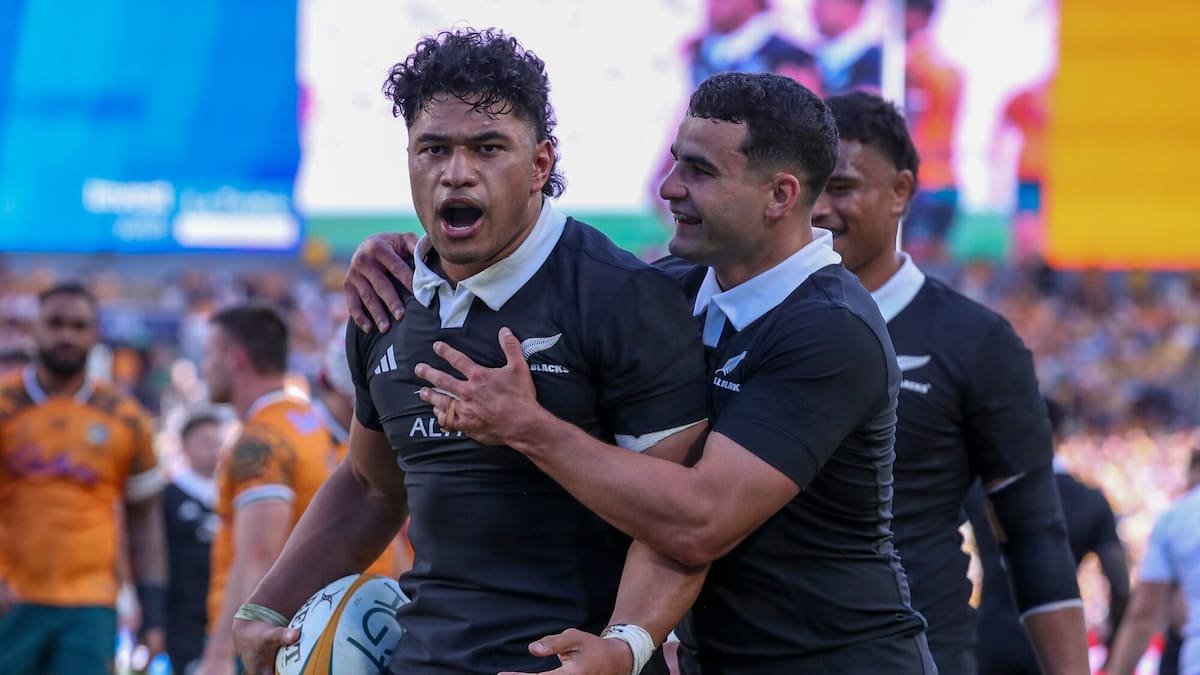
Josh Moorby celebrates with Beauden Barrett after another try against the Wallabies. Photo / Photosport
There is a flow and confidence building and a better understanding of how to balance the kick-pass-run ratio and where to play and when to take risks.
It would be easy to say that the Australians afforded New Zealand too much time and space in which to play, but it was more the case that the All Blacks earned their momentum.
They fought their way through the first line of Wallaby defence and then exploited the space they had worked to create.
For the last few years there have been growing concerns about the quality of New Zealand’s best players’ skill-sets and their ability to pass and catch with the same sharpness as their predecessors.
Fears had been building that the Covid years, the break-up of Super Rugby and an unchecked and unfounded smugness about the perceived quality of development programmes had eroded the quality of New Zealand’s rugby IP and ability to lead on the world stage.
There is, though, clearly nothing wrong with the foundations of the game. Some of the passing under pressure and out of contact was outstanding.
Holland had some lovely soft hands at times, McKenzie threw a ridiculous ball 40 metres across the field and in almost every phase there would be an All Black adapting or manufacturing a pass that enabled the attack to keep going.
But the satisfaction that came from the speed and accuracy of the first 50 minutes was somewhat diminished by the ragged and erratic nature of the last 30.
New Zealand lost their shape and momentum after they had scored 43 points. Their bench came on and added not much, with Australia able to forge their way back into the game in terms of possession and momentum and get some pride back with three tries.
That the All Blacks faded the way they did took much of the shine off the performance. It ended up feeling a little underwhelming – the whole business hardly helped by the fact the visitors finished up with 13 men on the field after they ran out of replacements and then Chay Fihaki was yellow carded.
The All Blacks should really have belted the Wallabies into some kind of record loss having built a 43-7 lead with 30 minutes to play, but at least they know for sure that their attack game can run teams off their feet and be just about unstoppable when it is done well.
Gregor Paul is one of New Zealand’s most respected rugby writers and columnists. He has won multiple awards for journalism and written several books about sport.