

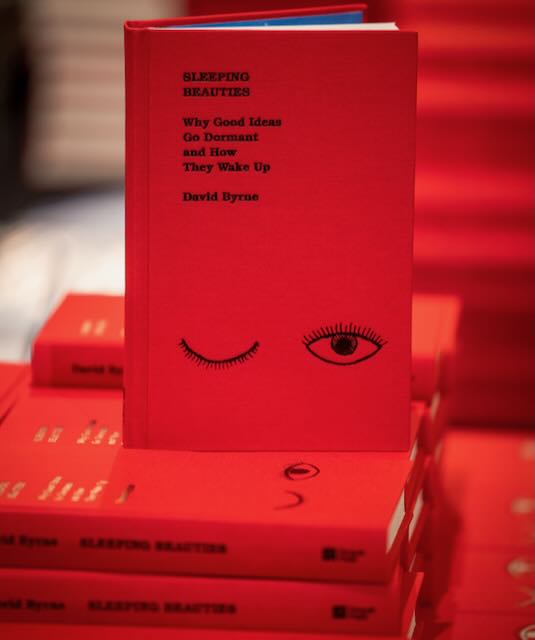
A rain-drenched but enthusiastic audience of David Byrne and Talking Heads fans greeted the artistic polymath Thursday night at the Athenaeum Center. There was no music from the new wave musician and Byrne also broke the mold of Chicago Humanities events by taking the stage alone. He was there to talk about his new book, Sleeping Beauties: Why Good Ideas Go Dormant and How They Wake Up.
The typical CHF format is the guest and a local/celebrity interviewer in two armchairs, center stage. Byrne stood alone at side stage with a large projection screen dominating the stage.
He began with a short introduction to the book and how he planned and researched its completion. His concept of “sleeping beauties” refers to artistic and product innovations that were briefly recognized and even popularized, only to be forgotten and rediscovered many years/centuries/eons later.
 Photo by David Kindler, courtesy of Chicago Humanities.
He went on to describe the book itself by telling us “a series of stories and how they were forgotten—and how they were rediscovered.” That in a nutshell is the theme of the book. Some of the five stories he tells are in the book and some are not. (Because, he explained, you can’t fit everything you research in a book of average size. His is 400 pages)
Byrne apparently reads scientific journal articles as normal mortals read novels—for enjoyment as well as intellectual insights. He found the title of his book in a 2004 article about scientific papers that were long forgotten and then revived.
These are the stories he told, accompanied by projected visuals. If you think the headline is clickbait: No, one of them is erotic.
Concrete
Concrete, that mundane mix of sand, gravel and water, was famously used to build important structures in the first century AD—structures like aqueducts and the Coliseum in Rome, still standing today. The material fell out of fashion in the middle ages and became popular again in the 1800s, when the invention of Portland cement inspired concrete’s use in homes. Later the development of steel rebar to support concrete walls and columns made it useful and popular for tall buildings.
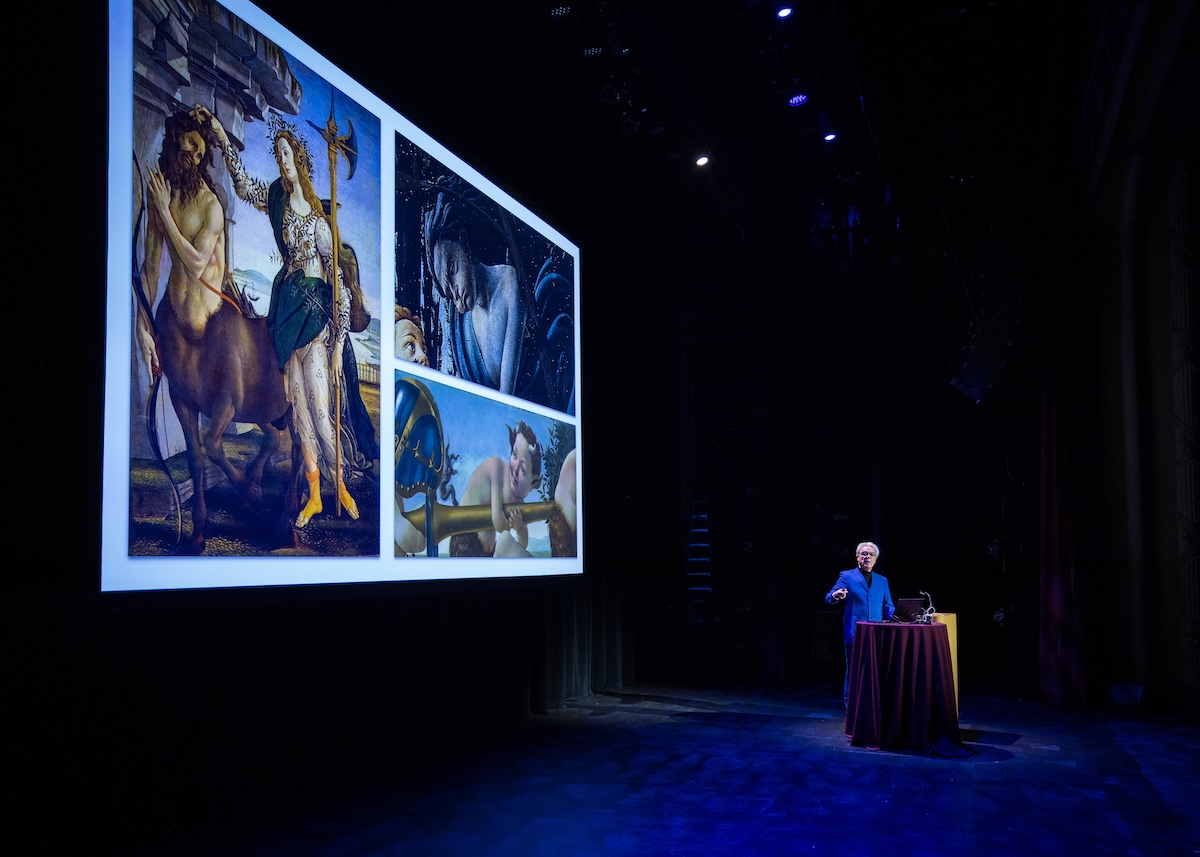 David Byrne discusses Botticelli. Photo by David Kindler; courtesy of Chicago Humanities.
Botticelli
Sandro Botticelli‘s figurative drawing and painting with its graceful, flowing lines and dreamlike style was in favor in the 15th century and then mostly dropped out of fashion. The pre-Raphaelites—such as Dante Gabriel Rossetti, John Everett Millais and William Morris–made it fashionable again in the late 19th century.
Scientist Lynn Margulis
Lynn Margulis today is considered a pioneer in the study of modern endosymbiosis theory. (I’m giving you that definition to read; I’m not going to try to explain it.) Margulis’ work in the 1950s and ‘60s was neglected, probably because she was a woman.
Her work was controversial throughout her career. Her early and important article, “On the Origin of Mitosing Cells” was rejected by 15 journals before finally being accepted and published in 1967. Her work was important in development of the metamorphosis theory. Her writing became controversial again later because of her views on the AIDS.HIV theory. She has been called a “vindicated heretic.”
The Concept of Zero
The concept of zero was an important element in the development and use of Arabic numerals and makes maths education and financial and scientific calculations possible. (Because, to paraphrase David Byrne, can you imagine doing algebra or accounting with Roman numerals?)
Zero started probably 5000 years ago as a placeholder, a positional notation, in early languages—rather than just standing for “nothing.” It was symbolized differently by different cultures; sometimes it was a dot or circle or a slanted double wedge. By the time of the Renaissance, the use of zero as a numeral was part of the Arabic numeral system, which began to replace Roman numerals in everyday applications. Zero and Arabic numerals paved the way for progress in mathematics and commerce.
The Clitoris
Byrne’s projection of this title on the giant screen surprised the entire audience, which erupted in applause and laughter. The clitoris and its purpose in female anatomy was known as early as 400 BCE, later dismissed as a flawed version of the male organ, then banned because of its erotic uses, and rediscovered several times over the centuries. Its disuse (if that be the case) was certainly because men were doing all the analyzing and deciding, Byrne pointed out. In the mid-20th century, it was rediscovered again, probably because of the work of feminist writers.
Of course, it was also known in the 19th century as a remedy for women’s “hysteria,” as in the delightful Sarah Ruhl play, In the Next Room, or the Vibrator Play.
Sleeping Beauties: Why Good Ideas Go Dormant and How They Wake Up is available from the publisher or your favorite bookseller.
Did you enjoy this post? Please consider supporting Third Coast Review’s arts and culture coverage by making a donation. Choose the amount that works best for you, and know how much we appreciate your support!