
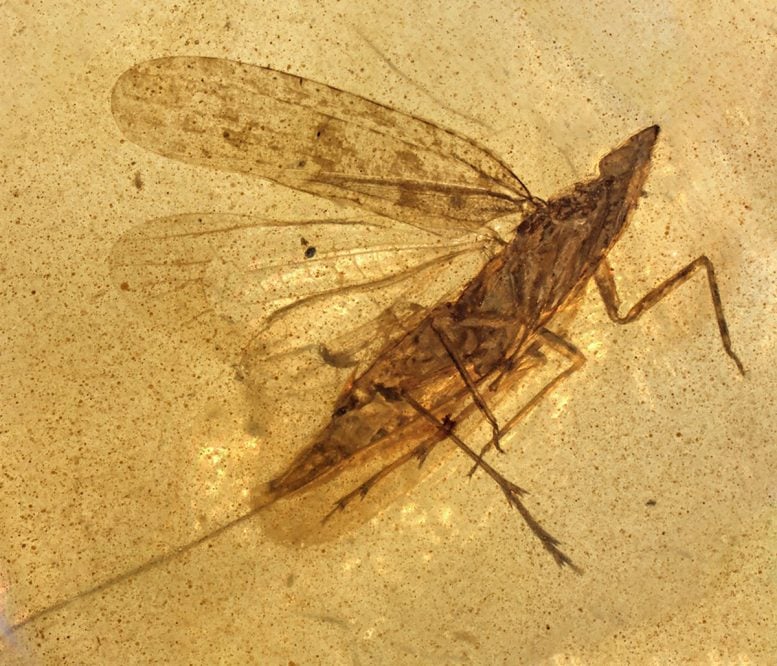
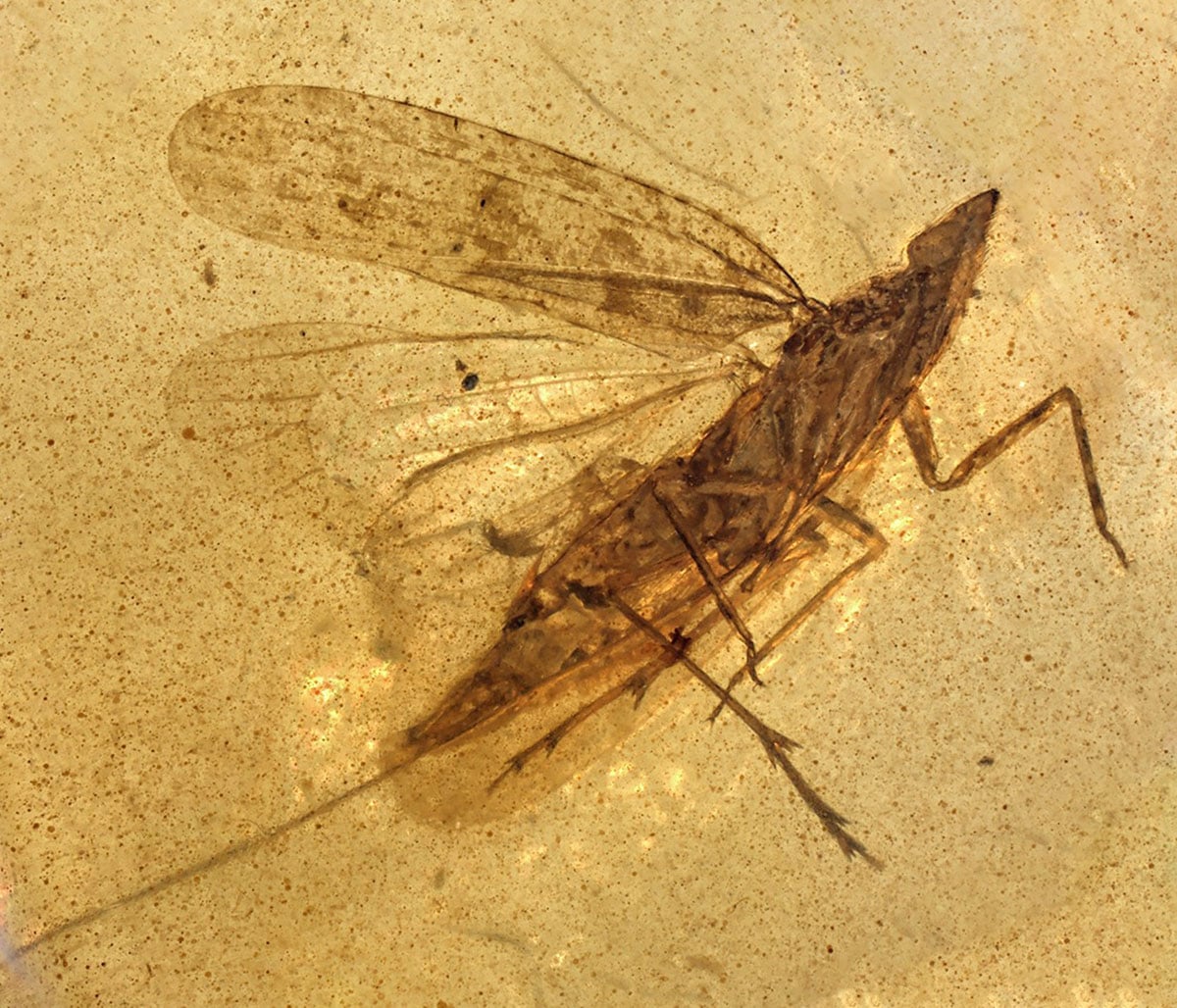
 The newly described species: Cretoduros noonoo. Credit: Dolev Fabrikant
Like a bendy straw, an ancient insect’s folded mouthparts may have flexed without collapsing, revealing a feeding adaptation unknown in living planthoppers.
About 99 million years ago, a tiny insect became trapped in tree resin with mouthparts nearly twice the length of its body. The resin hardened into amber, preserving an unusual feeding organ that researchers think could bend through narrow cracks in tree bark to reach sap.
The newly described species, Cretodorus noonoo, takes its name from Noo-Noo, the friendly vacuum cleaner in the children’s television series Teletubbies. The character’s long, flexible hose resembles the ancient insect’s mouthparts.
Long mouthparts, little evidence of pollination
Noo-Noo belonged to Neazoniidae, an ancient family of planthoppers. In a study published in the journal Insects, researchers examined fossils from this family, including 13 specimens preserved in Kachin amber from Myanmar. Their living relatives use mouthparts shaped like a simple needle to pierce plant tissues and suck out fluids.
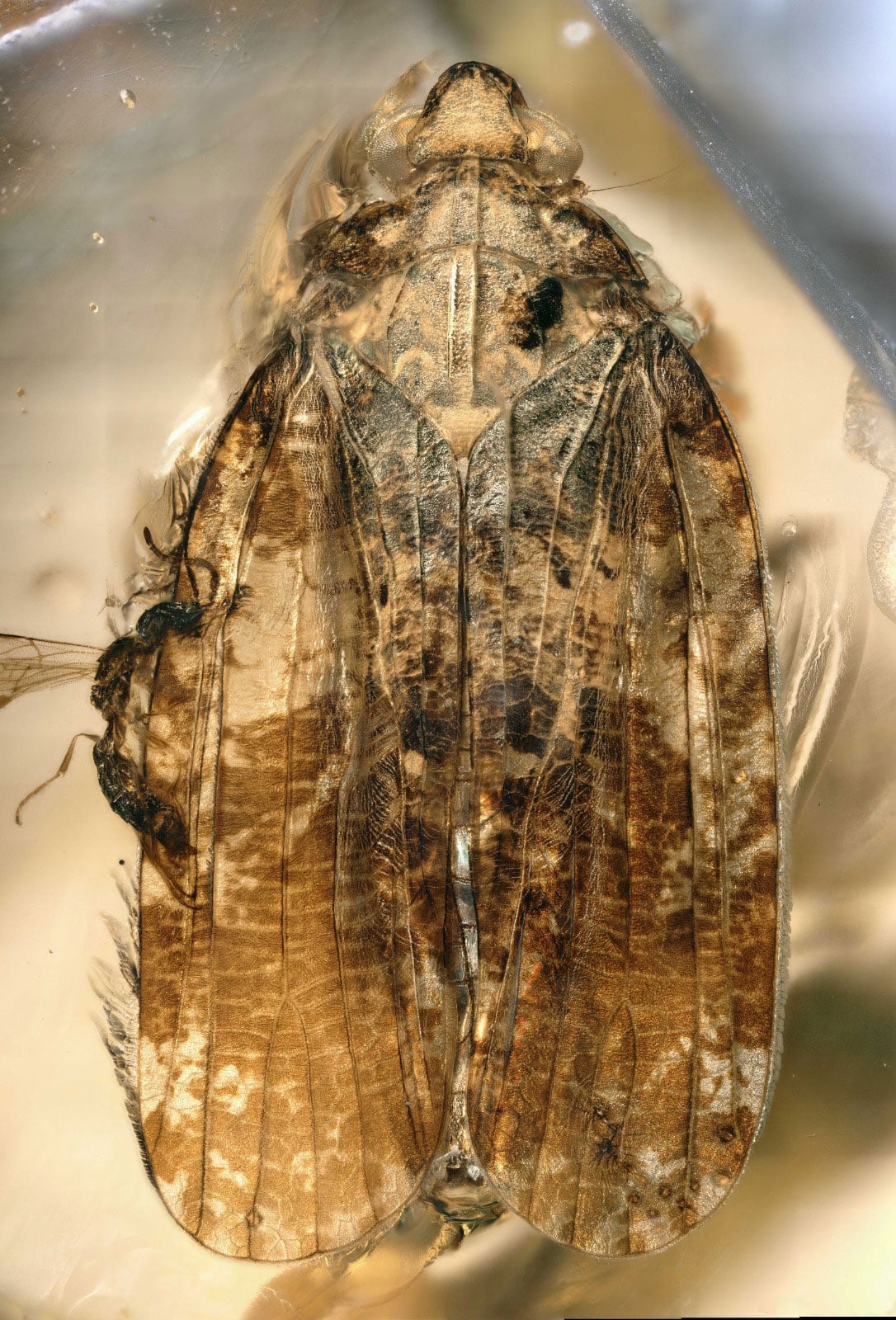 An amber fossil of a Neazoniid planthopper. Credit: Dolev Fabrikant
Although the ancient insects’ long mouthparts might bring a butterfly’s flexible proboscis to mind, the researchers consider that resemblance superficial. Butterflies use their proboscises to drink nectar, whereas Noo-Noo’s mouthparts pointed backward and formed a piercing-and-sucking system less suited to nectar feeding. The researchers also found no convincing evidence of pollen accumulating on the insects’ bodies despite examining numerous fossils. Such accumulations would have supported a possible role as pollinators.
Mouthparts that could bend without collapsing
The elongated mouthparts of the ancient insects were densely covered with crosswise folds. Using high-resolution micro-computed tomography, the team reconstructed their internal structure and found that the folds were part of the organ’s construction, rather than merely surface decoration. Like the corrugations in a bendy drinking straw or flexible hose, the folds likely allowed the mouthparts to bend while keeping them from kinking or collapsing.
Several specimens had their mouthparts preserved in bent positions. Since the resin held the insects in place when they became trapped, the researchers regard these bends as additional evidence that the organs were flexible during life. This folded structure is unknown among their living relatives, suggesting an evolutionary adaptation that has since disappeared.
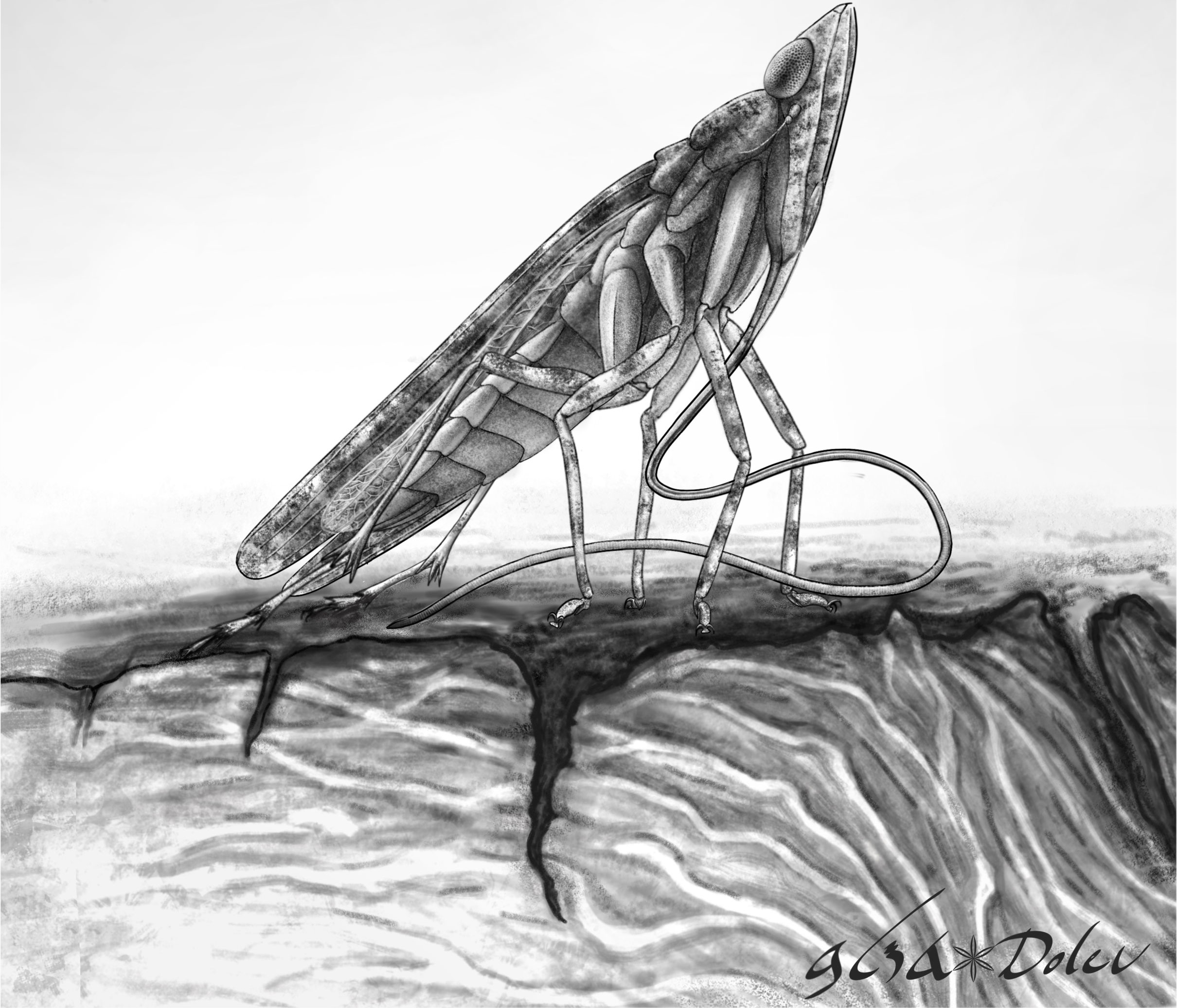 Illustration of Cretoduros noonoo. Credit: Dolev Fabrikant
The researchers propose that these insects specialized in feeding on tree sap. Their long, flexible mouthparts could have threaded through narrow cracks in bark, guiding the piercing organs toward deeper vascular tissues, which transport fluids through a plant. Two grooved lobes at the tip may have helped secure the mouthparts during feeding. The team thinks these lobes opened against the walls of a crack, anchoring the organ much as a wall plug expands inside a drilled hole.
Thick bark may have favored flexibility
Similar feeding structures appeared beyond this one family. Several unrelated insect groups developed long or corrugated mouthparts during the Cretaceous period, raising the possibility that forests rich in thick-barked trees favored insects able to reach deeper tissues. The study notes evidence of recurrent fires associated with resin-producing Cretaceous forests, and trees in fire-prone environments often develop thicker bark. The researchers cautiously suggest that these conditions may have opened opportunities for feeding strategies now almost entirely absent among planthoppers.
 Lead authors of the study. Dolev Fabrikant (right), Dr. Leonidas Romanos Davranoglau (left). Credit: Dolev Fabrikant
The research was conducted by Dolev Fabrikant and Dr. Leonidas-Romanos Davranoglou of the School of Zoology, Wise Faculty of Life Sciences, The Steinhardt Museum of Natural History, and New Environmental School at Tel Aviv University, in collaboration with Dr. Yanzhe Fu of the Nanjing Institute of Geology and Palaeontology of the Chinese Academy of Sciences.
Davranoglou said, “The discovery of ‘Noo-Noo,’ a new species that lived approximately 99 million years ago, gives us an extraordinary glimpse into the insect world of the age of the dinosaurs. This is not merely an insect previously unknown to science, but an animal that developed an evolutionary solution with almost no modern equivalent: a long, flexible, and durable feeding organ that likely enabled it to reach food deep within tree bark.”
He continues, “The fact that similar structures appeared in several insect groups during the Cretaceous period suggests that ancient forests created ecological conditions and opportunities very different from those we know today. The discovery of a new species like this is therefore not simply the addition of another name to the tree of life, but another piece of the puzzle that enables us to reconstruct what ecosystems looked like and how they functioned tens of millions of years ago.”
Reference: “Flexible Drinking Straws of the Cretaceous: A Novel Type of Labium in Mesozoic Auchenorrhyncha and Its Functional Implications” by Dolev Fabrikant, Yanzhe Fu and Leonidas-Romanos Davranoglou, 28 July 2026, Insects.
DOI: 10.3390/insects17080789
D.F was funded by a PhD Scholarship from the New Environment School at Tel Aviv University. D.F was supported by the Chinese Academy of Science International Visiting Student program (Project: 132432GJHZ2025011STUPRO).
Never miss a breakthrough: Join the SciTechDaily newsletter.
Follow us on Google and Google News.