
After a terminal cancer diagnosis, Karen Barnett is putting the fun into a FUNeral she plans to hold before her death. She’s one of many refusing to go quietly.
Karen Barnett watches her friend’s reaction as she spots the playlist lined up for their girls’ road trip. “Songs
for my funeral” could be full of tear-jerkers but that’s not Barnett’s style. The banging singalongs she’s chosen for her big day reflect her approach to dying, which could be summed up as “celebrate living life rather than dwelling on its ending”.
Barnett, who lives in Auckland, was diagnosed with incurable breast cancer at 38 and told she might have only 15 months to live. Nearly six years later, she’s passed her “best before date” and is working her way through a still-growing bucket list, making every heartbeat count, and most importantly to her, encouraging others to do the same.
“My approach is that life is 10% what happens to you and 90% how you respond,” says Barnett, 44, who undergoes chemotherapy every three weeks and is often fatigued and extremely nauseous.
Her list has included overseas travel that’s reconnected her with family, swimming with dolphins, and bungy jumping, despite her fear of heights. She still works part-time as a counsellor for children and teenagers, volunteers at Riding for the Disabled, and last year, adopted a puppy. She also fundraises for charities, including Sweet Louise, which cares for Kiwis living with metastatic breast cancer.
Her oncologist noted on her file, “Karen would like honest and frank discussions about her prognosis because she wants to organise a massive party before her death.”
She’s dubbed this her FUNeral, and it will be a colourful Hawaiian-themed celebration, with an MC and speeches. She encourages others to achieve what’s on their bucket lists, take videos and share them.
The date for this funeral depends on how her cancer progresses. When her oncologist tells her death is near, plans will be put in motion.
“My goal long before I was diagnosed was to change the world one person at a time. If I can encourage others to make the most of living, it makes everything worthwhile.”
But friends and acquaintances don’t always share her exuberant approach to death; some steer clear of the topic to avoid saying or doing the wrong thing.
Silence can hurt more than an awkward conversation, says Barnett. “My advice would be to just say something. You don’t have to have the right words. You can simply say, ‘I don’t know what to say, but I’m here.’”
She says sometimes the hardest part is feeling as if some people have already started grieving her, even though she is still with them.
“It can make dealing with a terminal diagnosis even harder. It doesn’t just happen with people I haven’t seen for a while either. It happens with family and close friends too.”
Karen Barnett’s bucket list, clockwise from top left: Meeting a dolphin at Sea World on the Gold Coast; suited up to be attacked by a police dog in Hamilton; a meerkat encounter; a SkyRide bungy jump with TV host Bree Tomasel for Daffodil Day, and a Dubai desert visit. Photos / Supplied
Navigating the end
Richard Egan, an associate professor of health promotion at Otago University, is a patron of the End of Life Doula Alliance Aotearoa. While birth doulas – a non-medical supporter during labour – are at the start of life, death doulas are there at the end. They complement our current end-of-life-support system, he says.
“They are like navigators. They are death literate and aware of all the systems – before, during and after death. This is a boon in a healthcare system that’s often completely strained, especially because of the ageing tsunami. That means there’s also going to be a tsunami of dying – and we want to do that as well as possible.
“People used to die in days and weeks – my granddad died mowing the lawns. But most of us will die of cancer or heart disease, and it takes a long time. That’s a long time to be thinking about all the issues in the context of dying, and doulas can help through that process.”
Barnett goes as far as saying cancer’s been a blessing, a wake-up call that invigorated her. Despite her overarching lightness though, concern for her family weighs heavily.
“I think the biggest fear for most people who are dying is not what’s going on for them, but how everyone else will cope emotionally,” says death doula Deborah McCullough, who Barnett engaged last year.
McCullough’s role includes helping people write a death plan, outlining how they want their ending to be. This could be as detailed as whether they’d like flowers in their room, certain people kept away or even whether they want the doula present. Medical wishes are also part of the plan – for instance, whether feeding tubes or catheters are acceptable.
“When you have that plan, it empowers you to just live life,” says McCullough, who likens her role to a midwife. She’s also an educator, demystifying the dying process. “Often, fears around what dying will look like stop people enjoying the time they have left.
“Classic signposts someone is close to dying include terminal restlessness, which as doulas we often understand as people wrestling with the fact they’re letting go of their physical body and moving to another realm. Another is hearing the voices of people who have passed. If they’re hearing them coming from outside in the hallway then they’re further away from dying than if they were hearing them in the room with them. Knowing what these represent can be really enlightening.”
Richard Egan and Deborah McCullough. Photos / Supplied
McCullough, a former beauty therapist and business owner, became a doula two years ago. She was widowed suddenly when her husband, Steve, died of cancer at 47. Their daughters were 12 and 15. The family had hoped the treatment offered when the cancer was first diagnosed would enable a full recovery, but only four months later, they learned the cancer had metastasised. Three days after that, he was gone.
“I realised this was a way to help others die better than Steve did,” says McCullough, who retrained as a death doula in the US. “It was really traumatic for us all sometimes, and scary and awful. If there’d been someone there to tell us what to expect we’d have realised that some of it was normal, and not as awful as we’d thought.”
Like writing a will, death plans are best completed before a terminal diagnosis, she says.
“We’re all going to die. It’s a 100% hit rate, yet we spend more time planning a holiday,” says McCullough.
Hiring a death doula costs anywhere between $45 to $200 an hour, partly dependent on clients’ individual needs, though doulas can sometimes help identify sources of funding. Similar to a midwife, they’re on call near the end of life.
Richard Egan’s research includes understanding what makes for a good death, focusing on spiritual care at the end of life. “You’re likely to have a better experience if you have some framework for understanding life and death.” Religion engenders a natural familiarity with death and dying, he says. “Most of us don’t have that familiarity any more though because 80% of the population aren’t actively religious.”
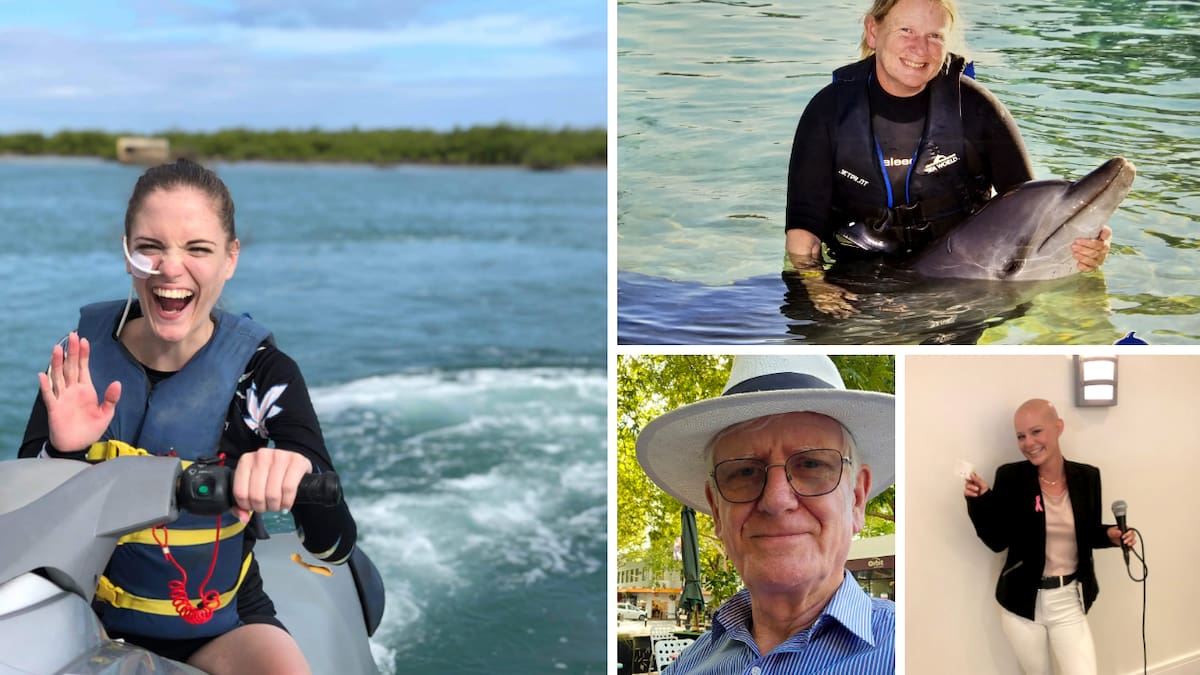
The fuck-it list: Before her death in 2023, Georgia Ferris ticked off skydiving in Motueka, a jetski ride in Honolulu and, right, a living wake. Photos / Supplied
A living wake
Georgia Ferris, who died in November 2023 at 27, left warm memories well beyond her family. In the care of Nelson Tasman Hospice, she had had Ehlers-Danlos syndrome, a genetic connective tissue disorder that led to gastrointestinal failure. Admitted to the specialist palliative care unit, Georgia organised a pyjama party for the entire facility.
“Even the CEO and charge nurse wore PJs that day,” says Liv Ferris, Georgia’s twin. Other patients came out of their rooms for the party, which included music, a catwalk show and prizes.
“The hospice was phenomenal,” says their mother, Robyn Maxwell. “People don’t know that hospice helps you live well while you’re dying. It was like being enveloped in a korowai of love and care.
“She was a beautiful young woman with a big heart. She showed everyone it’s possible to live while dying, with graciousness and dignity.”
Following her terminal diagnosis, Georgia had been working through her bucket list, which she dubbed her “fuck-it list”. She also set up a charity, Treasure Troves, for children in hospitals nationwide and shaved her head to raise money for a friend with cancer and donated her hair for a wig.
As she became too sick to tick off the remaining “fuck-it list” items herself, friends, family, and even a member of the hospice staff did it for her, videoing and sharing their experiences with her. Before she died, she threw another meticulously planned party – her living wake.
During many wakeful nights, she would pass time drawing mandalas and gifting them to people. A doctor suggested she make a book, so she did, and gave the rights to the hospice. So far, it has raised $5000.
Government funding covers only about 65% of hospices’ clinical services, so initiatives like these are invaluable, says Hospice New Zealand CEO Wayne Naylor.
This year, Health New Zealand announced an extra 10% in funding ‒ $12 million ‒ with much of it targeting underserved areas. “This goes some way to addressing inequities of palliative care access nationally, but is not a full solution to the postcode lottery.”
Before joining Hospice NZ, Naylor was director of nursing at Hospice Waikato, where funds raised by the Race4Life charity helped make wishes come true for terminal patients. “One person wanted a final dinner of crayfish,” says Naylor. “Race4Life didn’t just organise that, a chef came along, too, and cooked it on site for the whole family. It helped make a very special memory.”
Living it up: Geneva Gill at a Breast Cancer Foundation event; with husband James on their wedding day in 2022; with her dog Bowie. Photos / Supplied
Last wishes
Race4Life Trust founder Viv James had previously been the patient programme leader at Mercy Hospice in Auckland, where she helped grant people’s wishes and organise memorable events and activities.
In 2015, she set up the trust to fulfil the wishes of palliative care patients nationally. Through it, her team granted more than 600 wishes. “We worked with incredibly generous communities throughout New Zealand who made these amazing things achievable.”
One case she remembers vividly is that of a 37-year-old father with terminal cancer who was sad he wouldn’t be able to dance with his then-teenage daughter at her future wedding. Viv rallied a team and together they created a groom-less mock wedding at an Auckland venue, complete with a tuxedo for the dad, wedding dress for his daughter, catering and musicians.
“We videoed everything, including the father-daughter dance, for her to use at her own wedding.”
She says such events “enabled patients to look beyond the confines of life-limiting illnesses”. “The biggest privilege was for us volunteers seeing the magic and importance of embracing the beauty of life.”
We were privileged to witness humanity at its best, and joy around death.
Viv James
Following Covid, instead of granting individual wishes, the trust focused on its annual Hampton Downs Track Day. At these, with more than 400 volunteers helping, there were rides in helicopters, on motorbikes and in classic cars, fire engines and supercars. But this year’s event will be the last for the charity, which is winding up.
One of those at the Hampton Downs event in 2023 was Geneva Gill, diagnosed with incurable cancer at 25. Her father Paul Simpson considers himself lucky to have been there with her.
“It was incredible,” says Simpson. “Geneva was a bit of a rock star and these were life experiences she wouldn’t have had otherwise, and memories we got to make together.”
Geneva’s breast cancer had been in remission for only a few weeks before she found out the cancer had spread to her lymph nodes and lungs. It was the trigger to her seizing every opportunity she could, says her mum Lisa Wilson, who describes Geneva as beautiful, smart and kind. She had been dedicated to her studies, worked hard, and volunteered with Youthline and Coastguard.
“She did this big change where she said ‘yes’ to everything. Some things you wouldn’t think she’d have been able to do, given what she was going through. She’d go swimming at night with her friends, throw amazing parties, travelled, went jet boat sprint racing, bungy jumping, and skydiving from 10,000 feet.”
For her parents it was sometimes hard to see her take on so much. “It was a double-edged sword because we didn’t want her to take off any extra life by exerting herself too much. She could be pretty feisty though, and if we voiced concern, she’d say, ‘What’s the worst that could happen? It could kill me?’
“It wasn’t that she had a bucket list, it was about having fun and creating memories. She always had a smile, and she did everything with grace and sheer determination, right to the end.”
Despite her terminal diagnosis, she also graduated with a degree in psychology and fulfilled another wish, getting married to her partner James Gill.
“To have been able to call her my wife makes me feel like the luckiest man in the world,” says James. “She was really determined to do good and help people.
“It was quite remarkable how beautiful this girl was, and she had no hair, but there was just this beauty that shone out in her face. Our first date lasted three days because we didn’t want to leave each other.”
The couple married in May 2022, a year after they’d met, and just six months after Geneva’s illness was found to be terminal. “It was amazing and felt really important for me to give her that,” says James. Geneva died 20 months later, aged 29.
When Declan O’Neill was diagnosed with stage 4 melanoma, one of the first things he and wife Jill did was include their son, daughter-in-law and 12-year-old granddaughter on a trip they planned to Europe. Photo / Supplied
The early exit
Declan O’Neill was diagnosed with stage 4 melanoma 21 months ago, though you wouldn’t know it to meet him, with his seemingly boundless energy.
“Like anybody who’s had a close encounter with their own mortality, you look at what the future might hold,” says the 75-year-old, who began immunotherapy following the discovery that the cancer had spread to his lungs. “I looked at how this might end if treatments don’t work and realised it was time to be proactive about really living, rather than just letting life happen.”
One of the first things he and wife Jill did was include their son, daughter-in-law and 12-year-old granddaughter on a trip they had planned to Europe.
With a career in corporate video production, O’Neill also decided to make a film, The Waiting Room, about the time between a terminal diagnosis and assisted death, focusing on end-of-life care in the remote Marlborough Sounds.
Twenty years ago, he watched his sister die from multiple system atrophy, seeing for himself the toll degenerative diseases have on the patient and loved ones.
“Having witnessed the sort of death some people have, I’ve said I wouldn’t want to put my family through that type of long, traumatic experience, so if I ever had something of that ilk, I’d prefer to go down the other route of assisted death if I could.
“It’s very much a taboo subject but I think people really want to talk about what death is actually like, and what choices are realistically open.”
One thing Karen Barnett’s never been afraid of is discussing what lies ahead. It’s one of the reasons those around her are able to support her, she says.
She’s still adding to her FUNeral playlist, and her bucket list, with attendance at the 2027 Rugby World Cup a high priority.
“I want to keep encouraging people to believe in themselves and to live life. The more I can achieve that, the more it makes this worthwhile. My advice is don’t wait for a terminal diagnosis, because none of us get out alive.”
SaveShare this article
Reminder, this is a Premium article and requires a subscription to read.
Copy LinkEmailFacebookTwitter/XLinkedInReddit