
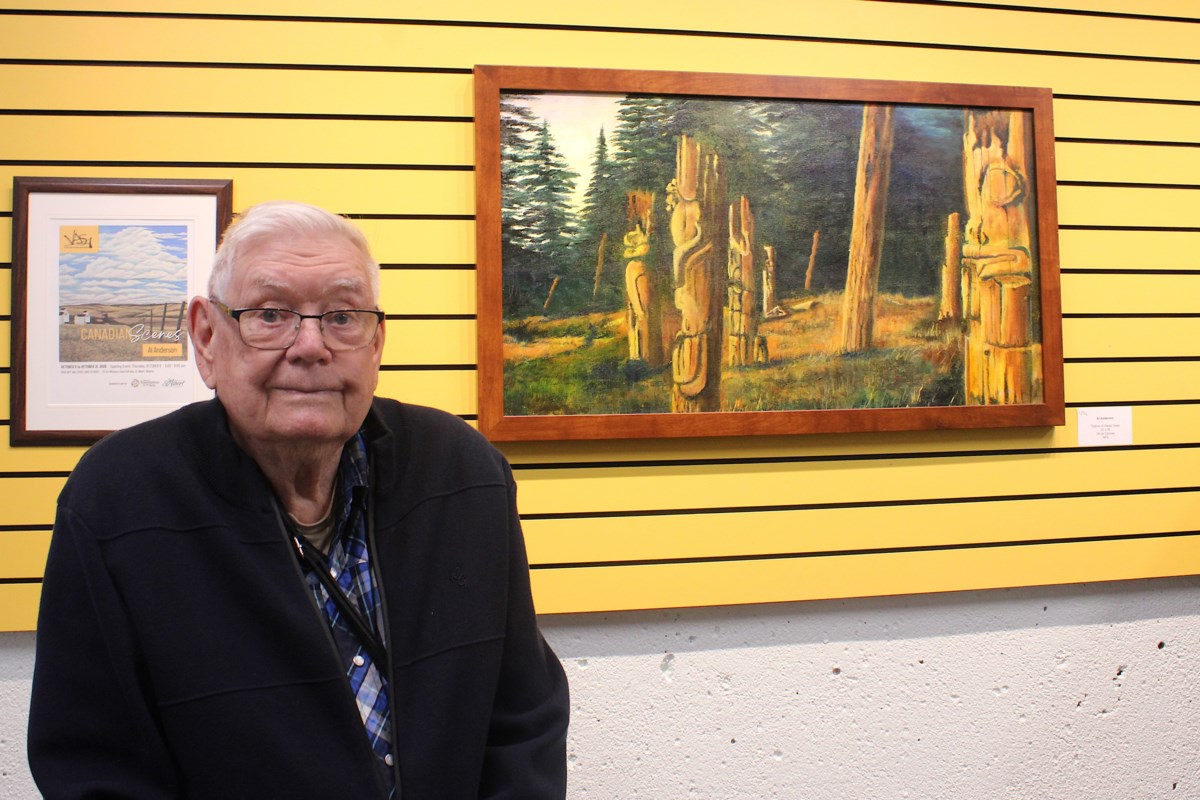
St. Albert artist displays his Canadian Scenes.
For nearly 50 years, Al Anderson has turned photographs of Canada’s landscapes into detailed oil paintings, drawing on decades of travel across the country to capture the wilderness, waterways and communities that have shaped his life.
The St. Albert artist is showcasing that work in Canadian Scenes, an exhibition at the Visual Arts Studio Association running until Saturday, Oct. 31.
“My inspiration comes from my love of nature,” Anderson said. “I’ve travelled across the country, from all 10 provinces, at one time or another, in my career.”
Anderson, who worked in construction for 43 years, said his travels provided countless opportunities to photograph the country’s scenery. Those photographs, many collected in about a dozen albums, have since become the foundation for most of his paintings.
“I’ve always taken photographs everywhere I went, even when I was up in the north, working,” he said. “It’s a great country, Canada.”
Anderson’s artistic journey began in earnest while working in northern Labrador about five decades ago. He developed his skills through independent study and years of practice.
He initially experimented with paint-by-number kits, but became frustrated with the visible boundaries between colours. Rather than accepting those divisions, he began blending the paints himself, an early step toward developing his own approach.
“I work off my own photographs,” Anderson said. “That’s 99 per cent of my work.”
His style evolved further after he began studying with the late John Hanley through continuing education in Edmonton in the 1980s. Anderson said he attended weekly classes for eight years, learning to bring greater detail and perspective to his landscapes.
“I was always trying to follow the Tom Thompsons of the Group of Sevens, you know, the bright colours,” he said. “And John said, ‘No, you gotta do more detail.’”
Although he has experimented with different mediums, oil remains his preferred choice because of its blending capabilities. The process, however, requires patience, as paintings must dry sufficiently between stages.
One commissioned landscape, measuring 48 by 65 inches, took approximately 100 hours to complete.
Anderson said landscapes remain his favourite subject, though certain scenes carry particular meaning. One of his favourites in the exhibition depicts a fishing village in Nova Scotia, inspired by trips he and his wife made to the Maritimes.
Other works preserve landscapes that have since changed dramatically. One painting inspired by northern Manitoba captures a waterway affected by a power project, documenting a scene that no longer exists in the same form.
“You’ve caught a moment in time,” one visitor remarked after viewing the painting.
For Anderson, the work has also become a way to pass artistic knowledge to others. He operated Allaura Artworks at Edmonton’s former Grandin Mall for about 17 years, where he taught and guided roughly 30 to 40 students through their own creative processes.
Rather than directing students to imitate his style, he helped them understand colour mixing, brush handling and technique.
“I didn’t really call it teaching,” he said. “I was guiding them through their process.”
Now retiring, Anderson continues to paint smaller works while acknowledging that his hands no longer allow him to work as they once did. He and his wife still hope to travel, continuing a shared interest in exploring new places.