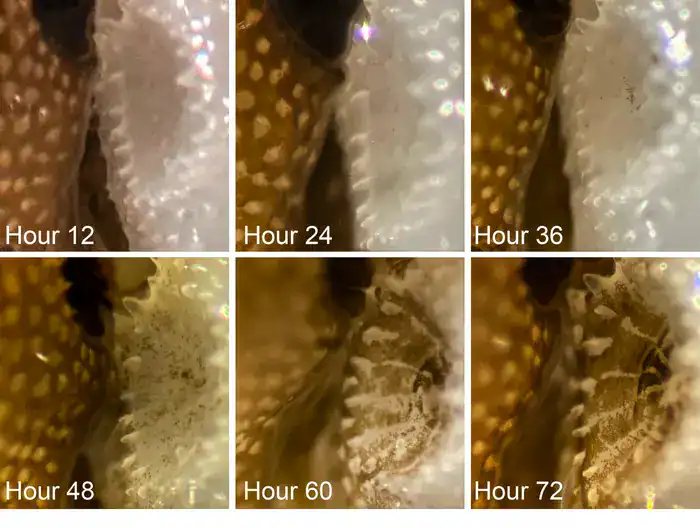
 In just a few days, life-giving algae flow from healthy corals to bleached corals, kickstarting the recovery process. Credit: Danny Collins
Corals that turn ghost-white from heat stress are usually written off.
They’re starving, stripped of the algae that keep them fed, and if they survive at all, recovery can drag on for months or even years. But a new study from Stanford University published in the journal Science Advances suggests there may be a shortcut. A bleached coral might need only a few days of contact with its healthy, genetically identical twin to start recovering.
An important partnership
In laboratory experiments, bleached coral fragments placed against genetically identical, healthy fragments regained their color within seven weeks — one of the fastest bleaching recoveries ever reported. Meanwhile, bleached fragments sitting just a few millimeters away from a healthy partner, close but not touching, failed to recover and eventually died.
“While bleached corals may be dying, they are not dead yet,” said lead author Danny Collins, an oceans Ph.D. student at the Stanford Doerr School of Sustainability.
Corals are mutualistic animals that live in a delicate partnership with colorful algae, which dwell inside their tissues and provide most of the energy they need to survive and grow. When water gets too warm, corals expel these tenants as a desperate moves.
It leaves them pale, hungry, and vulnerable to disease and other threats. With marine heat waves becoming more frequent and intense, finding ways to help corals recover has become increasingly urgent.
An accidental rescue
The discovery began with a chance observation. In 2025, Stanford marine biologist Steve Palumbi noticed that two fragments taken from the same colony, one bleached and one healthy, had tipped over in a tank and come to rest against each other. Right where they touched, color was creeping back into the bleached piece. That was a telltale sign the beneficial algae were returning.
Around the same time, Collins was considering the origins of coral disease, particularly bacteria lurking on plastic debris that settles onto corals. Harmful bacteria, he noted, enter corals through physical contact. If touch could transmit something harmful, he wondered, why not something good?
×
Thank you! One more thing…
Please check your inbox and confirm your subscription.
“Harmful bacteria enter corals through physical contact,” Collins said. “We were curious about what would happen if we used contact to reintroduce something good – the beneficial algae from healthy corals.”
So he decided to set up a straightforward test. Collins paired 10 bleached fragments with 10 healthy ones cut from the same genetic individual, using a branching coral species called Pocillopora damicornis. Five pairs were arranged so they touched, while the other five were separated by gaps of only a few millimeters.
The results were pretty stark: Every bleached fragment that touched its partner recovered within seven weeks, while none of the five separated fragments recovered.
Twin tissues, shared plumbing
 The researchers assembled pairs of coral fragments – one bleached, one healthy – and found that continuous physical contact led to full recovery within seven weeks. (Image credit: Danny Collins).
The trick works because individual coral colonies can grow through cloning, producing genetically identical polyps that share living tissue. When identical corals touch, they recognize each other and their tissues fuse, much like organ transplants go more smoothly when the donor is an identical twin.
Using a high-powered microscope, the team watched what happened next. Shortly after contact, tiny channels in the coral tissues lined up, forming a pipeline between the two fragments. Beneficial algae, along with the nutrients they produce, could then move through this connection. Within just three days, algae from the healthy fragment had already moved into its bleached twin.
The researchers then tested how long the corals actually needed to stay together. They pulled pairs apart at different intervals and found that a single week of contact was enough, and in some cases only five days. Some fragments even received enough algae after just three days to begin sustained recovery.
After separation, the bleached fragments still made a full recovery in seven weeks, the same pace as pairs left touching the whole time. That led the team to conclude that continued recovery was driven mainly by algae replicating inside the bleached fragment, rather than by algae still traveling over from the healthy one.
“Once beneficial algae enter bleached corals, they don’t just spread out,” said Palumbi. “They flood in and start dividing at the fastest rates seen in corals.”
The algae multiplied fast. During the second week of contact, their numbers inside the bleached fragments doubled every four days. That’s roughly 10 times quicker than what scientists typically see in wild corals, helping explain how a brief encounter could trigger such rapid recovery.
Not a reef-saving silver bullet, yet
 Image credits: Unsplash / Li Fei.
The authors caution that while the healing potential of physical contact is promising, many questions remain. The method depends on having a healthy, genetically identical copy for every bleached coral. That’s simply not feasible at the scale real reefs need.
The experiment also involved a small number of fragments from a single coral species, kept under controlled laboratory conditions. Whether the same process could rescue corals on a natural reef remains unknown.
Still, it adds a promising tool to a kit that already includes breeding heat-tolerant corals, replanting reefs with nursery-grown corals, and even transplanting coral microbiomes. Fiorenza Micheli, a Stanford marine scientist who advises Collins, noted that bleached corals are often dismissed as a lost cause. She hopes the work inspires ways to keep them alive long enough for slower natural recovery, through growth, reproduction, and the settling of new colonies, to take hold.
In the coming months, the team plans to explore ways of delivering beneficial algae to bleached corals that don’t require bringing genetically identical fragments together. One idea is to harvest algae from healthy corals well before a heat wave strikes, then deliver them in large batches to bleached corals.
Of course, even a coral that recovers quickly can bleach again if ocean temperatures remain dangerously high. This discovery doesn’t solve the underlying problem of warming seas.
But it reveals something researchers hadn’t appreciated before: under the right conditions, corals may be able to recover from bleaching far faster than previously thought. And that could be an important first step toward helping more of them survive.
“We hope this new research will inspire solutions that keep corals healthy long enough to enable full recovery after heat waves through slower processes such as growth, reproduction, and recruitment of new colonies,” Micheli said.