
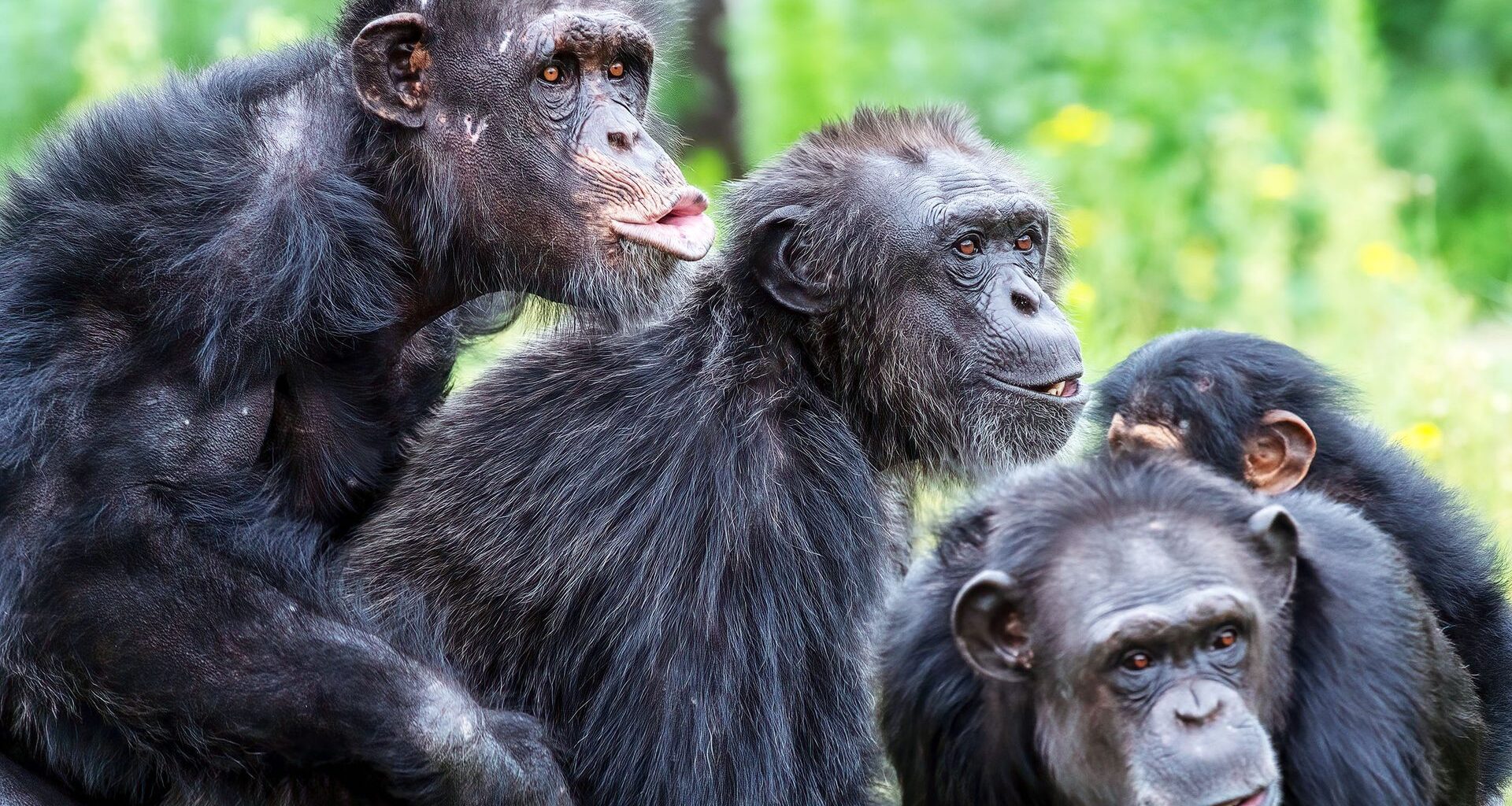
Chimpanzee calls become more distinct between populations as the individuals age, suggesting that experience may help shape communication over time.
People can often hear clues about where someone grew up in the way they speak. An accent reflects years of hearing and using sounds within a particular community. Chimpanzees do not have human language, but their calls can also differ from one population to another.
Some of these differences appear in baby chimpanzees and become more pronounced as they grow older.
Why this matters to humans
Human speech is unusually flexible, and researchers want to know whether that ability has deeper evolutionary roots.
Chimpanzees are our closest living relatives.
Chimpanzee calls become more different between groups as the individuals age. This suggests that experience may help shape how they sound.
Two populations were compared
The team studied 30 chimpanzees from two African populations. Seventeen lived at Chimfunshi Wildlife Orphanage in Zambia, where the animals were semi-wild in Miombo woodland.
Another 13 came from Gombe National Park in Tanzania, where the chimpanzees were wild and lived in semi-deciduous tropical rainforest.
The analysis included 21 infant chimpanzees up to age four and 10 juvenile observations from chimpanzees older than four and up to age 10.
One chimpanzee was recorded in both age groups.
Three common chimpanzee calls
The researchers focused on grunts, whimpers, and laughs because these calls are common from early in life.
Grunts are short, low sounds, while whimpers are soft distress calls that can rise in pitch and loudness.
Chimpanzee laughter has a repeated, noisy pattern linked to breathing in and out.
Altogether, the team analyzed 11,225 call elements, including 3,694 grunts, 2,798 whimpers, and 4,733 laughs.
How calls reveal chimpanzee populations
Each call was turned into a spectrogram, a visual picture showing how a sound changes across time and frequency.
The researchers measured 15 features, including call length, the speed of repeated elements, the spread of frequencies, and how noisy or orderly the sound was.
They then tested whether those features could identify which population had produced the call.
One chimpanzee could make many calls, so the researchers made sure this did not unfairly affect the results.
They also shuffled the population labels many times to check whether the real pattern was stronger than chance.
Differences appeared in infancy
When infant and juvenile calls were combined, all three call types contained enough information to distinguish the two populations better than expected from the shuffled data.
Infant grunts were classified correctly 78.25 percent of the time, compared with 52.02 percent expected.
In contrast, infant laughs reached 93.17 percent, compared with 59.31 percent expected.
Infant whimpers were correctly classified 71.81 percent of the time, compared with 55.31 percent expected. However, that difference was not strong enough to confidently separate it from chance variation.
Calls changed as chimpanzees grew older
Among juveniles, all three types of chimpanzee call showed clear population differences. Classification reached 90.58 percent correctly classified for grunts, 87.89 percent for whimpers, and 96.70 percent for laughs.
A separate analysis showed the same overall pattern.
Population classification rose from 76.1 to 91.9 percent for grunts, from 76.6 to 84.9 percent for whimpers, and from 92.9 to 96.5 percent for laughs between infancy and the juvenile stage.
Lead author Kassandra Giragosian is a doctoral researcher at Queen Mary University of London.
“Understanding how communication develops during early life is fundamental to understanding animal behavior,” Giragosian said.
“Our findings show that chimpanzee vocalizations are not simply fixed from birth but continue to develop as young animals interact with their social and ecological environments.”
Chimpanzee call types changed differently
The population signal was not carried by the same sound feature in every call.
For infant grunts, the overall sound quality mattered more. For infant laughs and juvenile grunts and laughs, the timing of repeated sounds mattered more.
No single feature defined a chimpanzee dialect. Individual measurements often carried substantial uncertainty, so the strongest evidence came from the overall sound pattern.
Whimpers may have limits
Infant whimpers stood out because they did not show a clear population signature. The purpose of the call may help explain why.
Whimpers are mainly distress calls directed toward mothers.
A distress sound may need to remain recognizable so a mother can respond, which could limit how much it changes between populations.
Laughs often happen during play with peers, while the social use of grunts changes as chimpanzees mature.
Those different social settings may give some calls more opportunities to change through repeated contact with others.
Several causes remain possible
Social experience and local surroundings may help shape chimpanzee calls. But the study does not prove that chimpanzees learn accents like humans do.
Genetic differences could still contribute. Physical growth may also matter because the vocal tract develops with age and chimpanzees gain better control over breathing and the parts of the throat used to make the calls.
Habitat is another possibility because Gombe’s dense rainforest differs from Chimfunshi’s more open woodland. The analysis was not designed to show whether habitat itself produced the vocal differences.
Important limits remain
The recordings from the two sites were collected with different equipment, distances, and procedures.
This means population, habitat, living conditions, and recording method cannot be completely separated.
The authors argue that recording differences alone are unlikely to explain the results because the pattern changed across call types and ages.
Even so, the design cannot show exactly how much social experience, environment, genetics, or physical development contributed.
Only one chimpanzee was recorded in both infancy and the juvenile stage. The age comparison therefore mostly involved different animals instead of following the same chimpanzees as they grew.
What dialect means here
In this work, a “dialect” means that calls carry a population-specific sound pattern. It does not mean chimpanzees have human speech, grammar, or regional language.
The researchers also did not test whether chimpanzees themselves can hear these differences and recognize another animal’s population.
They showed that population information in the calls became easier to detect as the animals matured.
For humans, that offers a clue about the long history of flexible communication.
Chimpanzee calls are shaped by growth, genes, social life, and their surroundings. This suggests that flexible communication may have started early in primate evolution.
The study is published in the journal PLOS One.
—–
Like what you read? Subscribe to our newsletter for engaging articles, exclusive content, and the latest updates.
Check us out on EarthSnap, a free app brought to you by Eric Ralls and Earth.com.
—–