
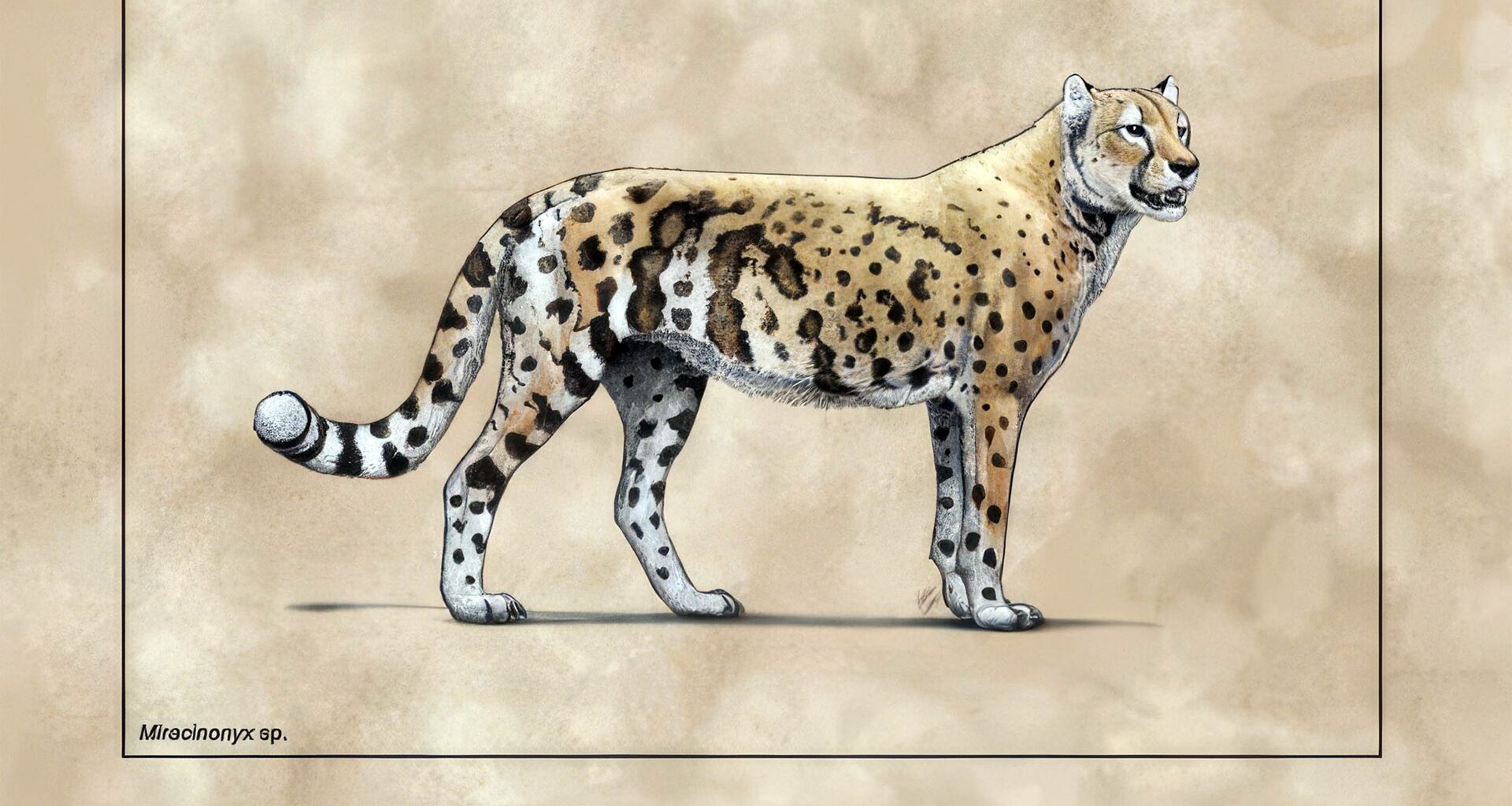
Fossil American cheetahs from the Yukon turned out to be more closely related to pumas. Their skeletons suggested they lived on a diet of fish.
A cat with long legs and a light build is supposed to run its food down in the open. Since the 1970s that’s how the extinct American cheetah has been read, on a skeleton that looks much like that of the African cheetah.
Researchers have now identified the same species in Arctic Yukon, dated to about 31,000 years ago. The fossils are very far north of any pronghorn, and have the bone chemistry of fish eaters.
Molly Cassatt-Johnstone and her colleagues at the Paleogenomics Lab at the University of California, Santa Cruz, took DNA from four fossil American cheetahs. Three came from Yukon, catalogued previously as pumas.
In an interview with Earth.com, Cassatt-Johnstone said American cheetahs had never been known from Beringia, the ancient land that joined Siberia to Alaska and Yukon while sea levels were low.
“The first surprise was the biggest one!” she said. “So that was very cool to get to add a new carnivore to the Pleistocene Beringian ecosystem.”
Yukon fossils were filed as pumas
All three northern fossils are small pieces. One is a foot bone from Bluefish Caves, near the village of Old Crow. It was dug out of a bedrock cavity between 1977 and 1987.
The other two, a foot bone and a piece of lower leg, thawed out of permafrost at a working gold mine on Quartz Creek in the Klondike.
They are between 31,000 and 34,000 years old. The Canadian Museum of History keeps the Bluefish specimen, and the Klondike pair belongs to the Yukon Palaeontology Program in Whitehorse.
That first fossil was dated decades ago and written up as a cougar, hundreds of miles north of anywhere this cat was supposed to be. The fourth animal is an ear bone from a Wyoming cave, about 23,500 years old.
Those northern pieces widen the known range of American cheetahs by more than 20 degrees of latitude, from present-day Florida to Arctic Yukon.
Pumas are the closest living relatives
The team sequenced the two best-preserved genomes and set them against nine other cats, from lions to house cats. They came out as the puma’s closest relative.
Those two lineages split about 2.6 million years ago, as the climate cooled and grassland spread across the continent.
Its shared ancestor with the African cheetah is much older, roughly 4.7 million years. The greyhound build appears to have evolved twice, on two different continents.
A 2005 study of mitochondrial DNA, the small set of genes passed down the mother’s line, had already grouped this cat with pumas. That kind of DNA often disagrees with the rest of the genome in cats, so the question stayed open.
Both animals also carried little genetic variation, comparable with what the Florida panther and the Iberian lynx carry today.
Cassatt-Johnstone’s team read that as a long-term small population, which would explain why so few of its bones have ever turned up.
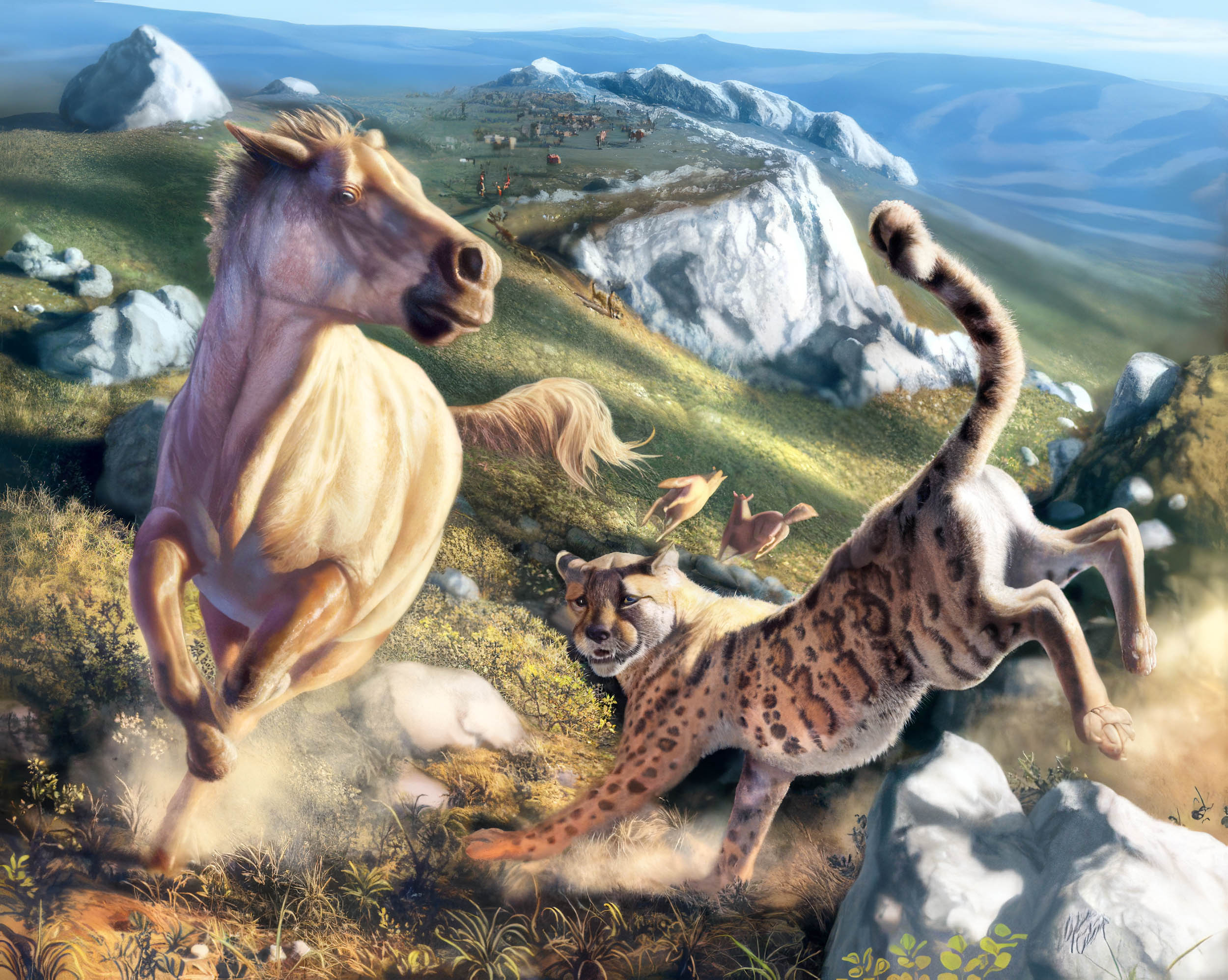 An artistic rending of Miracinonyx and the ecosystem they lived in. Credit: Julius Csotonyi. Click image to enlarge.What did the Arctic cats eat?
Pronghorn don’t live that far north, so the team looked at what the northern cats ate instead. What an animal eats leaves a chemical mark in the protein of its bones.
Nitrogen in the three Yukon cats measured about six parts per thousand higher than in other meat eaters of the same time and place. The plant eaters that those predators were killing measured lower still.
Nothing they could have hunted on land accounts for numbers that high.
Values that high belong to animals eating fish. Brown bears in Alaska today, for whom salmon makes up roughly 60 percent of the diet, come in lower than these cats did.
The team then measured individual amino acids, which is a finer test of where an animal feeds. The Wyoming cat fed one step above the plant eaters, which is where a lion feeds. The Yukon cats fed a step above that, where a predator’s own prey is a hunter.
All three matched one another closely, though the sites are nearly 250 miles (400 km) apart and the animals lived more than 2,000 years apart. Whatever they ate, they ate it for a long time.
How the cats caught fish is unknown
The chemistry shows what the Yukon cats were eating. How they got hold of it is a different question.
“I don’t know how they did this!” Cassatt-Johnstone told Earth.com. She said that Bluefish Caves held fish fossils from the same period.
“So hard to speculate as to how they accomplished it, but we know there were good resources around for them to exploit.”
Northern digs do turn up salmon and inconnu, a whitefish that moves between rivers and the sea.
Cassatt-Johnstone’s team suggested three routes. A cat might have scavenged spent fish after a run, hunted where fish crowded into spawning shallows, or grabbed them the way fishing cats and jaguars do.
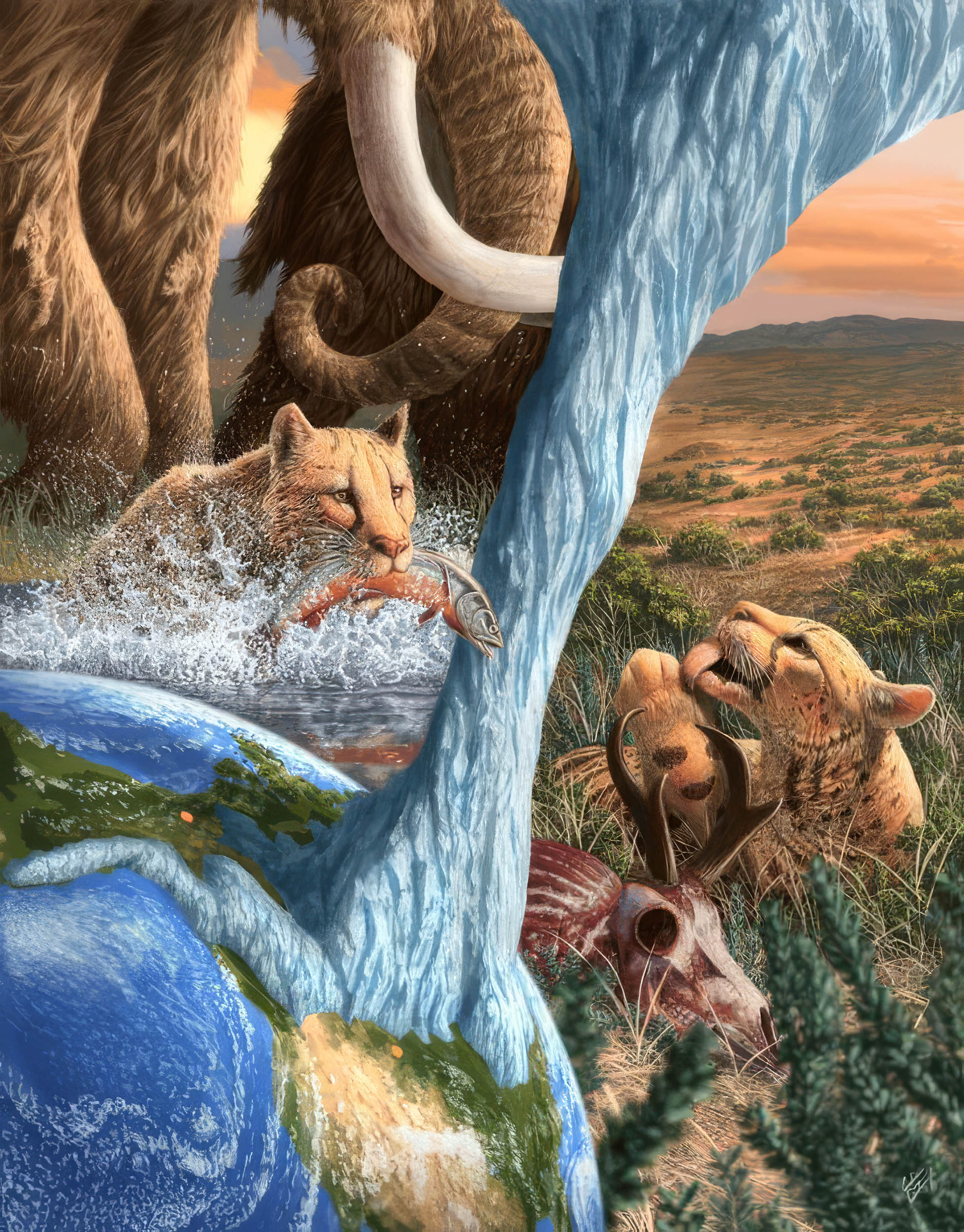 An artistic rendering of two Miracinonyx, one in Beringia preying mainly on fish and one in the Lower 48 feeding on pronghorn antelope. Credit: Julius Csotonyi. Click image to enlarge.Two body-clock genes had stopped working
Both cats carried broken copies of 48 genes. Two of them help an animal read daylight and set its sleeping schedule, and one of those, PER3, is switched off in many Arctic mammals too.
Earth.com asked what it would take to test whether these cats hunted at night. Without living animals to watch, Cassatt-Johnstone said, she isn’t sure genes can be tied to behavior that confidently.
“But we do see a lot of variation in hunting time in different cat species, so it may be a possible hypothesis we can draw,” she said.
Twenty-three other genes looked like they had been under selection in this lineage. None held up once the researchers corrected for testing thousands at once, so all 23 stay on the list as things to test later.
The team had two animals for the genetic work in any case, one from each end of a range that spans a continent, and six for the chemistry.
Body shape alone can mislead
The American cheetah probably died out when the last ice age ended. In Yukon it had shared the ground with lions, scimitar cats, gray wolves and two kinds of bear, and how it made room for itself is still unclear.
Cassatt-Johnstone said the big takeaway is how much the methods gained from one another. Her team studied the same fossils three ways, by bone shape, by chemistry and by DNA, and “none would’ve given such a complete answer alone,” she said.
She expects other collections to hold more misplaced animals, since the bones of a medium-sized cat are hard to tell apart by shape.
Nobody can yet say how a cat got a fish out of a Yukon river. Whether those broken clock genes changed when the animals hunted is untested too.
More cats than four would settle both. That means more bones out of the permafrost, and more drawers opened where the label is somebody else’s name.
The full study was published in the journal Current Biology.
—–
Like what you read? Subscribe to our newsletter for engaging articles, exclusive content, and the latest updates.
Check us out on EarthSnap, a free app brought to you by Eric Ralls and Earth.com.
—–