
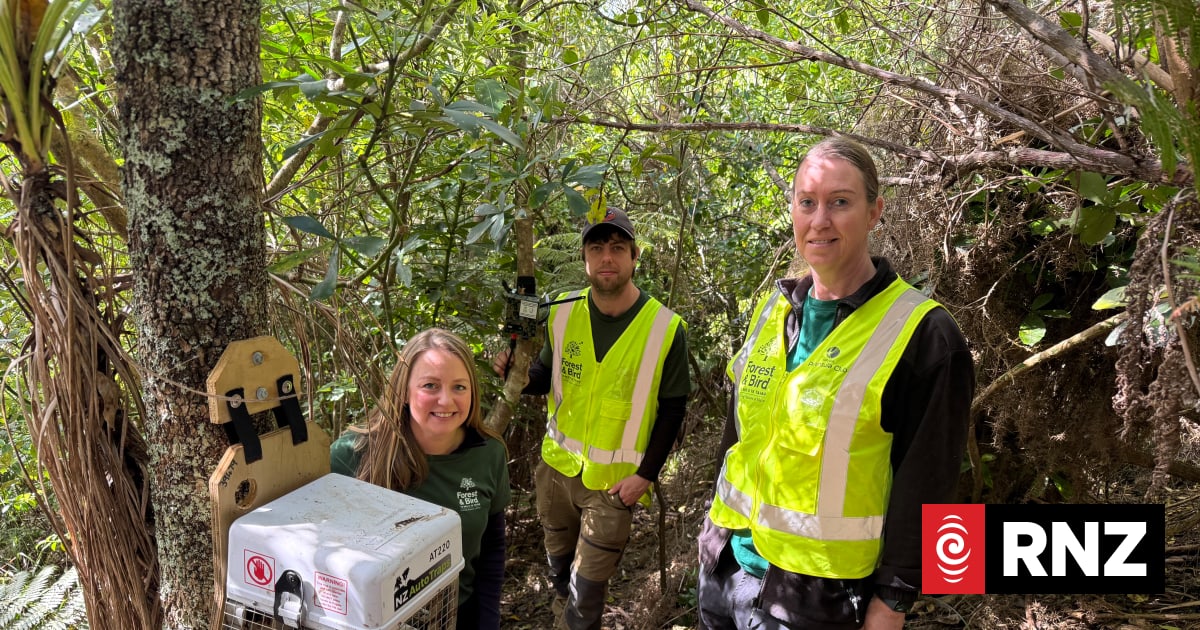
New smart devices can track that last sneaky possum, saving hours of time. But the price tag is too high for most conservation groups.
The Kiwi AI tech saving our native bush from pests
It’s blamed for killing jobs and creating fake information but artificial intelligence is the very thing that could save our native bush from destruction by pests.
Kiwi-invented high tech predator eradication is on the rise in Aotearoa and gaining an international reputation.
But the big barrier is the cost of the AI units to the small conservation groups around the country.
“A lot of these community groups do not have funding for trap bait,” says Miranda Wells, project lead for the 800 Trust in Taranaki.
The trust does conservation work on private and public land in Taranaki, and is behind the world-first monitoring device Hark, which listens for birds, bats and pests.
“Historically, as a country, we don’t have the best monitoring, and monitoring, as we all know, is really important to understand whether we’re succeeding or we’re failing,” says Wells, explaining the inspiration behind Hark.
“We were struggling to understand whether our bird population that we were working on, helping through pest control, whether we were making a difference or not, because if we’re not making a difference, gee, we really need to rethink what we’re doing.”
The team of technical gurus on the trust realised the old methods of sitting in the bush for five minutes and doing bird counts were no longer up to scratch. Hence Hark, a one litre-milk bottle-sized gadget, with microphones and antenna, that listens to the bush, identifies sounds and delivers the data.
Wells says Hark can get the message that it has heard a pest to a team member in real time and they can respond immediately, even if it’s the middle of the night.
“Especially if you’re after the last possum in an area because those are often the cunning ones that are evading the traps,” she says.
Hark has won a technology award and a highly contested place on the Google accelerator programme for startups to help fine tune the device and scale up production.
“The Harks are being manufactured here in rural Stratford. We have strong desires for it to be a regional entity and create jobs in the regions,” says Wells.
But at about $1000 per unit, many local groups cannot afford the homegrown Hark.
The trust hopes that international buyers will help fund local distribution.
“Yeah we definitely have had international interest, and so now we’re just working on how do we balance that and are there ways for us to sell internationally in a structure that might benefit some of the community organisations locally,” says Wells.
The Detail also visited Pest Free Hibiscus Coast in north Auckland where the country’s largest network of AI cameras has been installed at a reserve bordering Shakespear Regional Park.
The Kiwi-made devices are powered by solar or old Lime Scooter batteries and capture videos of animals in the bush on infra-red technology, and send the information to the users’ phones, identifying the animals.
“So I can just look at this dashboard on my phone and see that last night there was a rodent on camera here checking out this trap,” says Pest Free Hibiscus Coast project leader Jenny Hanwell. “So this is instantly telling me what was happening.”
Hanwell says the AI technology cuts costs and time.
“To give an example, when we put out 55 cameras over 1490 nights, we ended up with over 44,000 videos comb through. And what the team were able to do is, because we were doing response work to possums and stoats, they were able to go on every morning to the dashboard and say, right, it’s identified a possum, it’s identified a stoat.”
Auckland University’s head of Ngā Ara Whetū – Centre for Climate, Biodiversity and Society, Professor Dan Tompkins says New Zealand has always been a world leader in pest management, supercharged by developments through Predator Free 2050, now 10 years old.
He says New Zealand won’t reach the goal without the volunteers and community groups. He’s working with local developers on cutting costs and finding overseas funding.
“I think there is huge scope for actually tapping into that wider market, and I know that many of our developers already are tapping into places like the States and Europe, and I think the more we can actually showcase what our tools and technology can do, I believe New Zealand is on the way to becoming a world leader actually in that conservation tool and technology space on the back of what we’ve done over the last decade.”
Check out how to listen to and follow The Detail here.
You can also get in touch with us by emailing thedetail@rnz.co.nz