
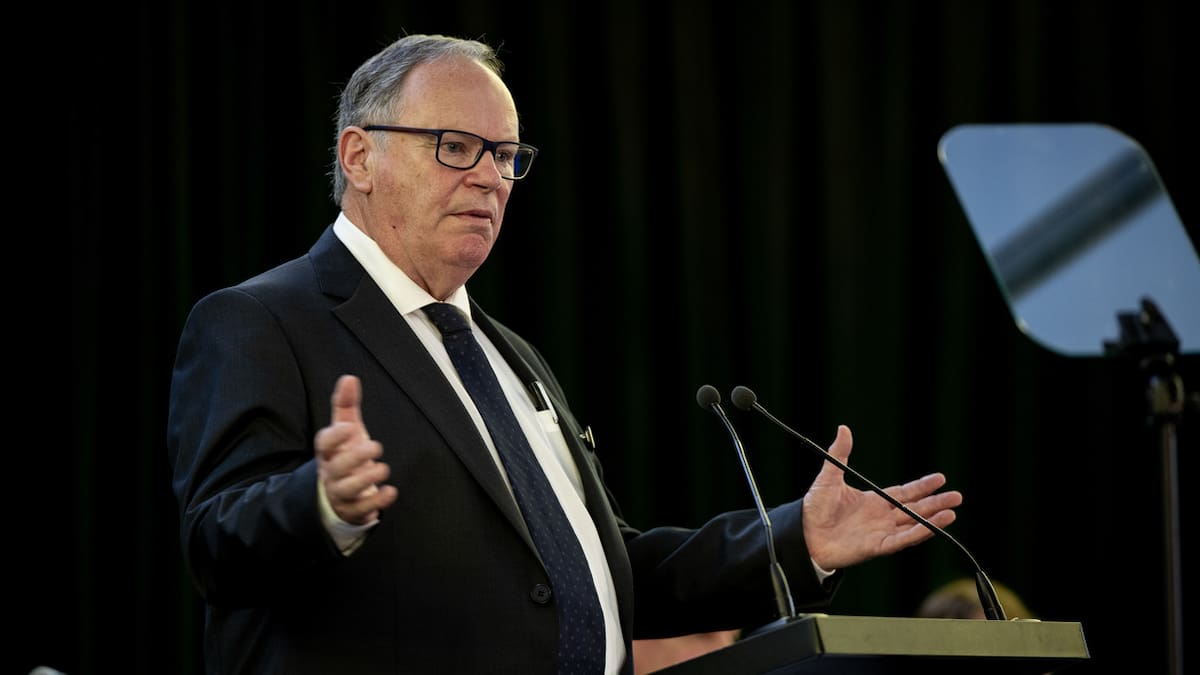
Fletcher Building chair Peter Crowley says the firm will only sell more assets for the right price. Photo / NZME
Fletcher Building has ruled out an early return to dividend payments despite reporting a $228 million profit and cutting net debt by more than a third.
Chair Peter Crowley said on Wednesday that dividends would not resume until debt was sustainably within the lower half of the group’s target range,
and future dividend payments had to be prudent and sustainable through market cycles.
He said a future dividend policy reset would be linked to achieving both free-cash-flow and balance-sheet targets.
The board recognised the importance of dividends to shareholders and remained committed to restoring payouts, Crowley said.
The building giant reduced its debt from about $1 billion to $637m by the end of the 2026 financial year.
The firm has set a net debt target of between $400m to $900m.
Crowley said he expected net debt would be about the same in the 2027 financial year.
Fletcher Building held its annual meeting in Auckland on Wednesday.
A long-standing shareholder, who didn’t want to be named, said he hoped he lived long enough to get a dividend.
“Thank Christ the company was big enough to sustain the losses.”
Long-time investors back Fletcher
It was a much lighter mood than in recent years, with few questions from shareholders and even a thank you forthcoming from one.
The building firm has divested assets including its construction division, sold off land, closed some plants and cut head office costs, but said its turnaround remains a work in progress.
Shareholder John Hulme, who said he has held shares in Fletcher Building for about 20 years, said the company was finally moving in the right direction after years of disappointing performance.
Hulme said he was pleased with how Fletcher was executing its strategy and said many of Fletcher’s problems were legacy issues.
He blamed the company’s troubled construction division and the disruption caused by the Covid-19 period for much of the group’s recent struggles.
“We’ve seen it going this way, and we’ve seen it come down and go up and down,” Hulme said.
He said previous leadership had at times pursued acquisitions without considering whether they were financially worthwhile.
Despite the volatility, Hulme said he remained committed as a long-term investor.
He said he had more than $5m invested across NZ and Australian sharemarkets, including holdings in Fisher & Paykel Healthcare, Skellerup, Auckland Airport and Ebos Group.
Another shareholder said Crowley and managing director/group chief executive Andrew Reding spoke like ordinary people and made it easy to understand what Fletcher’s strategy was, and how it is tracking against its goals.
“I just hope that Reding will stick around and finish the job, with the directors.”
Fletcher ready to capture recovery
Crowley praised Reding and his team for the work they had done to position Fletcher Building for an eventual market recovery.
He said the company had invested in key assets, including a major concrete plant at Penrose, quarry capacity and its Golden Bay Cement operations, leaving the group well placed to capitalise on an upswing in construction activity.
He said Fletcher now had both the assets and people in place and would be ready to respond quickly when market conditions improved.
“When things pick up, we’re not going to miss a beat. We’ll be in there, and we’ll be really getting our share.”
Reding said Fletcher had shifted to a more decentralised operating model and business units had greater accountability and decision-making authority.
“There is still more to do, but we are getting closer to an optimal balance. The reality is that, whilst our preference is to have businesses choosing and owning their functionality, some centralised corporate functions do carry real economies of scale which we may not want to forgo. But I can assure you we are running the ruler over everything.”
Reding said the most obvious elements of Fletcher’s turnaround had now largely been completed and management was turning its attention to the company’s next phase of growth.
He said the focus would be on operational improvements, extracting further value from the business and refining Fletcher’s growth strategy.
Reding said the company aimed to complete that work by the end of the year so it could begin the next financial year with clear strategic and operational priorities.
Portfolio review not over
Reding said the sale of the construction division had simplified the group.
He said the firm could now focus on Fletcher’s core manufacturing, distribution and building products businesses rather than large and complex contracting projects.
Fletcher is continuing a strategic review of its residential and development division.
Reding said the review remained underway, and a range of options were being considered.
The division owns a sizeable residential land bank and development portfolio.
In response to a shareholder question, Crowley said the company was still actively reviewing its portfolio.
He said the future of the residential arm would depend on whether retaining or exiting the business delivered the best outcome for shareholders.
Crowley said Fletcher would continue to assess underperforming assets over time but any decision to sell would depend on achieving an acceptable price.
The firm acknowledged the group’s performance remained below expectations in several areas.
SaveShare this article
Reminder, this is a Premium article and requires a subscription to read.
Copy LinkEmailFacebookTwitter/XLinkedInReddit