
“We expect the economy to start to get better. Economists are telling us we should expect about 3% growth next year. But competition is really fierce in the financial services and banking sectors, so that’s what’s driving the revenue flat despite the fact we’re seeing a bit of growth in the economy.
”Cyber-spend is an area that’s definitely going up for the bank to make sure we continue to protect our customers really well but also to ensure tools are used in the right way to free up our teams a bit more so they can spend even more time talking to customers.”
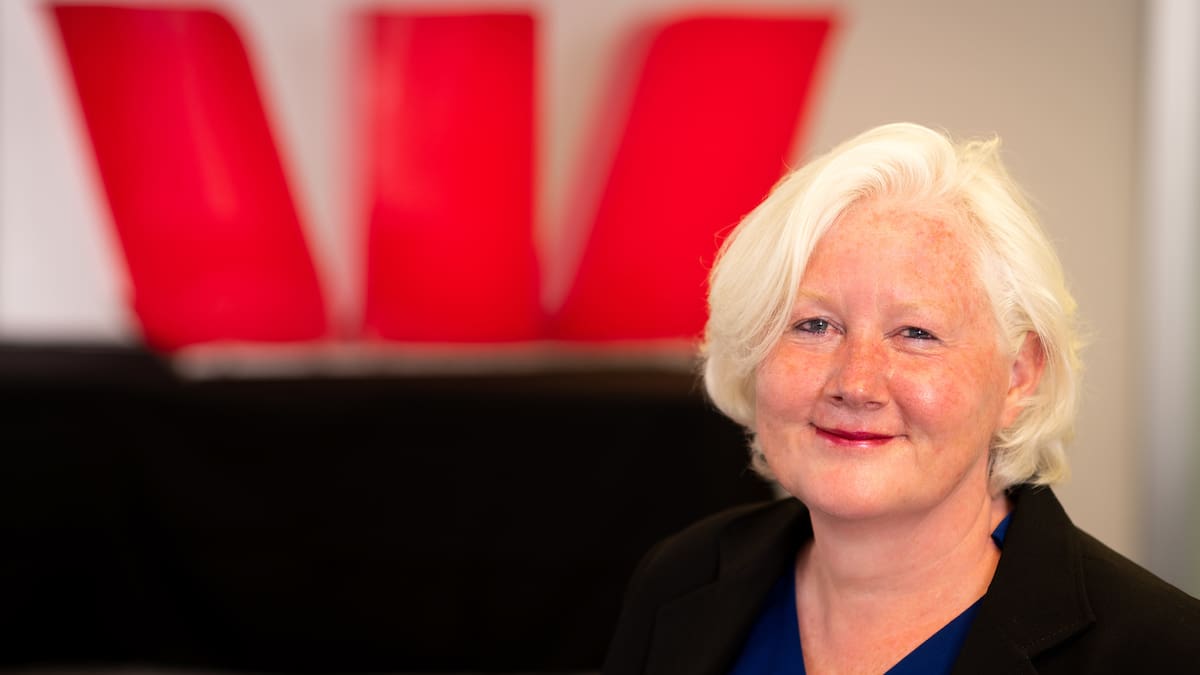
Westpac NZ’s Catherine McGrath says the chopping and changing of policy and regulation has been the most challenging thing for economic growth. Photo / Mark Tantrum
McGrath identifies regulation, infrastructure and government policy uncertainty as the three biggest constraints on economic growth.
“The thing that’s most challenging is the chopping and changing of policy and regulation and therefore, what’s happening with infrastructure.”
She urges New Zealand to recognise that in the world’s new operating “norm”, predictability is an asset and that the country has a stellar reputation internationally as a stable economy, a good place to do business and a safe harbour for capital from overseas.
“We need to make sure those assets and the way we’re seen continue to be strengthened as opposed to eroded.
“It’s a real opportunity for us to continue to stand up as a country as a bit of a shining light of sanity in a world that’s feeling less predictable. So us being predictable, with a very strong democracy, a very cohesive society and therefore a great place to both live and invest is, I think, really important.”
As to what infrastructure decision the next government could make that would most boost productivity, McGrath says it’s not about wholesale change.
“It’s about staying on the path in terms of decisions already made and letting businesses and offshore investors see there is a bipartisan agreement about how infrastructure is done and delivered in New Zealand.”
McGrath is highly concerned about the impact of election policy uncertainty, while acknowledging it’s an “inevitable consequence” of an electoral system that produces coalition governments.
“What’s becoming increasingly clear, if it wasn’t before, is that you might vote for Party A and they then need to do a coalition agreement with a couple of other parties. Therefore, the policies you end up with by definition and by the construct of the system are compromised in one way, shape or form. This has its upsides but it also has downsides – and that is uncertainty.”
Asked if political volatility is becoming an economic competitiveness issue, McGrath says on core areas like infrastructure, the country needs to have more than a three-year view and bipartisan support is really important.
“It doesn’t matter whether it’s big bits of infrastructure like roading or whether it’s overhauling the education system, there are things that we simply can’t afford to change every three years.”
McGrath says for New Zealand to become genuinely competitive for international capital, “it’s about overseas investors being able to have real confidence in the way our Government looks at business, the way we make longer-term decisions and not chop and change every three years.
“Continuing to have an amazingly stable democracy and a very cohesive community are all things I think really help us be competitive for investment on the world stage.”
McGrath doubles down on her view that the time for Kiwi businesses to hope for a return to plain sailing with no economic uncertainty is over.
“That means businesses need to make sure they’re future-fit, which means investing for growth, better customer service, productivity, whatever is most important to them.
“The fundamentals we can see are heading in the right direction and our economists are currently predicting 3% GDP growth, so for investing in things like cyber protection or whatever you need to make your business fit for the future, now feels like a really good time.”
McGrath says driving the improved outlook is the expectation that the rewards from strong agri-sector performance will start flowing from rural regions to cities next year, and conservative-spending consumers adjusting to an uncertain world.
“We’re all getting used to the uncertainty that is our new norm.”