
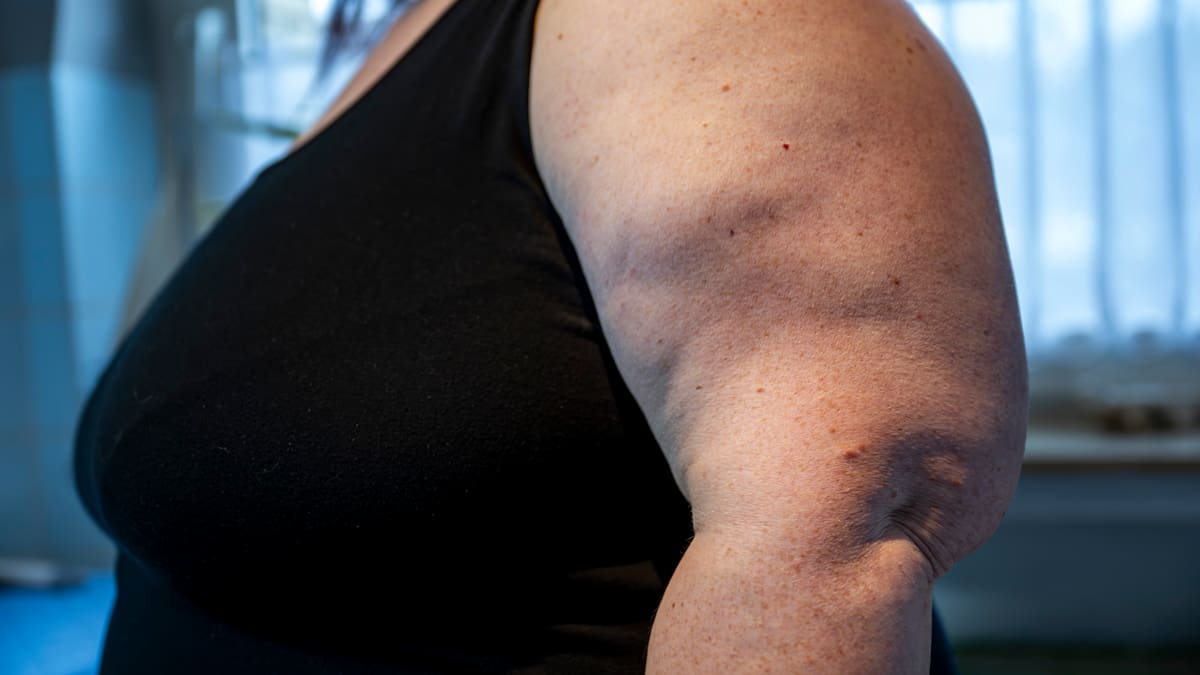
Lipoedema is a chronic and progressive fat distribution disorder that almost exclusively affects women. It causes build-up of fatty tissue in the lower body and sometimes the upper arms. Photo / Getty Images
For decades, Alison Sinclair was told by everyone from family, teachers and doctors that she was too fat and had to lose weight. Despite great efforts to eat less, her weight continued to skyrocket until she was told she had lipoedema, a condition that affects more than one in 10
women. She tells Paulette Crowley what it’s like to live with the condition.
The first signs of lipoedema started for me at the age of about 10, when I noticed my upper legs and buttocks were becoming disproportionately large. In a school photo from that time, I sat in the middle of the front row and you can see that my legs are much bigger than my classmates’.
All that extra weight in my legs really slowed me down and stopped me from doing activities. I was part of a school netball team, but I was in the lowest grade because I wasn’t as agile as some of my peers. It also affected the way I dressed myself. I didn’t want to wear shorts and I was very conscious of getting into bathing togs to go for a swim.
My parents really wanted to help me and my mother became very conscious of what I was eating. She was careful as to what she gave me for school lunches – where other people would take sandwiches, cake and biscuits, I took salad with cold meat and a piece of fruit. They enrolled me in a gym – this was back in the mid-1960s when gyms were only just starting to be a thing – where I exercised two to three times a week. It did absolutely nothing for my weight issue because actually, weight wasn’t the problem.
After school I took up nursing. In those days you had to live in the nurses’ home. I remember the nurse assigned to look after us student nurses had a chat with me about my weight. She said I needed to be really careful about what I ate, and maybe I needed to do some more exercise.
When I was first married, I was desperate to lose weight, so I went to Weight Watchers. I stuck to their eating programme to the letter. We had to make a diary of everything we ate, and I lost five or six kilos very easily. And after that, I plateaued. I could not lose any more weight, even though I stuck with it for 18 months.
Then, I had three children and with pregnancy, I gained more weight. This is one of the hallmarks of lipoedema – it is connected with hormonal changes. Lipoedema is a chronic disease that affects loose connective tissue, such as fat cells and surrounding cells. It means your lymphatic system is compromised and doesn’t work the way it does in most normal people. Extra fluid ends up sitting in the lymphatic system and turns into a type of fat. It isn’t normal fat you have if you put on weight – it’s a different tissue. It’s a complicated condition and is often a genetic thing. It runs in my family. I have a daughter with it and a sister whose grandchild has it.
Interestingly, although our doctors aren’t well educated about it, the first medical paper on lipoedema was published in 1940. So, they’ve known about it for a long time. And although lipoedema is considered a rare adipose fatty tissue disorder, it’s reported to affect 12% of women worldwide, so it’s not really rare at all. Sadly, people with lipoedema have great difficulty in getting GPs to diagnose it because they don’t know what it is. Many will say, “Oh, you’re just fat.”
Alison Sinclair has run support groups for people with lipoedema. Photo / Supplied
I wasn’t diagnosed with the condition until I was 43. I’d been in a serious car accident 18 months earlier where I was hit by someone coming from the opposite direction at about 160km per hour. My car was smashed at the front end, the engine was pushed through the firewall, and I was trapped in the car for more than an hour. I had soft tissue loss down to the bone of both lower legs. Looking back, I can honestly say thank goodness I had lipoedema because if my legs hadn’t had the volume they did, I would have lost them.
I spent five months in hospital and about a year after that, I needed plastic surgery. The surgeon took one look at my legs and asked me, “How long have you had lipoedema for?” I had no idea what he was talking about. He talked me through it and then said the best thing ever: “I want you to know that it’s not your fault.”
During my life, everyone has blamed me for being fat. “Do you think you should change your diet? Do you think you should exercise? If only you could lose a bit of weight,” they’d say. The surgeon’s words took a heavy burden off me.
It took me years of research to find out what I could do to help myself. Regular manual lymphatic drainage by a specialised therapist can help, as well as wearing compression garments, which helps lymphatic flow. Movement and exercise are helpful and for me, the best exercises are water activities. When you are in deep water, it acts as a compression.
The other thing that helps is nutrition. The recommended eating plan is a low-carb, healthy fat diet, such as the ketogenic diet. When I started keto several years ago I lost 27kg in 12 months. But I’ve never been able to lose more than that because you get to a point where you’re just losing fluid and other normal fat tissue. You really aren’t losing the lipoedema fat – it’s impossible to move that. There are surgeries you can have to remove the lipoedema fat but they’re very expensive and complicated.
We also have to be very careful with our skin because we are prone to cellulitis. I have had many hospital admissions with severe cellulitis where I’ve had to have intravenous therapy with antibiotics. Earlier this year, I was in hospital for two weeks with cellulitis in my leg after a light graze on the top of my foot where I’d hit it against a piece of furniture. Within four hours my leg was red from my toes to mid-thigh, and I was acutely ill with vomiting and a rip-roaring temperature.
I’m 73 now and have stage 5 lipoedema, which is very advanced, mainly because I was diagnosed later in life. There is no cure for this condition, and I spend a lot of time carefully managing it.
I’ve run support groups for people with the condition over the years and have even been known to tap people on the shoulder in the supermarket and ask them if anyone has ever told them they might have lipoedema. I get varied responses, including, “Oh, I’m just fat,” or “It runs in the family.” Some people don’t want to know. I tell them many doctors don’t know about the condition and it’s hard to get a diagnosis. I suggest a website for them to look at and give them my phone number. Many people do end up giving me a ring and the first thing I always say to them is, “It’s not your fault.”
SaveShare this article
Reminder, this is a Premium article and requires a subscription to read.
Copy LinkEmailFacebookTwitter/XLinkedInReddit