
Unlike in many parts of the world, including the US, in New Zealand you can’t buy eggs. Retter didn’t have friends who could donate. She didn’t know where to turn. But Gadd’s response to Retter, whom she barely knew, was quick.
“Well, I could give you some eggs.”
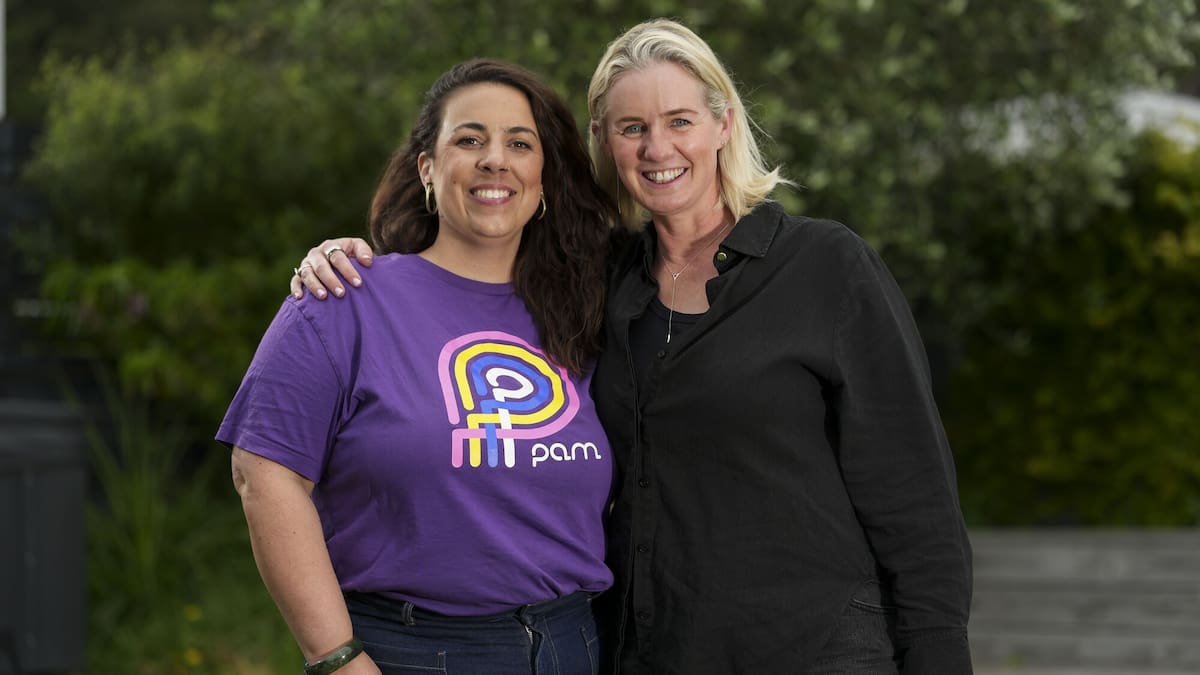
The relationship between egg donor and recipient can be distant or anonymous. But Gadd, a business owner and HR industry leader, and Retter, founder of family admin manager app Pam, decided to remain close.
When you want a baby, you might fear disappointment after someone promises you one. What if they change their mind? Retter says she never doubted Gadd would follow through.
“The thing with Sam is, if she says she’s going to do something she’ll do it, and you get that feeling from her the minute you meet her,” she says.
Gadd, who has three children, asked Retter for more information about the process and suggested she talk to her husband about the idea. Though Gadd says she “knew immediately” she would go ahead. She had thought about it before.
“I’ve got two younger sisters and I always thought if either of them had ever needed fertility help I would have helped them because my kids are my world … I couldn’t imagine being in a position where I couldn’t myself have children, I had a lot of empathy for that,” Gadd says.
By the time Gadd made the offer, Retter had spent five “years of hell” trying for a baby with her husband Tyler Kendall.
Even though she knew she would need medical intervention to get pregnant – she has had 10 surgeries for endometriosis – she didn’t think her journey would be that “extreme”.
“I didn’t think that my fertility was completely screwed,” she says.
Nicole’s kids, Bowie Belle and Meihana, are “super proud” of how they came to be. Photo / Marty Melville
At 29, her anti-Müllerian hormone test results, which indicate how many eggs you have in your ovaries, showed her levels were “undetectable”.
She did two rounds of in vitro fertilisation (IVF), and went on to do two more, despite being told it was “not likely” to be successful. Two of the four rounds were done privately, costing around $12,500 each.
Retter says the process was “soul-destroying”.
“It’s a numbers game with IVF,” she explains. “You need to have 10-plus eggs in order to get one or two that will fertilise.”
After every round of IVF, the couple got about two eggs and some hope. But it was never enough.
“It was definitely the hardest period of mine and my husband’s lives,” Retter says. “Luckily we’re in an incredibly strong friendship and partnership so we could support each other through it, but it was really tough.”
When they started taking steps towards the egg donation process, the two families met for lunch, where they assessed their shared values and talked about their concerns.
Sam with Nicole’s daughter, Bowie Belle, the day after she was born.
The next step was the “tricky” discussion about what a family would look like if they were successful.
“There’s no to-do list on how to create a relationship with someone who’s giving you their DNA to create your children,” Retter says.
At first, she was worried Gadd would want “unlimited access” to their prospective family. These concerns quickly subsided: Gadd knew she wanted to be involved in any potential children’s lives, but not too involved. She didn’t want to be their mum. Retter wanted to consider her babies genetically half-siblings of Gadd’s children, though.
Then it landed: “How about you’re their aunty?” Retter recalls asking Gadd.
“Your children are [the babies’] cousins, and we see you guys like we do aunties and cousins – we catch up on birthdays … I send you pictures of my kids doing cute things.”
She agreed.
One happy family: Tyler (left), Meihana, Nicole, Sam and Bowie Belle. Photo / Marty Melville
For Gadd, the formal process of egg donation “didn’t feel like that big of a deal”.
A few months after that first coffee, they started the process of retrieving Gadd’s eggs.
Before the procedure, she had a couple of meetings with fertility specialist company Fertility Associates, attended required counselling and took daily hormone injections to stimulate the growth of eggs. Then she underwent the egg retrieval.
“You feel a bit woozy for a couple of hours afterwards, but not too bad,” Gadd says.
Retter received 21 eggs from Gadd – 14 fertilised successfully.
“Then, as soon as we put in the first egg [via IVF] I got pregnant and had my son, and then with the second egg I got pregnant and had my daughter,” Retter says.
Her son Meihana, 10, and daughter Bowie Belle, 8, call Gadd “Aunty Sam” and Gadd was honoured in Kendall’s tā moko, representing the family.
“There’s a section on it that includes Sam, and her children as well, because … they’re part of our whānau,” Retter says.
Retter shared her “super proud” children’s origin story with them from the beginning.
“The last conversation we had was so funny. I was talking to them about how the way they were made is incredibly rare, and they were like, like a rare Pokémon card? Oh my god … we’re super special.”
Retter says she will “never like be more grateful to anyone else in my entire life than what Sam’s done for me”.
“They love those kids, and those kids are so lucky to have them as their mum and dad,” Gadd says.
When she learnt she would need to use donor eggs to have a child, Retter was devastated her family would never be a traditional one.
”It wasn’t the expected way,” she says.
“And now I could give zero s***s about what the expected way to have a family is.”
Varsha Anjali is a journalist in the lifestyle team at the Herald. She is based in Auckland.