
“[In other shows] I’ve always been 15 minutes in the makeup chair, because it’s like, slap some powder on and f*** off. But I came in and Kevin, the amazing makeup artist, looked at me and [said] ‘45 minutes’…”
Dark shadows, model’s own.
Sometimes, old habits re-emerge at the worst time. Today, as he’s about to have his photo taken, he explains he’s been up since 2am while his now-18-month-old daughter Huia power-chucked her way through the early hours.
What’s that saying about daughters stealing your beauty?
During filming of Happiness season two, McNaughton was “the walking dead”.
There was poetry to this familiar plight of new parenthood playing out on the set of Happiness. While filming season one of the show – a kaleidoscope series of comedy, musical numbers, possibly the first local series set in Tauranga and almost certainly the first to feature a gay man as the lead character – McNaughton found out Huia was on her way. Finally.
“One of the things about how difficult it was, on one level, for us to have a kid is that so many people are so invested [in the process] for you. I was on set when I found out that the fertilisation had been successful. I was in [co-star Rebecca Gibney’s] trailer with her and Robyn [Grace, director] and they burst into tears the same time I did.”
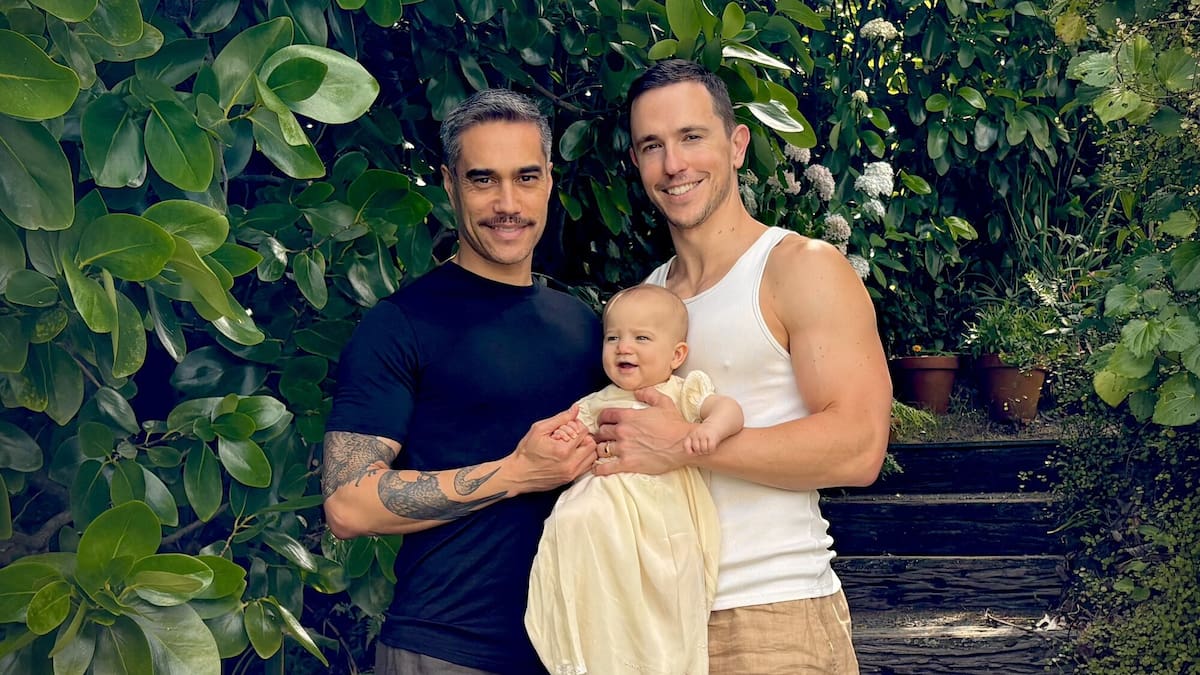
McNaughton and his husband Koro Dickinson met by chance in 2014, when Dickinson was in Auckland for just 24 hours. They moved in together three weeks later, even though Dickinson was due to relocate to Brazil to become the deputy ambassador (he eventually quit his job and the pair now run a production company). They were married less than two years later.
If their love story sounds like a whirlwind, their path to becoming parents was not. It was 10 years of hoping and planning and finding a way to grow their family. When you are two men, there’s no leaving it to chance.
There is an app, though. Or a website. Knowing they wanted to use a surrogate in New Zealand, rather than travelling overseas, they joined Love Makes A Family, which McNaughton describes as “basically a dating site for surrogates and people who can’t have kids”.
“We put up this profile and then this woman messaged us out of the blue. We were like, what the f***? And messaged her straight back.”
They talked, went back and forth for months, before friends demanded to meet Lucie, who was married, had three children and was offering to carry their baby for them.
“Our bestie was like, ‘right, so are you guys going to s*** or get off the pot? Because it sounds like everyone’s pretty keen on this, so what’s going on?’,” McNaughton says of the brunch date.
“I have such a strong memory of how scared I was to hope that it might work.”
McNaughton and his husband spoke to their surrogate for months before committing. Photo / Jason Dorday
Surrogacy in New Zealand is a long, hard process for everyone involved. Unlike overseas, no money changes hands. Everyone involved is required to undergo counselling, there are medical assessments and each party needs to get legal advice before the family gets approval from an ethics committee, which can take up to six months.
“Then, you have to obviously go through IVF, which is not an insignificant expense. There’s medical procedures which are huge for people,” McNaughton says.
“Obviously huge for Lucie, but also my sister, who donated her eggs. I don’t know if you know, but donating eggs is horrific. It’s horrific. You’re on fentanyl and they shove a needle this big through the wall of your uterus… like, what the f***?”
McNaughton says his sister “half offered and we half asked her” to be part of the process as an egg donor, which he is still coming to understand the impact of.
“Guilt…it’s another big part of it. How do you rationalise the fact that these two women have done such an extraordinary thing for you? That takes so much, you know? It’s just such a huge gift.”
Though exact numbers aren’t known, a 2022 Law Commission report estimated up to 50 children are born in New Zealand each year as a result of surrogacy arrangements.
In New Zealand, when a baby is born via surrogacy, the intending parents have no legal rights until they adopt their child. It means, at birth, the baby’s legal parents are the surrogate and her partner, if she has one.
It’s been almost a year since McNaughton and Dickinson adopted Huia, when she was 6 months old. On social media, he wrote about it being a “strange process, having to prove we’re morally, socially and financially fit to parent our biological daughter”.
Today, he doesn’t like to dwell on that part, preferring to put his energy into the good things that came from the surrogacy process.
“We were so lucky, not just to have her but to have all these other relationships that have been strengthened as a result of it. I try to focus on that.”
Lucie and her family are part of the McNaughton-Dickinson whānau now. And her role in Huia’s life is not a secret, fluid in the way it is explained to their daughter as she grows up.
“There’s nothing we’ll keep a secret from her.”
Rebecca Gibney was with McNaughton when he found out his daughter Huia was on her way.
It’s been 19 years since an 18-year-old McNaughton joined Shortland Street as receptionist Gerald Tippett and 14 since he left. He and his family still live in “the house that Shortland Street bought”.
If a parent’s life is hard to plan, a creative’s might be harder. Often, despite the best intentions, it can be a case of feast or famine. A quiet patch, and then projects that took years to make all come out at the same time.
McNaughton’s year has been like that. There was Madam, the sex worker comedy starring Aussie actor Rachel Griffiths that he wrote and co-created. He had the same jobs on Head Girl, the fierce “trauma-dy” based on a poem by Freya Daly Sadgrove.
Now, there’s his return to Happiness and being in front of the camera.
He had to be asked three times to audition for the role of Charlie, a local boy made good on Broadway, who then finds himself doing not so good, and is forced back home to Tauranga with his mum, working with the local am-dram society.
He once said the reticence to act again was because doing something joyful, like performing, came with a layer of selfishness. That feeling hasn’t changed.
“I think I struggle even more, now that I’ve got a daughter, with this idea of selfishness,” he says.
“[Acting] is such a joyful thing to do. It’s so joyful to be on set. It’s so joyful to be playing with this other person while cameras happen to be pointed at you. I feel so fortunate to be able to do that. And it’s hard not to feel like, ‘oh, that’s just like a silly little thing that you do’, this kind of, yeah, selfish thing.
“And particularly since my daughter’s been born, I’ve [realised], my lord, this industry’s unsustainable.”
McNaughton in the home he bought while starring in Shortland Street, nearly 20 years ago. Photo / Jason Dorday
So he’s making things happen. He’s creating and writing projects that have interest from American platforms, as well as a couple that will be (hopefully) made here too. He’s just written himself a role in another project because, well, why not? All to say, he’s been busy.
“Having these meetings in America, they’re like, ‘sorry, hold on, what have you done?’ And, well yeah. You have to write and act and direct a couple of things and then produce a whole lot of things and then start a production company. That sounds amazing on paper, but you have to pay your mortgage somehow. I can’t just sit around waiting for someone to call. Right? So as hard as it is having that work ethic, born as it is from terror, I do feel fortunate.
“But it’s really anxiety-inducing when it’s not just you that you’re doing it for.”
And that why is everything. McNaughton describes Huia as “a force of nature”, though the family’s home is pristine, with her colourful toys tucked neatly away. Even the “gay houseplants” climbing up the wall are in one piece, safe from a toddler’s grabby hands. (Huia is easily distracted by getting outside, hands in the dirt.)
Even if she was pure chaos, having tried for a decade to have a baby, McNaughton had a strict rule when Huia was conceived: he didn’t get to “want” certain things.
“I have no time for people who are like, ‘I wish it’s a boy’. You are so lucky to get a happy, healthy child,” he says. Except…
“One thing I would never have admitted that I wanted was a child with a sense of humour. And oh my god she has this capacity to turn anything into a joke. And it just floors me.
“It sounds so trite, but we spend a lot of our time laughing, all three of us. And that feels like the greatest joy.”
Happiness starts on Three and ThreeNow, 8.30pm on October 29
Bridget Jones joined the New Zealand Herald in 2025. She has been a lifestyle and entertainment journalist and editor for more than 15 years.