
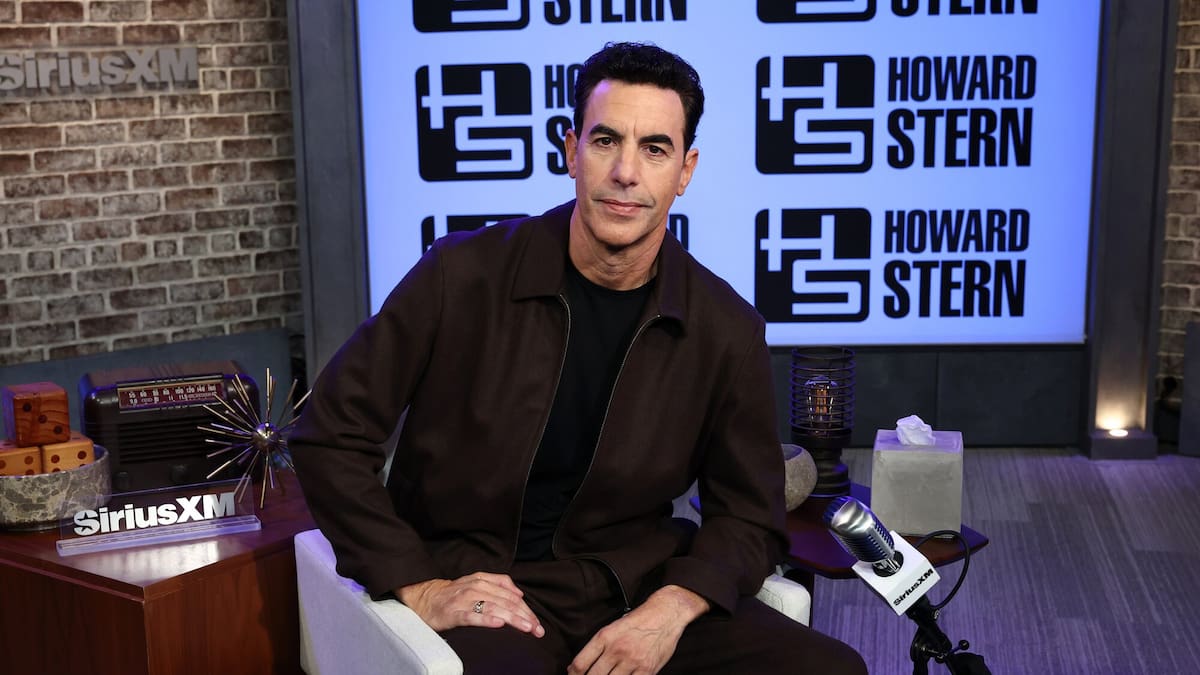
The filmmaker also plays a character at the opposite end of the political spectrum, Colonel Morad.
Yet for some, Ali G is a relic of the past whose cultural appropriation is no longer funny.
“The film has a few scattered giggles, but it’s dawdling and cumbersome, and far less ‘relevant’ than it thinks,” read a review from the Hollywood trade publication Variety.
“The joke of Ali G is that he was a maximally clueless white-bro poseur,” the review continued. “He was most funny as a talk-show stooge.”
Speaking with journalists, Baron Cohen acknowledged how times have changed, saying that’s exactly why he wanted to dust off the character.
“I brought back Ali G because he is a problematic dinosaur,” he said. “I just love the idea of dropping him into today’s world.”
“It felt like this was the perfect time to bring back a character that should have been left in the 2000s.”
Two decades ago, Baron Cohen used his hit film “Borat: Cultural Learnings of American for Make Benefit Glorious Nation of Kazakhstan” as a sociological mirror to lay bare certain prejudices within US society.
His work has been compared to that of filmmaker Nathan Fielder, whose documentary You Can See Everything” about fallen biotech prodigy Elizabeth Holmes debuted last week to critical acclaim and box office success.
Baron Cohen praised Fielder, noting that the comedian “created something completely different”.
‘Shared lies’
Ali G film faces criticism over cultural appropriation. Photo / Getty Images
Baron Cohen, 55, arrived at the Los Angeles premiere of his new film in character, wearing neon yellow from head to toe.
He stepped out of a convertible alongside Julie and performed Richer than Elon – a song that satirises the SpaceX executive, who is the wealthiest man in the world.
“The world’s gone to crap. You know, there’s wars, there’s Covid, people are listening to Ed Sheeran more,” Baron Cohen told AFP in character.
“You know, Coldplay still exists. It’s, like, well depressing.”
At a later press conference, Baron Cohen – as himself – defended satire as the quintessential format for “shining a light on, maybe, subjects that we haven’t really discussed as a society before”.
“We’re at this really dangerous point in society where a handful of billionaires control what information is being spread, and societies and democracies in particular rely on shared facts,” Baron Cohen said.
“We’re moving to these autocracies that rely on shared lies, and now we have AI. Who’s choosing what is the information that goes in there?”
– AFP