
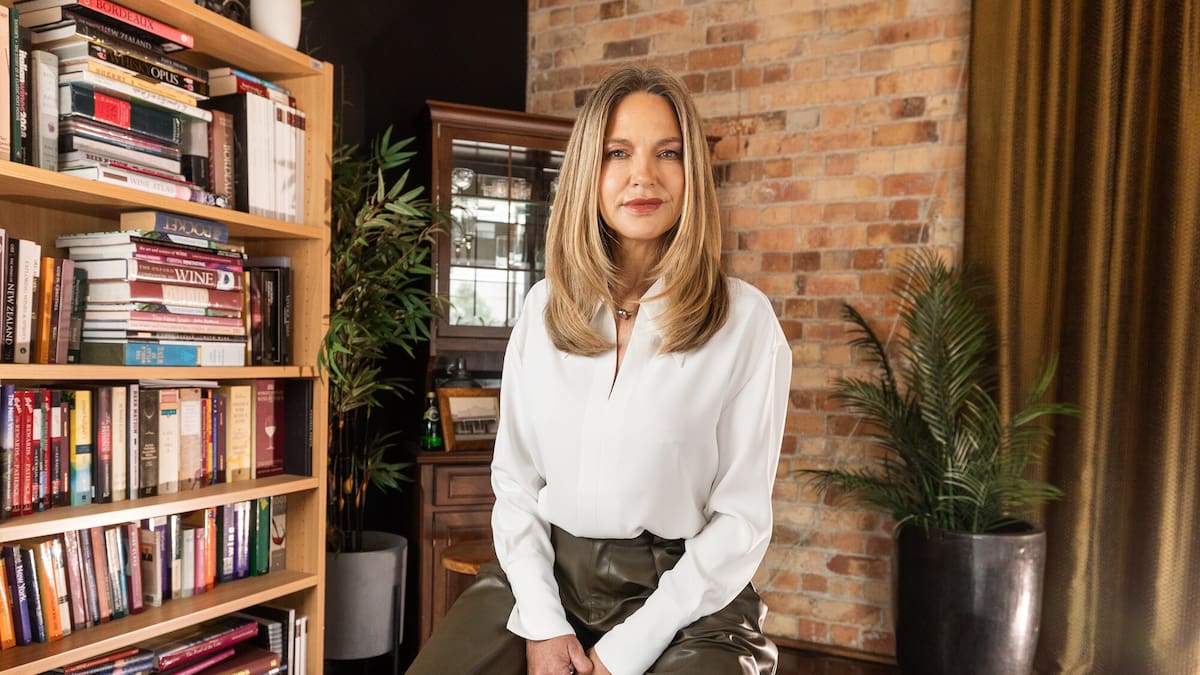
Leather pants, pristine white shirt, immaculate hair and make-up. She’ll swap her stilettos for sneakers before the drive home to Tauranga but, two weeks out from launch in a meeting room at an Auckland liquor store, Hunter is camera-ready.
Her governance experience spans the likes of Rugby World Cup 2011, the Robin Hood Foundation, Antarctica NZ, Eventfinda, Company of Women and the Starship Foundation. She is a director of Hunter Powell Investments (alongside her husband, Tenby Powell) and has had her name on multiple businesses. The first, in 1989, was PC Direct.
Hunter was just 22 when she and Maurice Bryham co-founded the company that, reportedly, earned them $30 million when they cashed in their shares from a new owner. Suggest that made Hunter “incredibly wealthy” and she bristles.
“I was a really small shareholder, relatively speaking. I was the smallest. It just didn’t suit everybody to report that. So, when you use the word ‘incredibly’, that’s a monster overstatement.”
How much did she make?
“Are you going to print that?”
Yes.
“No. Okay. Single figures.”
Wealth, says Hunter, “is a weird thing”. But she also understands she was young, female, and “it was a good story”. Nobody appreciates the power of a story like someone in sales.
Sharon Hunter checks the label on a bottle of Vodkher. The new female-centric premium spirit brand is “born in New Zealand” and features a huntress on the logo.
Hunter grew up in Papakura. (Justine and Geoff Ross of premium vodka brand 42 Below fame were, respectively, one year behind and ahead of Hunter at high school). She was the eldest of four kids on a rural-ish property with bantam hens, a goat, a sheep, and an adopted duck.
“It was flipping brilliant,” she says. “I was one of those lucky, lucky girls who got a pony when I was 10 years old.”
She tried nursing. “That lasted a year until I had to go into a hospital and I thought, ‘this is not me’.”
She tried a first marriage. “Some lovely man asked me and polite women say yes, you know?”
Hunter describes her younger self as “restless”. When she discovered the meritocracy of tech sales – a job where she was as good as her numbers – she says everything settled.
“I love building things. Building PC Direct and leading that team was one of the greatest privileges of my life. We took really young, unformed people. I taught them how to dress, walk in a room, answer a phone …
“I committed wholly and fully to that company and enjoyed every moment of it. The tough times, the lean moments. Those early days when we’d do everything from vacuuming the showroom to answering the phone to figuring out how to do my first GST return to actually physically walking the banking up the road. God, what a joy.”
When she needed a break, she’d head to Centrepoint Fabrics, and flick through the Vogue pattern books and rolls of fabrics. Her mother taught her to sew. Recently, she considered buying a new machine but “they’re expensive now and so electronic … how on earth would you begin to make a buttonhole with this?”
She’s done these stories before, of course. The women’s magazine covers pre-date Google; early New Zealand Herald coverage appears to pre-date gender equality. Consider the language in this piece on Auckland A-listers:
“There are … about 100 people so stellar they are welcome at any function. Among the creme de la creme are the loyal Dean Barker and his pretty girlfriend Mandy Smith, television personality Charlotte Dawson, businessman Eric Watson (when he’s in town), sporting wife turned TV decorator turned businesswoman Sally Ridge, rugby hero Carlos Spencer and entrepreneur Sharon Hunter.”
Entrepreneur versus “pretty”? “I’ll take it,” says Hunter.
At the launch of Vodkher, guests will be invited to align themselves with personality archetypes. The instigator, the grounding force, the empath and the truth-teller. It’s just a bit of fun, says Hunter. While the new business venture suggests she is an instigator, she says it’s more accurate to describe her as “the one who never says no – and then I’m the one who never goes home. I say yes way more than I ever say no”.
Sharon Hunter and 9-month-old daughter Charlotte with Tenby Powell, before his 2001 departure for a United Nations peacekeeping role based in Israel. Photo / Brett Phibbs
This, perhaps, is how she finds herself landing at Heathrow Airport in 2001 to news of the September 11 terror attacks. She is 36, and travelling with Charlotte (11 months old) and George (3 years old) en route to meet Tenby Powell, her second husband, who has signed up for a tour of duty with United Nations peacekeeping forces in Nahariya, Israel. She makes it to Tel Aviv on one of the last flights before a no-fly zone is declared, and spends seven increasingly high-risk months on the ground, before the New Zealand Defence Force orders peacekeepers’ families home.
“It was Tenby’s dream,” she says. “Crystal balls are a wonderful thing. We never knew the plane was going to go into the Twin Towers – probably not even he would have gone. At the time we left, it was a very, very moderate peacekeeping tour … the tour it became was not the tour we set out for.”
Hunter presents as polished and on message. A woman with command of a room – but also genuine curiosity about the people in it.
“I find female friendships fascinating,” she says. “I saw a phrase the other day; it was something like ‘friendships, particularly old ones, hold the true archive of our lives’. And I thought, that’s true, right? They’ve seen all of us. Vulnerable, angry, our confidence fall-outs, our prideful moments, ambitious moments, joyful moments.”
She spies on women all the time. Recently, in Perth with Kiwi Kare (Kiwi Aid and Refugee Evacuation – the Ukraine-focused humanitarian and medical relief organisation founded by her husband), she found herself at a rooftop bar.
“There’s this cacophony of sound, because there’s a group of women …”
She can’t help herself. “Who are you guys? What are you doing? How long have you known each other?” They are geologists, dressed up and decompressing post-conference.
“And I can imagine them laughing about an industry dominated by men and rocks, you know? And I just love witnessing that … I think in those moments, you get to sit somewhat in awe of someone.”
Business, however, is business. Hunter confirms Great Goodbyes, the one-stop web-based funeral industry disrupter she founded with Jude Mannion, is no more.
“Founder fallout,” says Hunter.
“You talk to any founders about it, and everyone will nod and go ‘yeah’. People who have founded companies before, particularly who have done it more than once, everyone goes ‘oh, damn, I’m sorry for that for you. Founders get it. It’s a thing that sometimes happens.
“There are ways where it’s done with grace and planning and others where it’s ugly … some marriages split up nicely, and they find their way forward. Others split up and hand grenades get lobbed … founders splitting up will run the gamut.”
Sharon Hunter (right) photographed with Jude Mannion in 2007, when the pair who went on to form Great Goodbyes were, respectively a director and the CEO of the Robin Hood Foundation. Photo / Kenny Rodger
Partners in the Vodkher venture include her brother and “some wonderful female backers”. It has been six years in the making. A scribble on a napkin exercise, says Hunter, with a group of people she declines to name (“we kind of have a family that chimes on stuff”).
She’d rather talk about the moment she saw the word written down.
“It’s for her, with her, beside her – what a word. What a powerful word, what a generous word. And you could both see the detail in the brand in that moment, and its true north all at the same time.”
Headlines since inception include, obviously and globally, Covid. On a more personal level, her husband Tenby resigned as the mayor of Tauranga in late 2020 and, in 2025, Hunter was allegedly assaulted by a friend’s son.
The latter is still subject to legal proceedings, and she won’t discuss it. Of the former, she says “no one likes to put their heart and soul into something and then feel that the best decision, if not for you, but for the organisation that you want so badly to thrive, is to step away”.
Hunter and Powell married in 1995. The glue that holds 30-plus years together includes “two incredible children” and the fact that “no one can make me laugh like Tenby can make me laugh”.
Sharon Hunter, her husband Tenby Powell and their children, George and Charlotte.
“You’ve got two people who have pursued their own ambitions and, I think, made space for those,” Hunter says.
“And I think, when you have history, that when things get wobbly … you ultimately … you try and protect it … find me someone who’s been married for 30 years that hasn’t had some things that are tough?”
The couple moved to Tauranga after Powell won the mayoralty.
“I have a lot of family that live there, as it happens. My dad, my mother-in-law, my brother, my sister. It just felt like a great place to put down our roots. The outdoor environment is epic. There are running trails on my back doorstep.”
Yes, she runs – even with her wrist in a cast and her fingers wildly splinted for optimal setting.
“I tripped over my feet and went down, and when I looked down, my finger was literally sideways. I’m like, ‘maybe it’s just dislocated?’”
An X-ray revealed four breaks across two fingers. She could no longer manage a hair tie, but could, she decided, still run a half marathon in Brisbane before a milestone birthday. Race-day photos show a grinning, pony-tailed Hunter.
“I just didn’t want to have to train for another one. I was three-quarters of the way through the training. I thought, ‘I’ll tough it out. I’ll get through it on the day’.”
Hunter calls herself an optimist. Her first foray into business was “such an incredible ride – I’m mindful that’s a little bit rare” and being a New Zealander is, she says, the equivalent of rolling a die and getting a six.
“The privilege of being a New Zealander means an enormous amount to me.”
Vodkher’s country of birth is front and centre of the carefully designed label on the carefully designed bottle at a carefully designed introductory lunch, where craft distiller Jill Mulvaney has recounted her initial refusal to make a liquid for Hunter.
“I said, ‘What if you only had to care what women thought about the liquid you made?’ And then she said, ‘Well, now I’m interested, now I’m curious’.”
Waiheke-based Mulvaney came up with the botanicals, and Caci Erasmus (co-founder of Sip Distilling) is on board as the manufacturing distiller. Hunter imposed two “guardrails” on the development of the spirit she says was in a “creative straitjacket” – it had to function like a vodka and it couldn’t contain ingredients that would be difficult to procure internationally (native New Zealand plants, for example).
Entrepreneur Sharon Hunter is launching Vodkher – a 10-botanical “sensory-led” vodka she says has been built “by female experts for the elevated female palate”.
Cue a flavour that is described as “herbal citrus with a hint of green anise” created from a combination of coconut, pink and green peppercorn, lime peel, fennel seed, angelica, celery seed, lavender, coriander and cinnamon.
“Not all palates are created equal,” claims the PR blurb. “Women tend to have a higher sensitivity and accuracy in taste and smell perception compared to their male counterparts. But culinary evolution is not yet exploring female-palate product design. Until now.”
Hunter: “By becoming the first brand to treat the female palate as the gold standard for taste, we’ve made something that pushes the boundaries in the category and gives women their own seat at the bar.”
She bats away suggestions that this is another play for the lucrative female dollar (it might be designed for women, but that doesn’t mean men won’t also drink it). Alcohol sales are reportedly trending down, but according to Hunter, a more nuanced take is that “we’re drinking differently”. And the potential reputational risk of aligning yourself with a product that can cause harm?
“I think that becomes complicated when you truly demonise something. Of course alcohol does lots of harm. Sugar does lots of harm. Vehicles do lots of harm.”
A week after this interview, she emails.
“I live by the mandate that we mostly regret the things we didn’t do, not the ones we did . . .”
And what she’s regretting is not answering the personal reputation question with “more courage”.
“The question is interesting because I doubt anyone would ask Jason Momoa the same thing when he launched Meili vodka, even though he’s a hero to a lot of young people. Nor would they ask Taika Waititi if he suddenly decided to put his name to a rum, or if Dan Carter created D10 beer.
“The world has incredible female wine makers, brewers, and distillers. They’re talented, smart, and creative, and they work incredibly hard. Women shouldn’t be consigned to being in the background of the industry; making world class product, but not seen. Thankfully we’re starting to celebrate them, but we need to do more. I wonder if the risk of questions like the one you asked me stops that?”
For the record: “I’m incredibly proud of what we’ve created in Vodkher, and the company we’re building. No, I’m not concerned about my brand.”
Kim Knight joined the New Zealand Herald in 2016 and is a senior journalist on its lifestyle desk.