
The drug is publicly funded in New Zealand for eligible breast cancer patients, but not for Mike’s bowel cancer.
The medication received Medsafe approval for his type of cancer in September 2026, allowing the family to claim a $10,000 annual payment through their Southern Cross insurance.
But the approval has not made the drug publicly funded for Mike.
Each infusion costs the family more than $12,000, with treatment required every three weeks, working out at about $17,000 monthly.
Mike, previously the family’s main earner, can no longer work, while Harriet balances a 30-hour work week with caring for him and their two children.
The family have drawn on savings, support from Mike’s relatives and donations through a Givealittle campaign to cover treatment and related expenses.
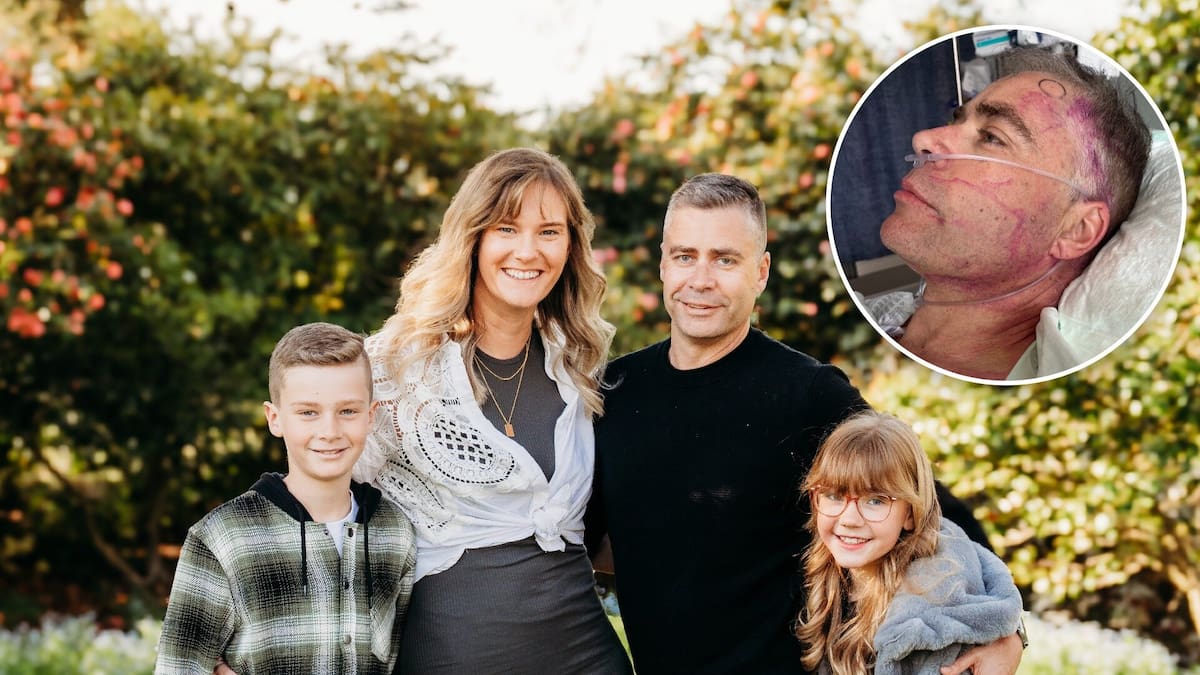
Mike and Harriet Hrynkewycz during one of his hospital stays since his stage four cancer diagnosis in September 2025.
They were hoping to secure individual funding for Enhertu through another application to Pharmac.
A previous application for a cancer drug called tucatinib was not progressed by Pharmac.
In a letter dated May 13, Pharmac said Mike’s circumstances did not appear sufficiently exceptional to qualify under its Named Patient Pharmaceutical Assessment policy.
It cited clinical advice estimating that about 60 to 80 patients in New Zealand could have similar circumstances.
The letter said the treatment would be more appropriately considered through Pharmac’s standard funding process, which could potentially make it available to a wider group.
A subsequent Official Information Act response confirmed tucatinib had never been approved through that individual funding pathway for HER2-positive metastatic colorectal cancer at the time of the response.
For Harriet, the funding situation has added another layer of uncertainty to an already devastating year.
“What frustrates me the most is the inequality around how things are funded … It feels really unfair,” she said.
“We’ve paid so many taxes over the years as two hardworking, earning people, and yet we can’t get the help we need.”
A Medsafe spokesperson said in a statement that approval allows a medicine to be prescribed and supplied in New Zealand, but funding decisions are made by Pharmac.
“However, Medsafe’s approval can help inform Pharmac’s decision on whether to fund a medicine,” the spokesperson said.
Pharmac told the Herald it could not comment on specific cases for privacy reasons, but as of October 19 had not received an application to fund Enhertu for HER2-positive bowel cancer, or for all HER2-positive cancers regardless of tumour site.
Chief advisor of pharmaceuticals, Adrienne Martin, said the agency assessed medicines based on applications from pharmaceutical companies, clinicians or members of the public.
“This is because the effectiveness of a particular medicine can differ based on what it is being used for.”
Martin said Pharmac would welcome an application to consider funding the treatment and had been in contact with the supplier to discuss the unmet need for patients with the condition.
From back pain to cancer diagnosis
Mike’s diagnosis came after what the couple initially believed was a minor back injury from renovating their home.
He had been experiencing lower back pain when, on September 11 last year, he suffered a seizure affecting his right side.
Scans revealed a brain tumour, followed by lesions in his bowel and both lungs.
A colonoscopy confirmed stage 4 bowel cancer.
Mike initially received funded chemotherapy, but a brain tumour grew rapidly from about 2.5cm to 5cm and required surgery in November.
A second tumour later developed in his cerebellum, affecting his balance and co-ordination.
Doctors then discovered his cancer was HER2-positive, opening additional targeted treatment options, but at a substantial cost.
Mike Hrynkewycz during his cancer treatment.
Harriet said Mike had previously been fit, active and heavily involved in family life.
Now he wears a brace to help with foot drop and uses an electric wheelchair for longer outings.
Simple activities, including mowing the lawns, driving the children to sport or going fishing, are no longer straightforward.
Harriet said Mike continued trying to support their children, Patrick, 12, and Elaina, 9, despite his limitations.
A recent fishing trip to Tekapo with Patrick and Mike’s father ended early after Mike suffered another seizure.
“I don’t think it was quite the trip that any of them were hoping for,” Harriet said.
She said their daughter particularly struggled with the changes to family life.
“She wants what she calls a normal life.”
Mike and Harriet Hrynkewycz with their children, Patrick, 12, and Elaina, 9. The family has spent nearly $100,000 on cancer treatment.
The family believes it has financial support for about six rounds of Enhertu.
Beyond that, the future is uncertain.
“I guess we’ll just have to cross that bridge,” Harriet said when asked what would happen if they could no longer afford treatment.
“Every decision we make is about trying to give Mike a future.
“Navigating the balance between hope, life and financial reality is a really hard and scary road to walk and we are desperately trying to get the balance right every day.”
She said the hardest part had been watching the life they knew disappear.
“I grieve the life we had. I grieved the life we were going to have.”
Rafaella Melo is a multimedia journalist with more than 10 years’ experience in Brazil. She spent two years reporting for Hawke’s Bay Today before joining the NZ Herald’s Christchurch team in 2026.