
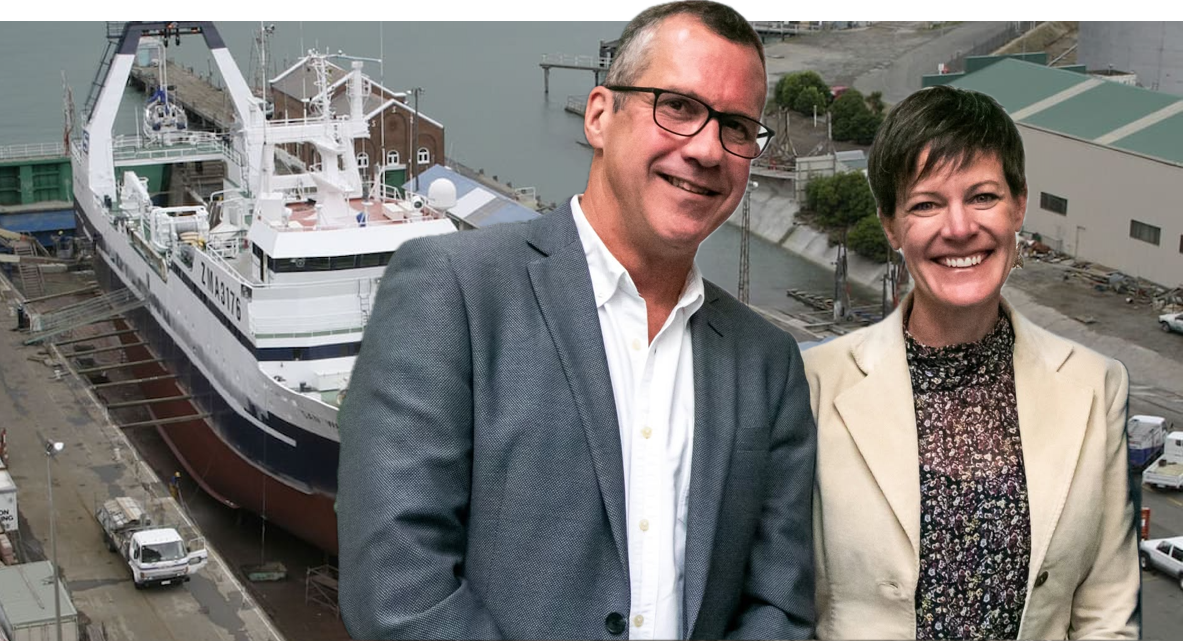
Analysis: Oh, to be a fly on the wall in the Kuntzsch household, of Nelson.
Nelson candidate Jodie Kuntzsch is guaranteed a seat in Parliament next month, if the Opportunity Party crosses the 5 percent threshold with its bottom line of phasing out bottom trawling.
Her husband Volker is the former chief executive of fishing company Sanford, one of the biggest bottom trawlers in the South Pacific. When he headed the company, it was convicted and fined $36,000 on three representative charges of illegal bottom trawling by its 64m trawler San Waitaki. The $20 million ship was forfeited.
He moved to the leadership of the Cawthron Institute, where he stuck to his trawling guns. As head of a publicly and commercially funded marine science institute, he admitted to me in 2023 that fishing does need to address its environmental impacts – but said controversial practices like bottom trawling paled in comparison to destroying biodiversity by ploughing land.
He acknowledged the harmful impact of trawling seamounts, but said that should be put in perspective. “We are not trawling across coral reefs – when I say ‘we’, I mean the fishing industry. And any fisherman out there would always be careful about where they put their trawling gear.”
That earned him a telling off from the Cawthron Institute’s then chair, Meg Matthews, who was unimpressed by his rousing message, to a sympathetic industry symposium, that New Zealand had no future without fishing.
She told him he should have expressed his views better. “I don’t think he’s expressed them in the way that he should have expressed them,” she said. “I think he was challenging the status quo. I think he was hoping to shift mindsets.”
Jodie Kuntzsch, in an interview with my colleague Hanna McCallum, chooses her words more carefully than her husband did, when asked about her position on the party’s “bottom line” of phasing out bottom trawling.
She says there’s an awareness that a conversation is needed and there is an openness to having one. Investment is also required to facilitate such a transition. “We can have a thriving economy and a thriving environment. It’s not one or the other; they’re mutually reinforcing, and that is really our commitment to the industry: to work alongside that transition,” she says.

Want to stay across stories like this? Start your day with Newsroom’s top stories and analysis in your inbox.
At Newsroom, I’ve been approached by some who perceive a scandal in the Kuntzsch household.
I take a different view. For my money, I think the world needs people who can find a way to disagree and get along. And New Zealand is a small country – we will have clashes and conflicts of interest. The question is, always, how we declare and manage them.
I’ve asked Jodie Kuntzsch about whether her household finances are reliant on the trawling industry. “The work of Cawthron and where their income comes from, I don’t have that information,” she says. “I’ve been very clear with the party that I’m married to Volker and what his role is.”
If the party or Parliament requires her to declare any perceived conflict, or recuse herself from any decisions such as bottom trawling, she would do so. “I don’t want to predetermine what those are, but being open and transparent about who I am and my relationships has always been a part of my work.”
I suspect that conflict will be more difficult to manage for Cawthron than for Opportunity. Customers and other stakeholders will want assurance that the chief executive has no influence on the fisheries research, especially around trawling.
On Wednesday night at the NZME powerbrokers’ debate, Opportunity leader Qiulae Wong was asked about the party’s five bottom lines, which include phasing out bottom trawling. To be clear, that’s 70 percent of NZ’s commercial fisheries; it’s also a big part of how the quota returned to iwi in the Sealord settlement is fished.
It prompted one of the more intriguing exchanges of the night, when Greens co-leader Marama Davidson said her party’s bottom line was getting rid of this Government.
Wong retorted: “How sad is it that our politics is in a state that a bottom line has to be getting rid of the Government? It should be about proactive policies that take our country forward. That is what our five bottom lines are about.”
And that is, perhaps, a realistic assessment of how Parliament could work and on occasion, does already work. For all the headline-grabbing clashes in politics, Parliament progresses non-controversial laws pretty much every sitting week with across-the-board support. Not everything has to be a fight.
Even the Greens have, in the past, signed a memorandum of understanding with the John Key govt to progress shared policy areas, without forming a formal coalition or confidence-and-supply agreement. These included home insulation retrofits, energy-saving initiatives, trying (and failing) to regulate natural health products, cleaning up toxic industrial sites and building a national cycle trail.
So when Qiulae Wong and the Opportunity party are accused of naivety for suggesting they can build case-by-case policy agreements with anyone in Parliament (perhaps in a confidence-and-supply arrangement), all strength to their arm. Because that’s how we work in business. And that’s how we reach agreement in our communities – and yes, in our homes.
Even Winston Peters knows about that – debate moderator Ryan Bridge asked him about domestic politics last night. “Does Jan ever bug you to retire?”
Peters pushed back: “I don’t come here to talk about private matters, do you mind?” But then he paused, then opened up a little more. “That’s one of the things about our great society, you have got a private life, so to speak. And I won’t have any of my family members ever troubled by politics, I’ve kept them out of it because it’s such a difficult and tough job.”
This analysis was first published in the Newsroom Pro subscriber newsletter. If you’re interested in seeing more content like this, you can subscribe here.