
“He tried to kick and hit me a few more times, then he turned and walked off and circled back and circled back.
“There was something going on with him … and I remembered seeing an ankle bracelet on – that stood out to me.”
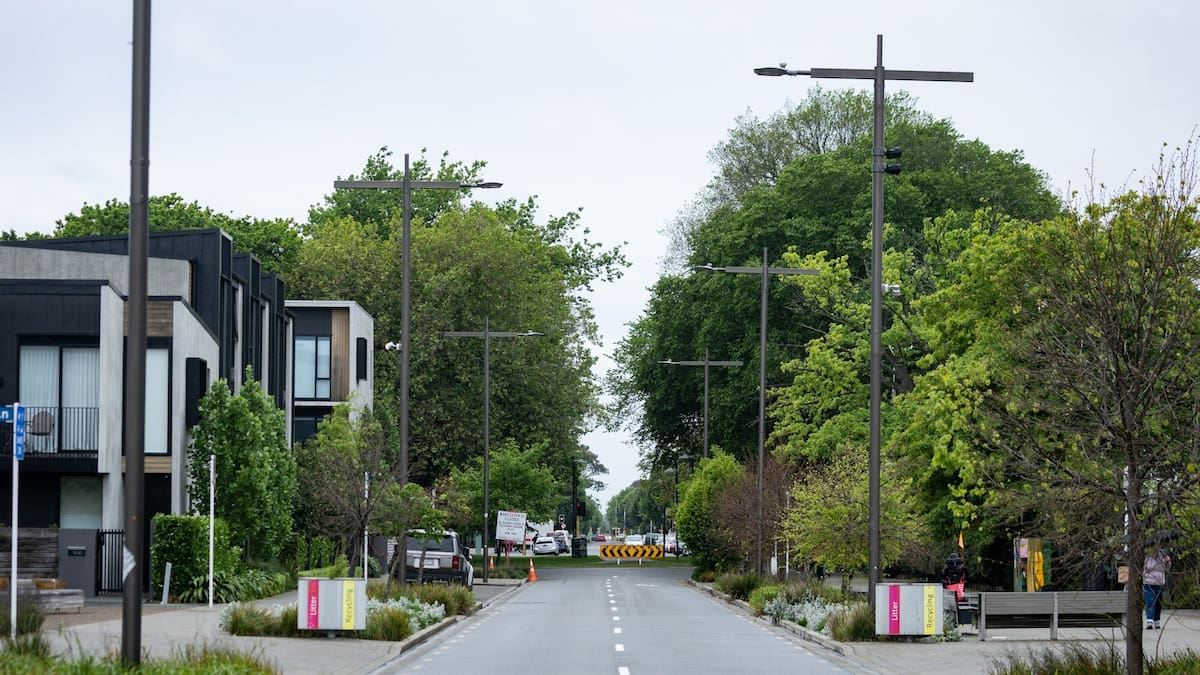
The attack happened on Worcester St, Christchurch. Photo / Anna Heath
John managed to get away from Whittaker and a woman on the other side of the street called 111.
Whittaker fled and police arrived soon after.
“The police called me later and said that they had arrested him. A few days later I was contacted by a court victim adviser who told me he had been charged with common assault and pleaded not guilty.
“He had been remanded in custody and I said I wanted to be told if he was let out. My main concern was that it appeared he lived on the route I take to and from work and the gym and I was concerned for my safety.”
John told the adviser on March 16: “If he is released back into the community … I don’t want to be looking over my shoulder to watch out for retaliation.”
On May 25 the adviser confirmed that Whittaker’s next date in the Christchurch District Court – a case review hearing – was set down for June 8.
“You are not required in court,” she told John.
On June 8 another adviser told John by text message that the case had been resolved.
“Just letting you know the defendant in your case pleaded guilty today to the charge and was also convicted,” it read.
“He was sentenced to five months’ imprisonment but was released today on time served as the Judge takes into account how long he was in custody on remand.
When John queried Whittaker’s release, the adviser said: “Prisoners usually only do half of the time they are given if there have been no issues within the prison while they have been there.”
Corey Whittaker was sentenced in the Christchurch District Court in June. Photo / George Heard
On June 10, John emailed the court asking for more information about the sentencing and the offender.
“As the victim of the offence, I am seeking these documents to gain clarity on the official facts accepted by the Court, the exact terms of the conviction, any safety-related orders put in place, and the timeline for any outstanding steps in the process,” he said.
On July 29, John was provided with the sentencing notes.
He learned that Whittaker had changed his plea and admitted the charge of common assault.
It appears he was sentenced immediately by Judge Greg Hollister-Jones.
The sentencing notes are short, comprising just three paragraphs.
The judge noted Whittaker wanted to proceed with the hearing without a pre-sentence report.
He briefly outlined Whittaker’s offending, wrongly stating that the victim was on a bike at the time of the assault, rather than the offender.
“You took objection to him looking at you. You punched him on the left side of his head and then punched him again on the right side of his head around the temple area.
“The charge has a maximum penalty of one year’s imprisonment. This is lower to mid-range offending for the charge of common assault.
“I take a starting point of five months’ imprisonment. I reduce that by 20 per cent for your guilty plea.
“You have 18 convictions for violence. So for that reason, there is a 20 per cent uplift and the end sentence is five months’ imprisonment and there are no release conditions.”
The man who attacked Sam already had 18 violence offences to his name. Photo / 123rf
John was appalled that a violent offender could be sentenced without any input from a victim.
He said he had clearly indicated that he wanted to complete a victim impact statement; however, at that point police were yet to contact him about that process.
“It’s like the victim is just peripheral to the whole thing the whole way through,” he said.
To add insult to injury, John said a week later the police officer in charge of his case made contact to “update” him and confirm the offender had “been jailed”.
“I said to him, ‘he’s not in prison, he’s out’, and the officer wasn’t even aware of that,” he said.
“It just blew me away … and that’s why I decided to speak out.
John told the Herald he was disappointed and frustrated by his experience, and worried other people were going through a similar ordeal – or worse.
He has since met his MP to discuss his case.
“I’ve had a lot of time to think about my experience and the wider situation, which I suspect is more common than people realise. My concern is broader than my individual case,” he explained.
“I want to understand how New Zealand’s short-term imprisonment and release regime deals with repeat violent offenders, when release conditions are used, and what protection and information victims receive when an offender is released back into their community.”
The victim was punched twice in the head by Corey Whittaker – a random stranger – in a Christchurch street. Photo / File
John felt that as an offender with 18 previous violence convictions, Whittaker should have faced more serious consequences.
“I do believe in rehabilitation, and I don’t think one offence should define someone forever.
My concern is when violence becomes a repeated pattern,” he said.
“At some point, if someone continues to offend violently despite previous convictions, sentences and opportunities to change, I think the balance has to shift towards protecting the public.
“Every time a persistently violent offender is returned to the community, the system is making a judgment about risk. If that judgment is wrong, the next victim bears the consequences.”
John was not suggesting that “every repeat offender should automatically receive an indefinite sentence”.
“But I do think there has to be a point where repeated violent offending places real limits on how much discretion the system has to keep returning someone to the community,” he said.
‘Where someone has 18 previous convictions for violence and then commits another violent offence, I think it is entirely reasonable to ask whether that point has already been reached, and when public protection should become the overriding consideration.”
Ministry of Justice chief operating officer Carl Crafter said he was satisfied the court victim advisers (CVAs) had engaged with John appropriately throughout the court process.
The Ministry of Justice says it is satisfied the victim received the appropriate support from court victim advisers.
He said the lack of a victim impact statement in John’s case was a matter for police.
“More generally, victims should be supported to understand the court process, the outcome of a case, and the options available to them if they need further information.
“The ministry regularly considers feedback and information about the delivery of victim services to identify opportunities for improvement. Where concerns are raised about a victim’s experience, these can also help inform improvements to the way services are delivered.
“We encourage any victim who feels they have not received the information or support they needed to raise their concerns with the agency involved.
“Where a concern relates to the court process, a CVA can help the victim understand the process, access available information and connect with appropriate support. Victims can also provide feedback or make a complaint if they believe their rights or expected standards of service have not been met. “
The Herald asked police why John’s victim impact statement was not completed in time for sentencing.
Canterbury metro area response manager Inspector Paul Reeves said: “Because the offender pleaded guilty and was sentenced at his case review hearing, there was no opportunity for the victim to address the court”.
Anna Leask is a senior journalist who covers Christchurch issues and national crime and justice. She joined the Herald in 2008 and has worked as a journalist for more than 20 years with a particular focus on family and gender-based violence, child abuse, sexual violence and homicides. She writes, hosts and produces the award-winning podcast A Moment In Crime, released monthly on nzherald.co.nz.