
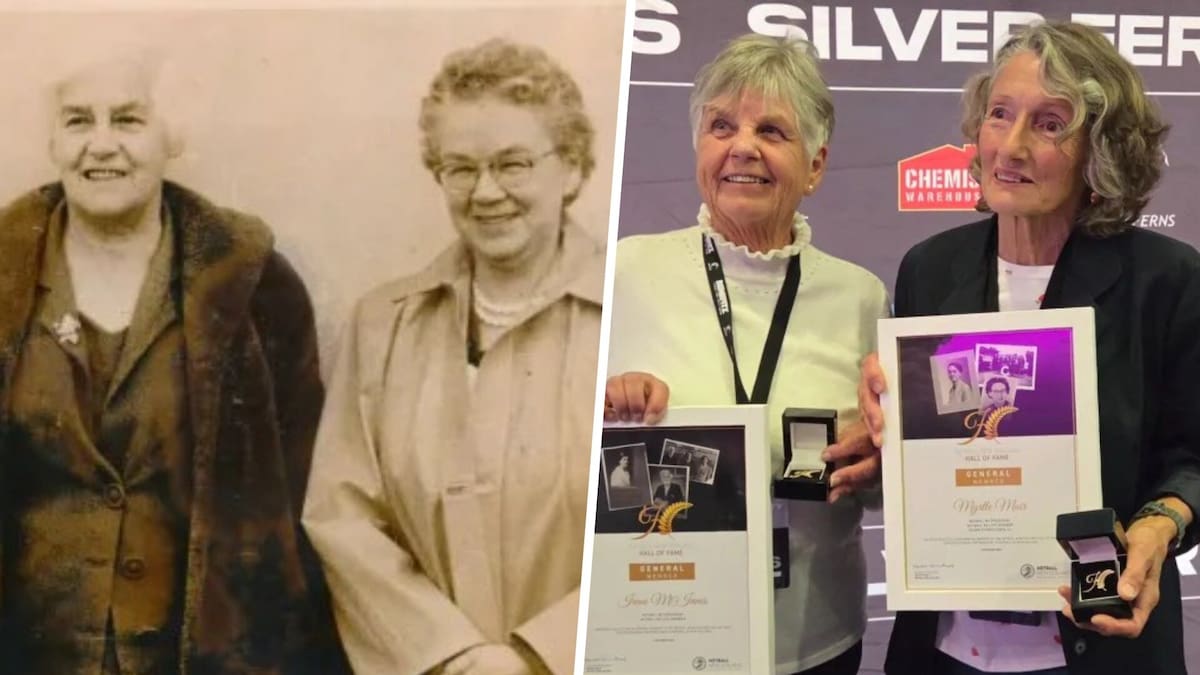
And both had visionary grandmothers who, more than a century ago, laid the foundations of netball in New Zealand.
Those two women – Irene McInnes and Myrtle Muir – were posthumously inducted into the Netball New Zealand Hall of Fame before the first test of the Constellation Cup in Auckland on Sunday.
Jackson and McCarthy knew little of their grandmothers’ achievements until a couple of years ago. Now they are proud custodians of their legacy, receiving the Hall of Fame gold pins in their honour. And now, like their grandmothers, they’ve become firm friends.
They live at opposite ends of the North Island – Jackson, granddaughter of McInnes, in Paremata, north of Wellington; McCarthy, Muir’s granddaughter, in the Northland town of Waipu.
“But it doesn’t make a difference when I see her, it’s like we’ve known each other forever, really,” McCarthy says.
Marcella McCarthy (left) and Jocelyn Jackson. Photo / Michael Bradley Photography
The pair were first brought together during Netball New Zealand’s centenary in 2024 by Dr Margaret Henley, a passionate netball researcher and archivist.
The university lecturer had discovered Mrs H.D. Muir – Myrtle – coached the original Silver Ferns side in 1938. She also found that Muir played a key role in establishing the New Zealand Basket Ball Association after Mrs R.S. McInnes – Irene – called a meeting at her Wellington home in 1924.
McInnes became the first president of the NZBBA, later known as Netball New Zealand, with Muir her vice-president.
Both women were forces of nature, Henley says – volunteers who kept the sport alive during the Depression and a world war.
“Jocelyn and I were laughing about how these two women went outside the home and took up management roles contra to conventional gender expectations of the time,” she says. “Both their husbands adored them and respected what they achieved out in the community.”
Jackson had no idea how much her “Nanny” McInnes had done for netball until Henley got in touch.
She remembers her as a terrifying driver, swooping her Vauxhall Velox straight out of the driveway on her way to the Hataitai netball courts without a second look, but also a generous woman “who always brought us boiled sweets like Blackpool rock from her many trips away”.
“Nanny was way ahead of her time. She and her friend were among the first women to cycle the South Island, yet she was always smoking cigarillos. Her father was a furrier, so it wasn’t unusual to see her sporting a fur,” Jackson says.
“She owned a bookshop in Newtown, and I’d go there after school to sort the magazine orders. She loved bagpipes and westerns and going to Susy’s Coffee Lounge, which was very cool in the 1960s.
“Oh, and she played hockey as a girl – not netball.”
McInnes was deeply committed to her community. She opened her home to unmarried mothers going through difficult times, was heavily involved in the Girl Guides movement – particularly with girls with disabilities – and was instrumental in the Gold Star Mother’s Club, which supported women who’d lost sons at war.
That cause was deeply personal. Her own son Paul was killed at Monte Cassino during World War II.
McInnes grew up in Dunedin, where her father, Robert Sheriff Black, was an exporter of frozen rabbits and furs, and the city’s mayor.
A maths and science teacher, she was an active member of the Dunedin YWCA – where she got involved in basketball. It’s believed to be where she first met Myrtle Muir, who was in the Christchurch branch.
Three of the pioneers uniting netball in New Zealand (from left) Irene McInnes, Myrtle Muir and Betty Armstrong. Photo / Netball NZ
After marrying Ralph McInnes, Irene responded to calls from around the country to create a national organisation and address the urgent need for a single set of rules to unify the game.
So she invited representatives of the five centres playing basketball to a meeting at her home in Kilbirnie. Muir was among those who attended and voted to establish the New Zealand Basket Ball Association. It was the first national netball association in the world, and the only sports body in New Zealand run exclusively by women.
Henley says McInnes was the obvious choice as president, and Muir, seven years her junior, was elected vice-president. McInnes modestly joked: “They couldn’t do anything else – the meeting was in my house”.
Both women were also umpires, and travelled the country together encouraging the growth of the game. In 1925, McInnes told the Wairarapa Age that outdoor basketball was “better than any other for girls and young women, especially those engaged in offices and factories who have not much opportunity in keeping themselves in hard physical form”.
When McInnes handed the national presidency to Muir in 1932, she became the sport’s first life member in recognition of her vision and leadership. Six years later, she was appointed to the newly formed National Council of Physical Welfare and Recreation – the forerunner of Sport New Zealand. She died in 1969, aged 76.
Myrtle Muir (in front of life buoy) with the 1938 Silver Ferns on board the MV Wanganella. Photo / Netball NZ
Muir was renowned as an excellent organiser, leading the New Zealand Basketball Association for 21 years. She also coached the first Silver Ferns team, captained by Meg Matangi, in four test losses to Australia. Not that they weren’t skilled: New Zealand played a nine-a-side game, but had to play to the unfamiliar seven-a-side rules the Australians played.
She pushed for New Zealand to adopt the seven-a-side rules and even tried to get the name basketball changed to netball to get in line with the international game, but that didn’t happen until 1970.
McCarthy remembers spending some school holidays with Muir, her “Gran”, in Wellington. She’d visit her grandmother’s office in the Town Hall, where Muir was secretary-manager for The Smith Family children’s charity, supporting families in hardship. She was a volunteer for numerous organisations.
Netball NZ pioneer grandmothers, Irene McInnes and Myrtle Muir. Photo / Netball NZ
Her enduring memory of her grandmother was “her immense kindness, her lovely smiles and her quiet strength and dignity … She was always helping people”. Muir died of a heart attack in 1966, aged 65.
Henley’s research helped Muir’s two grandchildren uncover their family’s Chinese heritage, tracing their ancestry to Muir’s grandfather, Wong See Que, a digger in the Central Otago goldfields in the 1860s.
Three former Silver Ferns who went on to coach the national team – Yvonne Willering, Leigh Gibbs and Wai Taumaunu – were also inducted into the Hall of Fame in Auckland on Sunday, before the Silver Ferns beat Australia, 56-50, in the first Constellation Cup match.
Three generations of Irene McInnes’ family were at the induction, including her great-great-granddaughter Hera Wiren, who continues the family’s unbroken line of netballers.
“Netball is part of our culture, isn’t it?” says Jackson. “All the girls in the family – apart from two who live in America – have played netball. Let’s just hope that carries on.”
McCarthy is “really working on” her 8-year-old granddaughter, Sadie, to encourage her to play the game, too. In 2024, Sadie did the coin toss for a Constellation Cup test in Auckland.
“She’s still got the game ball – it’s her most prized possession,” McCarthy says. “She’s getting taller and has very long legs, so I’m hoping. But she lives in Australia, so that could be a dilemma.”
This story was originally published at Newsroom.co.nz and is republished with permission.