
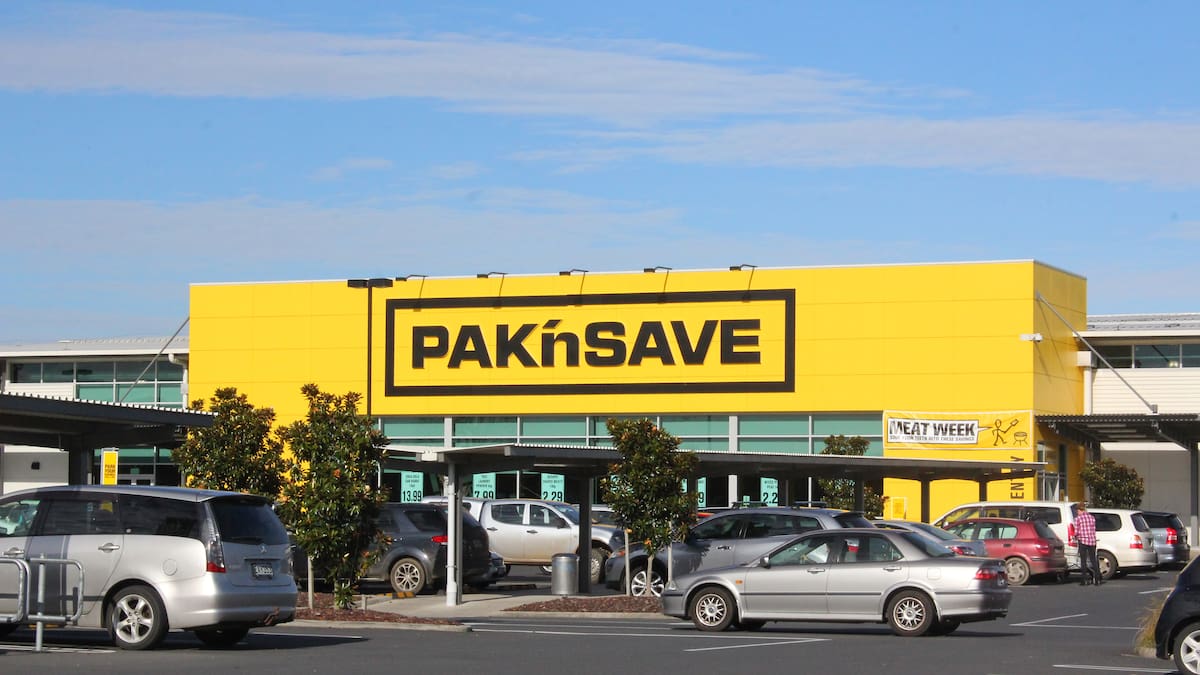
The Mill St store pleaded guilty to eight charges and the Silverdale one admitted 10 charges.
Each charge carries a maximum penalty of $600,000.
The sentencing was heard in Auckland District Court in May before Judge June Jelas, who reserved her decision.
The judge’s written findings are still pending, but a decision on the financial penalties was released this morning.
Pak’nSave Silverdale was fined $234,000, and Pak’nSave Mill Street $346,500.
Commerce Commission deputy chair Anne Callinan said the watchdog had long put big supermarkets on notice about meeting their fundamental responsibility to ensure the ticket price on the shelf matched the price at the till.
“Despite this, Auckland’s Pak’nSave Silverdale and Pak’nSave Mill St, in Hamilton, have now been criminally convicted for repeated pricing errors that misled their customers.
“The commission will not hesitate to prosecute other supermarkets if we believe there is wrongdoing. Consumers are entitled to rely on accurate pricing; that is the bottom line.
“These are highly profitable stores who should be investing in pricing systems that ensure these errors that mislead consumers do not happen.”
Callinan said the commission was satisfied with the penalties, but the case showed the need for the Government’s current review of the Fair Trading Act.
“Increasing the penalties and changing to a civil regime as proposed will give us the option to push for fines of up to $5 million for each breach, compared to our current maximum of $600,000.
“Fines in this range would have a much stronger deterrent effect and encourage genuine behaviour change.”
Proposed changes to the act would support fairer outcomes for consumers and level the playing field for businesses that followed the rules, she said.
The commission’s case against Woolworths NZ for similar conduct was ongoing, Callinan added. Woolworths has pleaded not guilty.
Breaches in the grocery sector remain an area of focus for the commission, with several ongoing matters involving the major supermarkets.
The commission also has current proceedings against Foodstuffs North Island and Gilmours alleging cartel conduct.
Separately, in August, it announced civil proceedings against Foodstuffs South Island for allegedly implementing and enforcing a restriction on independently owned Pak’nSave stores discounting selected products.
“We will continue to act within our current remit to hold the major supermarkets to account on behalf of Kiwis,” the commission said.
Duffy said the prosecution originated from a Consumer NZ complaint about inaccurate pricing.
The fines, while substantial under the current available penalties, “are a drop in the bucket for a major supermarket and will not do much to deter future conduct of this nature”.
Duffy said it was important that proposed increases to penalties under the Fair Trading Act proceeded under the next Government.
“Pricing errors and misleading discounting practices are widespread in the sector. The conduct demonstrates how a lack of meaningful competition is not only producing excessive profits, but also allows supermarkets to get away with declining customer service and low levels of investment in innovation.”
Previous form
Earlier, Commerce Commission prosecutor Nick Flanagan called for “significant” penalties for the two supermarkets, “substantially” higher than in a previous case.
He argued that supermarkets could be incentivised to take risks if the penalties imposed were not significant.
Being a high-volume business that made frequent price changes was not an excuse for the breaches, he said.
Flanagan pointed out that another Pak’nSave had earlier been before the courts for similar breaches.
This indicated that the level of penalty in the previous case, against Pak’nSave Māngere, was not enough to prompt the supermarkets to ensure prices were accurate.
In the 2020 Māngere case, the supermarket was fined $78,000 for discrepancies between the promotional price displayed or advertised and the price charged at the till.
Flanagan argued that the fine imposed on the two latest stores needed to “substantially increase” from that figure.
In the latest cases, he told the court that prices had been advertised as specials when they were “nothing of the kind”.
For instance, one product was advertised as “extra low”, when it was actually priced at that level for 90.7% of the year.
Staff were manually updating prices at Silverdale, he said, without a systematic approach. An electronic system came into effect at the store in October 2024.
Grocery pricing is under the spotlight in the Commerce Commission case against two major supermarkets.
However, Flanagan said errors continued because there was so much confidence in the new system that prices were not being checked as often.
At Mill St, which had an electronic system, the store did not have processes to properly record price complaints before June 2024.
This failure would have led to more breaches, he submitted.
He argued that the excess revenue from breaches recorded at Mill St “materially understates” the true gain the store would have received from its misleading prices.
He sought a penalty starting point of $550,000 and, in the Silverdale case, $400,000, but accepted that the operators should get a 25% discount for pleading guilty at the earliest opportunity.
Defence lawyer Iain Thain argued that both stores should get a further 10% discount for co-operation.
It was “not right” to say the two stores had learned nothing from the Māngere case, he said.
The Māngere store used paper labels in its product pricing, while Mill St used electronic shelf labels, in part due to increased errors associated with paper pricing.
Pak’nSave Silverdale had also moved to digital labels before the prosecution commenced, towards the end of the offending period.
Thain said that, on some occasions, consumers had benefited from breaches.
For example, a wooden display board had advertised a Vogel’s product for $5, but customers were charged less at the checkout, in most cases $4.
At Mill St, a staff member with a scanning gun would check prices every morning in the fresh food section to ensure they were correct, Thain said.
As a result, only two of the 18 breaches were related to the fresh food department.
Unless staff were “constantly” scanning, errors could still occur with electronic prices if, for example, someone bumped an electronic label or the scanner ran out of battery.
Thain said each store had made further improvements to their systems once the proceedings began, which he argued showed remorse.
After media applications, the supermarkets asked the judge to suppress some aspects of the summary of facts, citing commercial sensitivities and disputed facts relating to Mill St.
Lane Nichols is Auckland Desk Editor and a senior journalist for the New Zealand Herald with more than 20 years’ experience in the industry.
Katie Harris is an investigative journalist for the New Zealand Herald, regularly writing about sexual assault, workplace bullying and harassment, covering high-profile court cases and national media scandals.
Sign up to The Daily H, a free newsletter curated by our editors and delivered straight to your inbox every weekday.